

On this page
Key takeaways
- Payment routing directs transactions to specific processors intelligent routing does this dynamically
- Static routing costs merchants $180K+ annually in preventable revenue loss
- Smart payment routing lifts approval rates 3-7% on average
- The gap between best and worst acquirers averages 8.7 percentage points
- 33% of customers who experience false declines never return
- Implementation shows results within 2-4 weeks
- Every 1% approval improvement = ~$10K per $1M processed
- Requires multi-acquirer setup (minimum 2-3 processors)
Who this helpsPayment operations teams, finance leaders, and high-volume merchants looking to improve approval rates and reduce decline-related revenue loss.
Your payment processor just declined a legitimate customer. They won't try again. They won't call for support. They're gone and you'll never know they existed.
This happens hundreds of times daily for merchants without intelligent routing.
This guide covers what payment routing is and why the fixed setup most merchants inherit costs them money. If you already know the concept and want the mechanism, our guide to intelligent payment routing covers smart, dynamic and static routing, cascading retries and the signals a routing engine needs.
Beast Insights data from 50+ subscription brands reveals the average approval rate gap between a merchant's best and worst acquirer is 8.7 percentage points. For a $10M business routing traffic evenly, that gap translates to $180,000 in preventable annual revenue loss.
The leak is invisible until you measure it.
What Is Payment Routing?
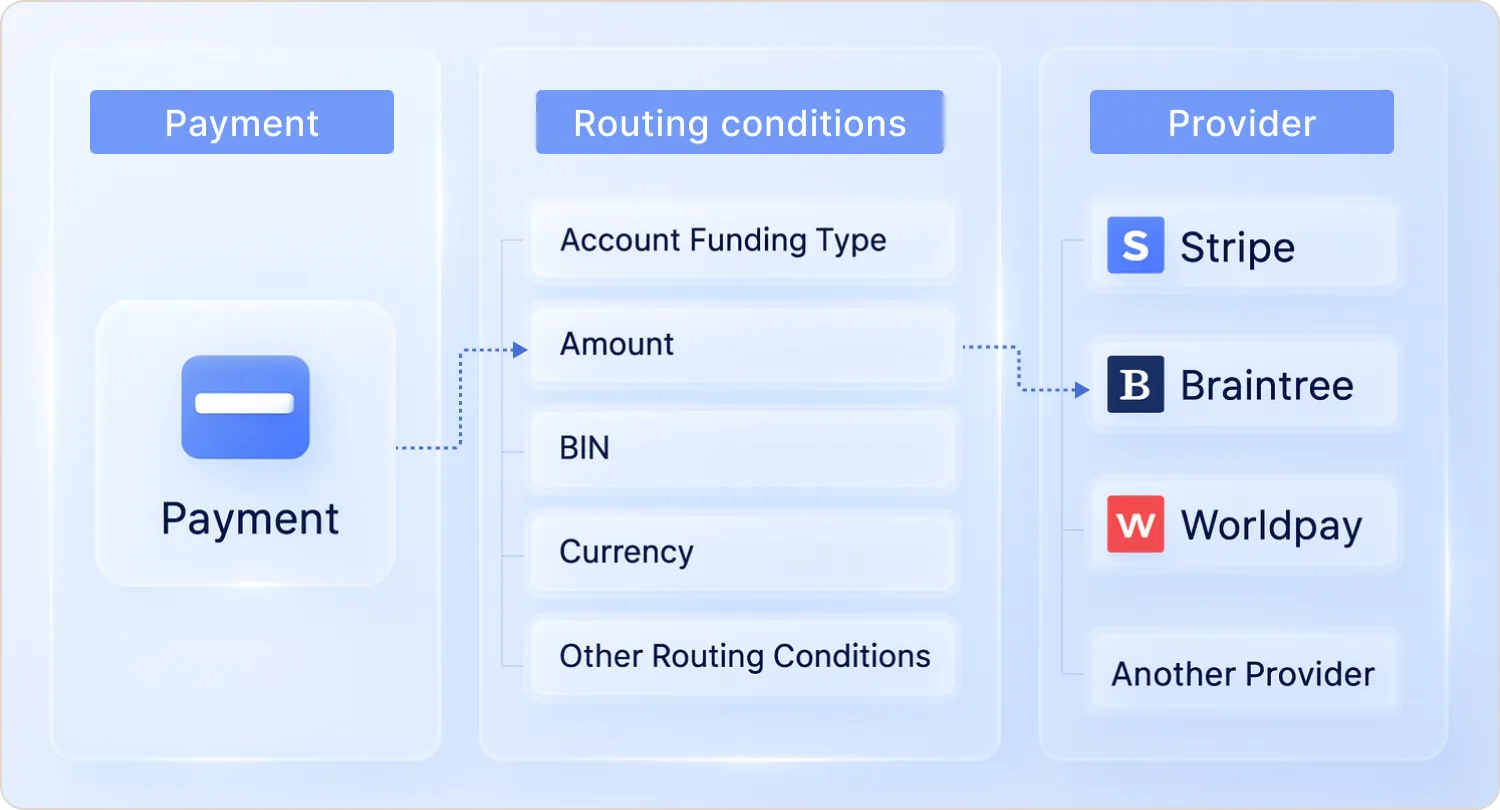
Payment routing is the process of directing each transaction to a specific processor or acquirer. Every card payment travels through multiple checkpoints: your gateway, an acquirer, the card network, and the issuing bank. A smart routing payment gateway evaluates these paths in real-time to select the optimal route for each transaction.
Payment routing decides which acquirer handles each transaction.
The simplest approach sends everything to one processor. This works. But it ignores a critical reality: acquirer performance varies dramatically by card type, geography, and time of day.
Why Static Routing Fails
Static routing uses fixed rules. Visa goes to Processor A. International cards go to Processor B.
The problem? Payment performance shifts constantly.
Our analysis shows issuers update risk models an average of 2-3 times monthly. An acquirer approving 94% of transactions last month might approve only 88% this month for certain BIN ranges.
Static rules can't adapt. They route transactions identically regardless of real-time conditions.
The cost is steep:
| Routing Type | Avg. Approval Rate | Revenue per $1M |
|---|---|---|
| Static (single acquirer) | 85-88% | Baseline |
| Static (multi-acquirer) | 87-90% | +$20K-$30K |
| Intelligent routing | 91-95% | +$60K-$100K |
Source: Beast Insights analysis of 50+ subscription merchants, 2024-2025
Developing an effective payment routing strategy requires understanding these performance gaps. Without visibility into acquirer-level data, merchants can't identify which routes underperform making optimization impossible.
False declines compound the damage. Research indicates 33% of customers who experience a false decline never return. You paid to acquire them. Static routing just lost them. Research from a 2020 Sapio Research survey indicates 33% of US consumers who experience a false decline never return to that retailer.
According to Visa's Global eCommerce Payments & Fraud Report, issuer banks frequently update fraud detection models, often rendering static routing rules ineffective quickly.
How Intelligent Payment Routing Works
Intelligent payment routing also called smart payment routing makes dynamic decisions for each transaction. Instead of fixed rules, it evaluates real-time signals.
The process:
- Analyze the transaction. The engine examines card type, BIN, geography, currency, amount, and time. Each factor influences approval odds.
- Score available routes. Using historical data, the system ranks each acquirer by approval probability for this specific transaction. A German-issued card might have 96% odds with Acquirer A but 87% with Acquirer B.
- Route to the strongest path. The transaction follows the optimal payment route based on the highest approval probability. No guesswork.
- Learn from outcomes. Every result feeds back into the model. Underperforming routes get deprioritized automatically.
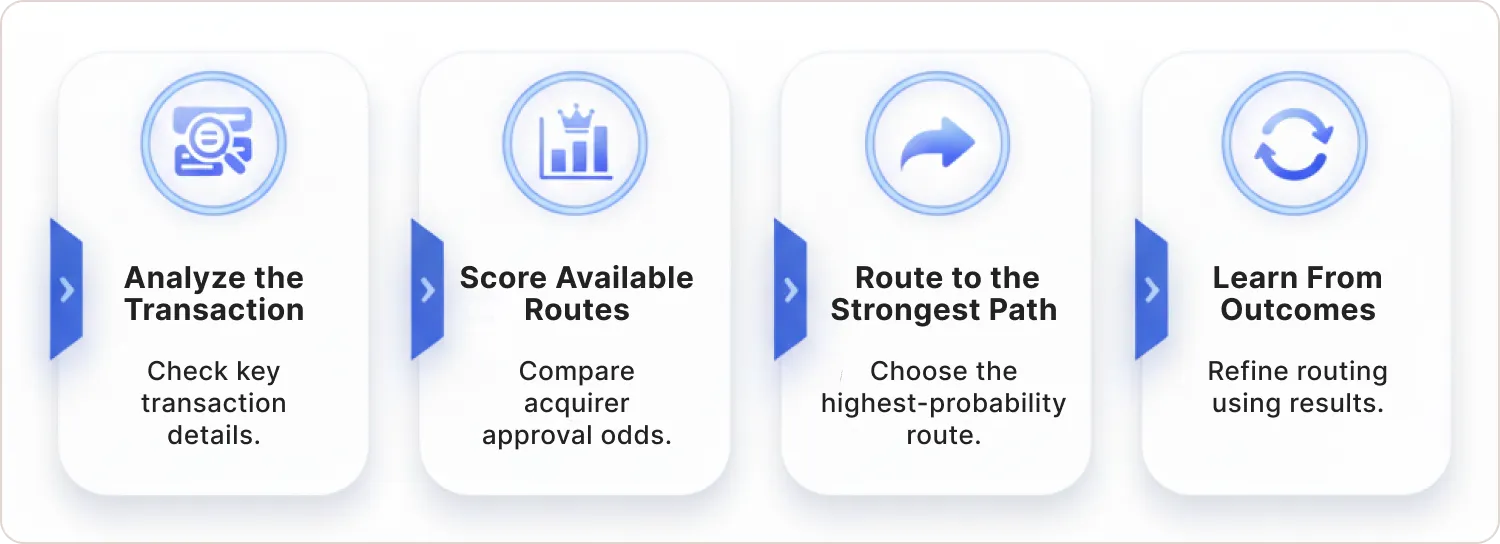
This closed-loop compounds over time. Each transaction makes the next decision smarter.
Static vs. Intelligent Routing: The Real Difference
| Factor | Static Routing | Intelligent Routing |
|---|---|---|
| Decision logic | Fixed rules | Real-time scoring |
| Adapts to issuer changes | Manual updates required | Automatic |
| Failover capability | Basic or none | Instant, graceful |
| Optimization | Periodic review | Continuous |
| Typical approval lift | Baseline | +3-7% |
The gap shows up in subscription businesses most clearly. Failed recurring payments cause involuntary churn customers who wanted to stay but couldn't pay.
Beast Insights data shows smart retry timing and selecting the right payment route recover 12% of failed recurring payments on average. For a $5M subscription business with 8% monthly payment failures, that's $48,000 recovered annually.
"The merchants who win in 2025 aren't necessarily processing more volume, they're capturing more of what they already process. Intelligent routing is table stakes for any business serious about payment optimization." — Tom Wilson, Senior Analyst at Merchant Risk Council
Case Study: SaaS Brand Recovers $127K
A B2B SaaS company processing $14M annually came to Beast Insights with 86.2% approval rates across two acquirers. Their static routing split traffic 50/50 regardless of card characteristics.
The diagnosis:
BIN-level analysis revealed Acquirer A outperformed on US corporate cards by 9 points. Acquirer B excelled with international consumer cards by 7 points. Static routing ignored these patterns entirely.
The fix:
Intelligent routing directed each transaction along the optimal payment route to the best-performing acquirer based on BIN, geography, and card type.
Results after 90 days:
- Approval rate: 86.2% → 91.8%
- Monthly recovered revenue: $10,600
- Annualized impact: $127,200
No new customers. No additional ad spend. Just capturing revenue they were already earning.
Beyond approval rate improvements, the company gained visibility into processor reliability and performance trends. This enabled proactive dispute prevention by identifying transaction patterns that historically led to chargebacks.
Building Your Payment Routing Strategy
Effective routing requires a comprehensive payment routing strategy, not just technology.
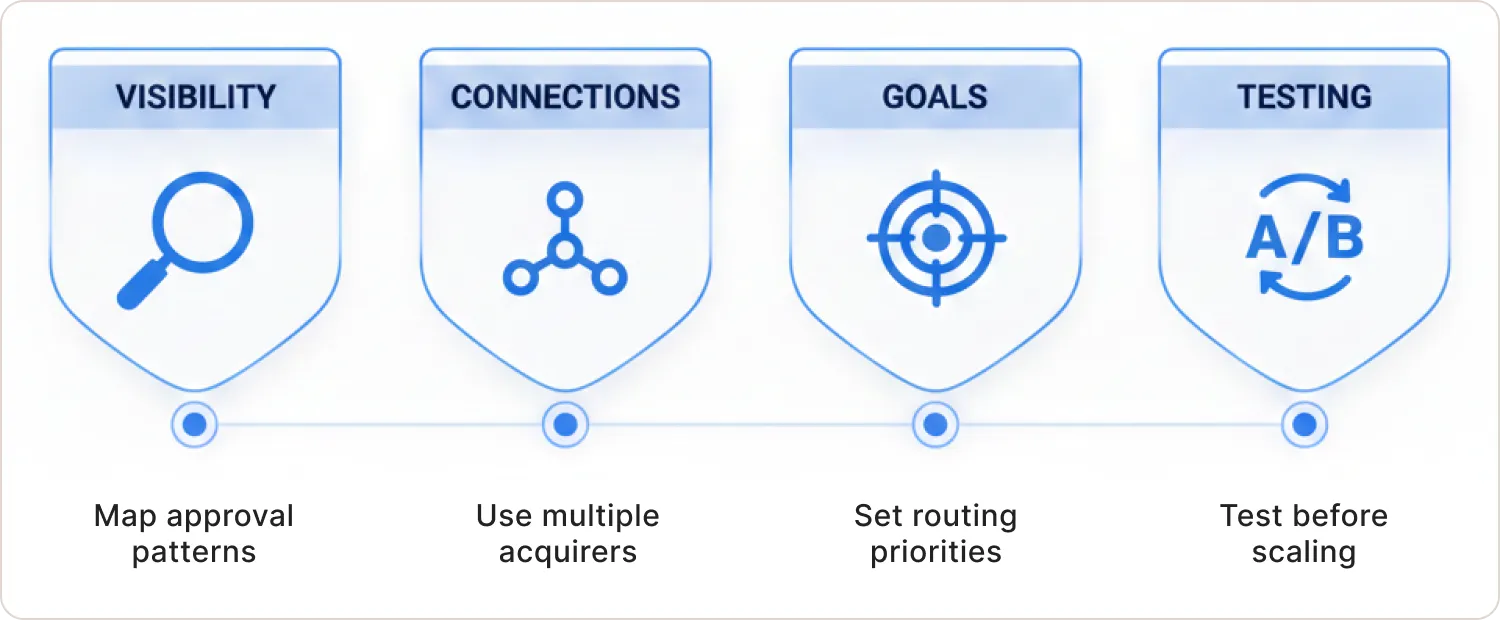
Start with visibility
Map approval rates by acquirer, card type, geography, and BIN range. You can't optimize what you can't measure.
Connect multiple acquirers
Intelligent routing requires options. A smart routing payment gateway requires options. Single-acquirer setups have nowhere to route.
Define optimization goals
Maximizing approvals? Minimizing costs? Most merchants prioritize approvals first, then layer cost optimization where odds are equivalent.
Test before scaling
Run controlled splits—10% through intelligent routing, 90% existing logic. Validate uplift over 2-4 weeks before full rollout.
- Audit current approval rates by acquirer and card type
- Identify top decline reasons by volume
- Confirm multi-acquirer connectivity
- Define primary optimization metric
- Run pilot with controlled traffic split
- Validate uplift before full deployment
- Establish ongoing monitoring
Platforms like Beast Insights connect payment data across gateways to reveal where revenue leaks. Their benchmarks from 50+ brands provide routing recommendations most merchants can't generate internally.
What to Expect After Implementation
Results appear fast. Most merchants see measurable improvement within 2-4 weeks.
Typical early wins:
- 3-7% approval lift across mixed acquirer setups
- Reduction in false declines for legitimate customers
- Improved resilience during processor outages
- Clear visibility into issuer and acquirer performance
The compounding matters most long-term. Month-over-month gains accumulate. A business recovering $10K monthly adds $120K annually without acquiring a single new customer.
Long-term success depends on evolving your payment routing strategy as your business grows. As you expand to new markets, add payment methods, or shift customer mix, your routing logic should adapt accordingly. Optimize your payment routing strategy with continuous monitoring and adjustment.
The Bottom Line
Payment routing runs invisibly. That's exactly why it bleeds revenue unnoticed.
Every transaction routed to an underperforming acquirer is a potential decline. Every decline is lost revenue. Every false decline is a lost customer who won't return.
Intelligent payment routing fixes this. It evaluates each transaction in real time, routes to the strongest path, and learns continuously.
The $180K leak is real. The fix is available.
The question: will you capture that revenue or let it keep walking out the door?
Frequently Asked Questions
What is payment routing?
Payment routing directs each transaction to a specific processor or acquirer. Intelligent routing makes this decision dynamically based on real-time approval probability.
What is the meaning of payment routing?
The payment routing meaning is simply the choice of path: which acquirer or processor a given transaction is sent to for authorization. Routing payments well means that choice is made per transaction on evidence, rather than once at setup and left alone.
What is a routing payment?
There is no such thing as a separate routing payment. The phrase usually refers to a payment that has been routed, meaning a transaction that was directed to one acquirer rather than another. The routing is a decision applied to an ordinary payment, not a payment type of its own.
What is intelligent payment routing?
Intelligent routing analyzes each transaction's characteristics (card type, geography, BIN) and routes to the acquirer with highest approval probability for that specific transaction profile.
Do I need multiple payment processors for smart routing?
Yes. Intelligent routing requires options. With a single acquirer, there's nowhere to route. Most merchants start with 2-3 acquirers.
How do I implement smart payment routing?
Start by auditing current approval rates by processor and card type. Connect 2-3 acquirers, define optimization goals, run a controlled pilot, then scale after validating uplift.
How long until I see results?
Most merchants validate uplift within 2-4 weeks. Approval improvements appear as soon as traffic routes through the intelligent engine.
Does smart routing work with my existing payment stack?
Yes. Modern routing platforms connect via API to existing processors. No re-platforming required.
What ROI can I expect from smart payment routing?
Merchants typically recover $60K-$180K annually per $10M processed. The exact impact depends on current approval rates, processor mix, and transaction characteristics.
What is the difference between static and intelligent payment routing?
Static routing uses fixed rules. Intelligent routing makes dynamic decisions using real-time data, adapting automatically to changing issuer behavior and processor performance.