Can You Connect Your Payment Data to ChatGPT or Claude?
Claude ships an official Stripe connector and ChatGPT reaches the same MCP endpoint. Here is what they genuinely do, what they cannot do, and why a merchant running several processors and MIDs has to unify data first.
Yes, you can, and the setup takes about ten minutes. The harder question is what the assistant can actually tell you afterwards. If you run one Stripe account, the official connectors are genuinely useful. If you run three processors and nine merchant IDs (MIDs, the account numbers your processor uses to identify each of your businesses), a connector answers confidently about one slice of your portfolio. It stays quiet about the rest.
Can I connect my payment data to Claude or ChatGPT?
Yes. Claude ships an official first-party Stripe connector built by Stripe. ChatGPT can reach the same Stripe MCP endpoint through a custom connector on a paid plan. Both give an assistant live tool access to one payment account. Neither gives it a view across multiple processors or merchant IDs.
The connector story is real and it is recent. Anthropic opened the Claude connectors directory in July 2025 with Stripe among the launch partners. The official first-party Stripe connector is classed read and write across Claude web, desktop, mobile, Claude Code and the API. On the OpenAI side there is no equivalent app to install. You point a custom connector at Stripe's endpoint yourself, in developer mode, on a paid tier. Both routes are gated behind a paid plan.
What can the official ChatGPT and Claude connectors access today?
The official connectors are API clients, not analytics products. Claude's Stripe connector is scoped to the Stripe API plus Stripe's knowledge base, with read and write capability. OpenAI ships no payment connector at all. Its eight built-in connectors are productivity apps, so payment data arrives only through a custom MCP server you vet and configure yourself.
Once you connect, a decent set of everyday questions becomes askable in plain language.
- Gross volume versus net after processing fees for a named period, on that account
- The fee breakdown on a specific charge, payout or balance transaction
- Refunds and disputes attached to a single customer, order or payment intent
- Transaction-level detail: status, decline reason, card brand, last four, currency
- How something works in the processor's own documentation, which the Stripe MCP server exposes as a first-class search tool
There are two setup paths and they are not the same product. The no-code path is Claude's directory connector: open Settings, go to Connectors, browse connectors, pick Stripe, authorize. The developer path is everything else: OpenAI's developer mode, a custom connector pointed at Stripe's MCP server, OAuth where the client supports it and a restricted API key where it does not. Merchants running more than one acquirer end up on the developer path whether they wanted it or not.
| Path | How it connects | Access level | What it will not do |
|---|---|---|---|
| Claude, Stripe connector | One click from the connectors directory, paid plan, OAuth | Read and write, including creating customers and payment intents | Span a second Stripe account or any other processor |
| ChatGPT, Stripe | Custom connector pointed at mcp.stripe.com, developer mode, paid tier | Full read and write MCP tool support | Appear as a one-click consumer app, because OpenAI ships no payment connector |
| PayPal MCP server | Official remote server, access token locally or OAuth remotely | Transactions, disputes, refunds, invoices, merchant insights | Join to your Stripe data, and PayPal disclaims the accuracy of its output |
| Adyen MCP server | Official server aimed at developers building integrations | Checkout API and Management API only, coverage still expanding | Answer settlement, reporting or dispute-portfolio questions |
| ChatGPT built-in connectors | OpenAI-maintained wrappers, no configuration | Dropbox, Gmail, Drive, Teams, Outlook, SharePoint | Touch a payment processor at all |
| Beast Insights MCP | Paste mcp.beastinsights.com/mcp into Claude, ChatGPT or Grok, log in with Beast credentials | Read-only across every gateway and MID already connected to the workspace | Route or execute payments: it is a measurement layer, not a processor |
Note: every row above the last is a separate authentication and a separate silo. The last row is the other shape: one connection over data already normalized across processors.
How does MCP connect payment data to an AI assistant?
MCP, the Model Context Protocol, is the open standard both vendors use to plug an assistant into an outside system. The specification's own analogy is a USB-C port for AI applications. Stripe runs a hosted server at mcp.stripe.com. That server exposes most of its API through two generic tools, one for reads and one for writes.
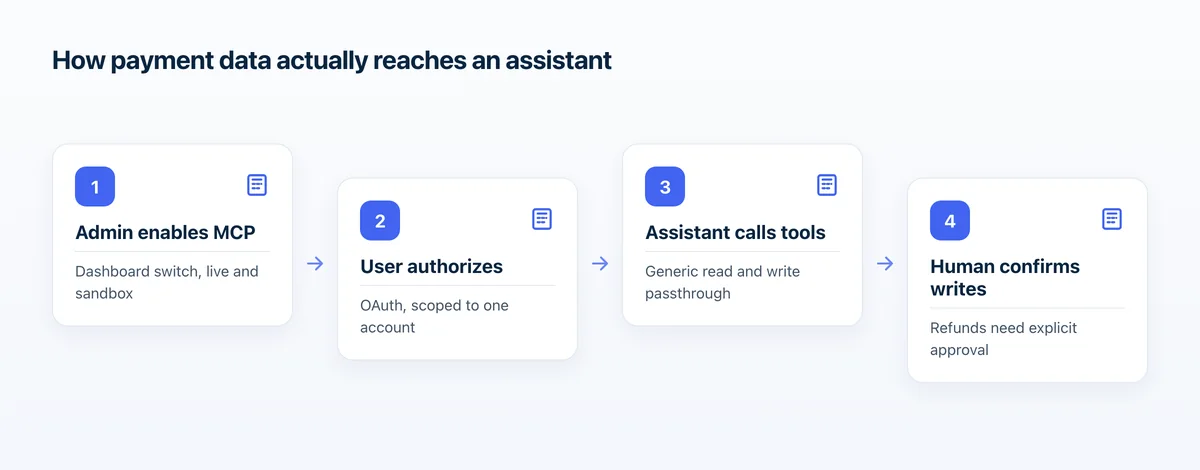
- An administrator turns MCP access on in the Stripe Dashboard, separately for sandbox and for live mode.
- A user authorizes the connection with OAuth, which scopes it to that user's permissions in that one account.
- The assistant discovers the tools: a generic read tool for GET calls, a generic write tool for POST, PATCH, PUT and DELETE, plus named tools including create_refund, balance summary and a reporting tool.
- Every prompt that needs data fires a live API call, and the response lands in the model's context window.
- Write actions require confirmation by default, in both ChatGPT and Claude.
What breaks when you run multiple processors and MIDs?
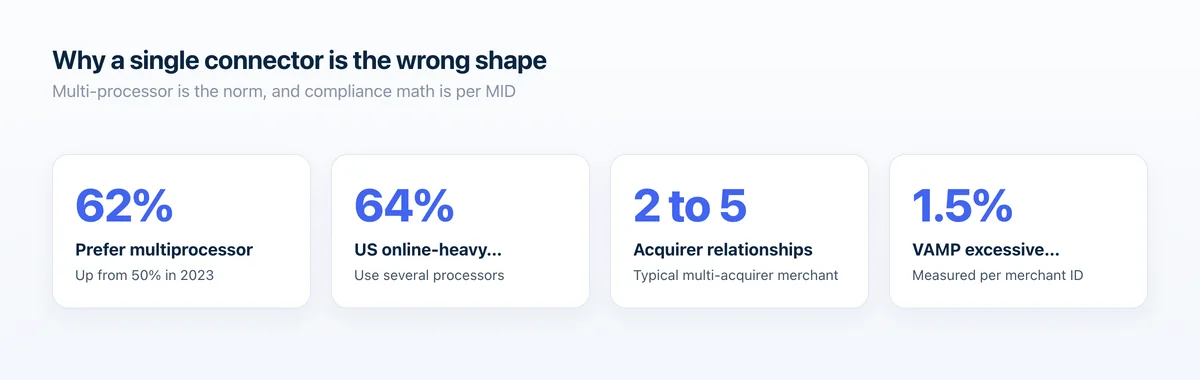
Everything that matters at portfolio level. A Stripe MCP session is scoped to one account and one environment at a time. Reaching a second account means abandoning OAuth entirely and issuing a restricted API key with a per-account header. Ask a connector for your blended chargeback rate and it answers for the slice it can see.
This is not an edge case. Preference for a multiprocessor setup rose to 62% of merchants in 2025, up from 50% in 2023. And 64% of US-headquartered merchants with half or more of sales online prefer to work with several processors. Merchants split MIDs deliberately, by revenue stream, sales channel, geography and risk segmentation. That is exactly the structure a single-account connector cannot see. Our per-MID health breakdown covers why that split matters operationally.
The math that gets you fined is per MID, not per company. Visa's VAMP (Visa Acquirer Monitoring Program) excessive threshold for merchants is now 1.5%, cut from 2.2% effective 1 April 2026, with an $8 assessment per fraudulent or disputed transaction. Mastercard identifies merchants by merchant account ID and reviews them monthly. One MID can breach while the blended portfolio number looks calm.
Then there is the normalization problem. Mastercard divides this month's chargebacks by last month's sales. Visa's ratio uses settled transactions in the same period and counts only card-not-present volume. Every PSP (payment service provider) emits its own schema, its own non-standardised decline codes and its own settlement timing. So two correctly read numbers still are not comparable on the same date axis. An assistant asked for one number will silently pick one convention.
How do you connect payment data from more than one processor?
You normalize first, then connect the assistant to the normalized layer. Reconciling schemas, decline codes and settlement timing has to happen before an assistant sees anything, which is why cross-account MCP servers are turning up on analytics platforms rather than on individual processors. The semantic layer is the product; the connector is just the door.
Beast Insights runs one at mcp.beastinsights.com/mcp. It connects to Claude, ChatGPT or Grok and answers from data already unified across gateways and MIDs, so a portfolio question returns one figure instead of three partial ones. Setup is one URL and a login. In Claude, open Settings, then Integrations, then Add Custom Connector, paste https://mcp.beastinsights.com/mcp and sign in with your Beast credentials. ChatGPT and Grok take the same URL under their own Connectors settings. There are no API keys and no config files. The MCP is included with the Beast platform, so the only extra cost is the AI plan you already pay for: Claude Pro or Team, or ChatGPT Plus or Team. Your conversation stays inside your own AI account, where nobody at your company and nobody at Beast can read it.
- Which gateway is dragging your approval rate down, and whether the drop is on first attempts or on rebills.
- Which MIDs are drifting toward Visa and Mastercard thresholds, before the notice arrives.
- Whether your RDR, Ethoca and CDRN alerts are actually preventing chargebacks, or just costing money.
- Which declines were recoverable, how much you recovered, and how much you left on the table.
- Where chargebacks and refunds are concentrated: which gateway, card brand, campaign or billing cycle.
- What a cohort is really worth after fees, refunds and chargebacks, and how long those customers stay.
You ask in plain language, the way you would ask an analyst who already knows your account:
- What's my approval rate by acquirer for the last 30 days, and which one is declining?
- Show me which MIDs are currently At-Risk or Critical on VAMP.
- How many alerts converted to chargebacks last month, and what credit can I claim?
- What's driving the spike in chargebacks this month? Break it down by campaign.
Two limits worth stating. It reports on the processors and MIDs already connected to your workspace, so a gateway you have not onboarded sits outside the answer. And it stays on aggregates unless you ask for rows: order-level lookups are opt-in, need at least one filter, and return up to 25 rows.
Is it safe to connect payment data to an AI chatbot?
It is as safe as the credentials you hand over, and no safer. A connector inherits the permissions of the user who authorized it, so the blast radius equals that person's existing processor access. The real risks are write scope you did not intend, prompt injection, unvetted servers, and using a consumer account for business data.
- Write scope you did not intend. Stripe's MCP toolset includes a generic write tool covering POST, PATCH, PUT and DELETE, plus a dedicated create_refund tool. Connected with default scopes, a chat assistant can move money.
- Prompt injection. OWASP ranks it the top LLM risk, and the indirect variant, instructions hidden inside data the model reads, fires precisely when an assistant ingests dispute evidence, customer notes or a vendor report.
- Unvetted servers. Anthropic states that custom connectors point at services it has not verified and that malicious servers can embed hidden instructions. OpenAI says the same, and adds that a server can still perform write actions even when it has labelled a tool read-only.
- The wrong account tier. On consumer Claude plans, allowing model improvement extends retention to five years, while the commercial products (Claude for Work, Government, Education and API access) are explicitly carved out.
- Context leakage. Any MCP server sees whatever data the assistant supplies during the interaction, whether or not the server is malicious.
What to demand from any payments MCP
- Authentication by login, not a pasted API key sitting in a config file.
- Read-only by default, so an assistant can explain your numbers but cannot change settings, costs or account state.
- Redaction at the boundary: an order-level answer should return order ID, amount, status, gateway, BIN (first six) and decline reason, not customer name, email, phone, billing address or full card number.
- Row access that is opt-in and filtered, so one loose question cannot pull your customer table.
- Your own analysis, not blended third-party benchmarks presented as your performance.
Beast Insights builds its MCP to that list: read-only by design, aggregates by default, order searches that require a filter and cap at 25 rows, customer identifiers withheld, and comparisons drawn against your own history rather than industry averages. Hold any vendor, including this one, to the same five.
Which payment questions do AI assistants answer well, and which do they get wrong?
Lookups and documented rules, yes. Portfolio analytics, no. On DABstep, a benchmark of more than 450 real multi-step analysis tasks built from Adyen's own payments platform, the highest-scoring agent reached 76.39% on easy tasks and 14.55% on hard ones. That gap is the honest boundary of the whole category.
| Question you ask | How reliable | Why |
|---|---|---|
| What was this customer's last charge, and did it settle? | Reliable | A single object lookup through the read tool, one API call |
| What does the processor's documentation say about dispute evidence? | Reliable | Documentation search is a first-class capability of the MCP server |
| Refund order 4471, wrong SKU shipped | Reliable but consequential | create_refund is a real write action, so confirm every call and read the input |
| What was my decline rate last quarter? | Unreliable | List endpoints cap at 100 objects per call, so the assistant samples rather than aggregates |
| What is my chargeback rate? | Unreliable | Visa and Mastercard use different denominators, so there are two correct answers and it picks one |
| Which MID is closest to the VAMP threshold? | Not answerable | The ratio spans fraud and dispute data across accounts one connector cannot reach |
Note: the pattern is that retrieval works and computation over a full period does not.
The failure mode to fear is not a refusal. It is a confident wrong number. Researchers call it silent hallucination: the query is syntactically valid, it runs clean, and no error signal appears. Reason codes make it concrete. Each network defines hundreds of them, and Stripe collapses them into its own seven categories. That normalization is Stripe-specific and does not map to another processor's buckets. Payments rules also move faster than training data, which is why an assistant answering from memory still quotes the old 2.2% VAMP threshold. If you are diagnosing a sudden approval-rate drop, that is exactly the wrong instrument.
How do you set this up without exposing raw card data?
You mostly do not have to try. Stripe returns only non-sensitive card fields through its API: brand, last four and expiry. The design rule is to keep cardholder data out of the assistant path entirely. Authorize with OAuth or a narrowly restricted key. Never type a raw card number, CVV or PIN into a chat window.
A setup that does not widen your PCI scope
- Have an administrator enable MCP access in the Stripe Dashboard, separately for sandbox and live mode
- Connect with OAuth rather than pasting a secret key, so permissions stay user-scoped and revocable
- Where OAuth is not available, mint a restricted API key limited to the minimum functionality and keep it in a secrets vault or environment variable, never in code
- Force the connector down to read-only across the org where your plan allows it, and disable write-capable tools before running research or agent modes
- Require human confirmation on every write call, and read the tool input before approving anything that issues a refund
- Never paste a full card number, CVV, track data or PIN block into a chat window, on any plan
- Use a commercial plan rather than a personal one, so the conversation sits outside consumer training and retention terms
- Review and revoke authorized MCP sessions in the Dashboard on a schedule, including for departed team members
PCI DSS (the Payment Card Industry Data Security Standard) scope follows the data, not the tool. The standard names chat explicitly as an end-user messaging technology, so a full PAN (primary account number, the full card number) in a prompt is a control failure rather than a grey area. Sensitive authentication data (card verification codes, full track data, PIN blocks) may never be retained after authorization, encrypted or not. The PCI Security Standards Council published AI principles in September 2025. Those principles state that AI systems should not be trusted with unprotected sensitive data, and that AI may see account data only in protected form: tokenized, truncated or aggregated. Your acquirer sets your obligation, not the Council, so confirm any AI setup with them or a Qualified Security Assessor.
What changes as agentic commerce and AI connectors mature?
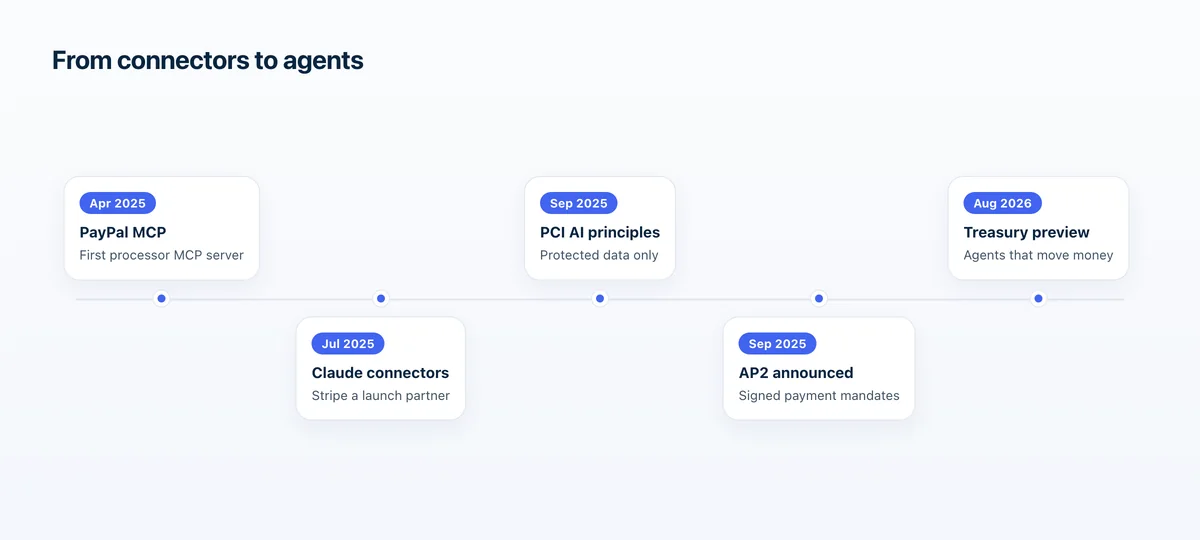
Connectors analyze; agents are starting to transact. Four rival protocols are live already, including Stripe and OpenAI's Agentic Commerce Protocol and Google's AP2. Four protocols is not a standard, and liability is openly unresolved.
Two things follow for merchants. First, settlement, refunds, chargebacks and compliance stay with the merchant and the PSP under ACP, so agentic checkout does not move your dispute exposure anywhere. We unpack that point in who carries the liability when an AI agent buys. Second, the money-moving tools are not general availability yet: Stripe's Treasury MCP tools sit behind a request-access preview as of August 2026, and Visa describes its Intelligent Commerce portfolio as still deploying rather than shipped. Meanwhile 19% of merchants can already accept agentic AI payments and 63% are exploring or implementing them. The reporting problem is about to gain another rail.
Frequently Asked Questions
Is it safe to give AI access to my Stripe account?
It is as safe as the credentials you grant. A connector inherits the authorizing user's permissions, so it cannot reach anything that person could not already open themselves. The exposure that surprises people is write scope: Stripe's MCP server includes a create_refund tool, so require human confirmation and use restricted keys.
Can ChatGPT analyze my Stripe transactions?
It can retrieve them, which is not the same as analyzing them. ChatGPT reaches Stripe through a custom MCP connector on a paid plan, and Stripe's list endpoints return at most 100 objects per call. A quarter of transactions is thousands of sequential calls, so period-level answers are sampled rather than computed.
How do I connect Stripe to Claude?
Open Settings, go to Connectors, browse the connectors directory and add the official Stripe connector, then authorize with OAuth. You need a paid Claude plan, because remote connectors are gated to paid tiers, and an administrator must first enable MCP access on the Stripe account, separately for live and sandbox mode.
What is an MCP server?
MCP, the Model Context Protocol, is an open standard for connecting AI applications to external data, tools and workflows. The specification calls it a USB-C port for AI applications. An MCP server is the thing on the other end of that port, exposing a fixed set of tools an assistant can call on your behalf.
Can AI see my customers' card numbers?
No, not through an official processor connector. Stripe returns only non-sensitive card fields such as brand, last four and expiry, which sit outside PCI scope. The risk is human rather than technical: a raw card number or CVV pasted into a chat window breaches PCI DSS rules on messaging and on retaining sensitive authentication data.
Can I connect Beast Insights to Claude or ChatGPT?
Yes. Beast Insights publishes an MCP server at mcp.beastinsights.com/mcp that works with Claude, ChatGPT and Grok. Paste the URL into your AI app's connector settings and log in with your Beast credentials. Claude needs a Pro or Team plan; ChatGPT needs Plus or Team with Developer Mode switched on.
Is the Beast Insights MCP read-only?
Yes, it is read-only by design. The assistant can query and explain payment performance but cannot change settings, costs, configuration or account state; changes stay in the portal. Order-level lookups are opt-in, require at least one filter and return up to 25 rows.