Payment Reconciliation for Subscription Businesses
One subscription order can produce a dozen money events across months and MIDs. Here is how to attribute every refund, chargeback, alert fee, and reserve hold back to its original transaction before you try to tie anything to the bank.
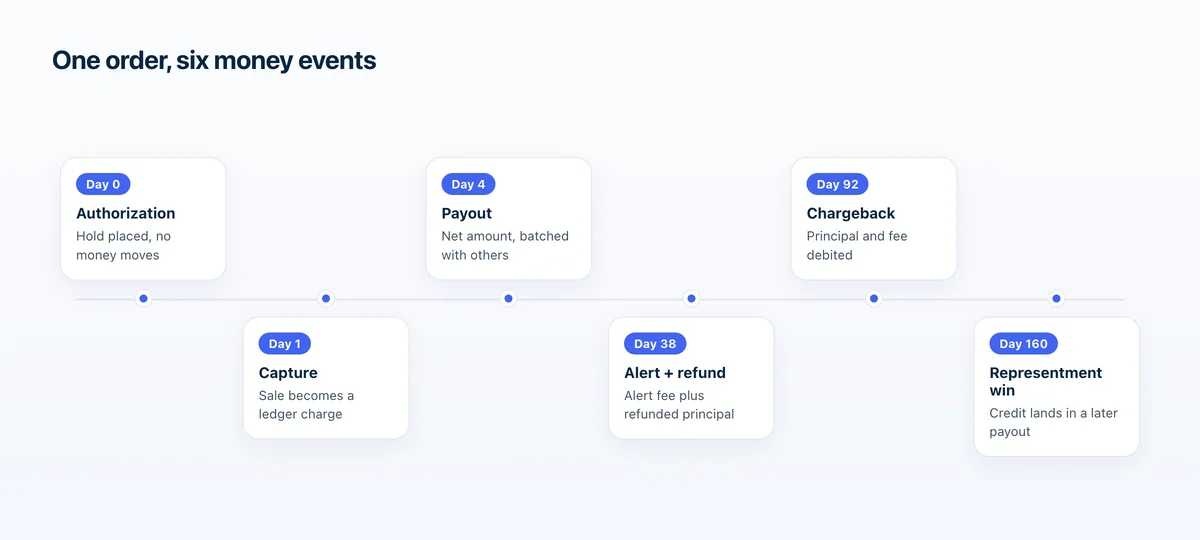
A subscription order does not produce one money movement. It produces an authorization, a capture, and a payout that batches it with hundreds of others. Over the following months, it can also produce a refund, an alert fee, a chargeback, a representment credit, and a reserve release. Most reconciliation guides start at the bank statement. For subscription businesses, the work starts far upstream: you first decide which of those events belongs to which original transaction.
Payment reconciliation matches the money that actually arrived against the transactions that were supposed to produce it. The arrived money is the net payouts in your bank account. The transactions include every sale, refund, chargeback, fee, and reserve movement. For subscription businesses, the hard part is attributing post-sale events back to their original transactions before any bank matching can begin.
What is payment reconciliation?
Payment reconciliation checks that the money you received matches the money you were owed, transaction by transaction. You compare three records: your own order system, the processor or gateway report, and the bank statement. When all three agree, the books are trustworthy. When they do not, you have an exception to explain.
Most guides describe that three-way match and stop there. The structure is right, but the middle leg is where subscription businesses get hurt. A processor's settlement file is not a list of sales. Adyen's settlement report, for example, lists Settled, Refunded, Chargeback, SecondChargeback, ChargebackReversed, RefundedReversed, and Fee as separate row types. Each of those rows can trace back to the same original payment.
The bank leg is a batch, not a transaction. A deposit is a settlement batch, which is why Stripe's payout reconciliation report exists. The report matches one bank line to the batch of payments, refunds, disputes, and fees it sweeps up. It groups those items by reporting category rather than listing them per order. Before either match can work, you have to attribute every post-sale event to the transaction it came from. Every ranking guide skips that attribution step. This piece covers it.
Why the payout never equals the revenue
The payout never equals the revenue. A payout is a net settlement batch, not a mirror of sales. The processor subtracts fees before money moves. It nets refunds and chargebacks against new sales. Reserves hold a slice back. Settlement timing shifts transactions across period boundaries. The gross-to-net gap is structural, not an error to hunt down.
One accounting-facing summary states the expected deposit as an equation with five terms, and only one term is revenue. The equation reads: gross sales, minus refunds, minus chargebacks, minus processor fees, minus rolling reserve. Every term moves on its own schedule. Reserves alone build in divergence. A rolling reserve typically withholds 5 to 15 percent of sales for 30 to 180 days. That schedule books a slice of every month's revenue into a later period by design.
| Deduction | When it lands | Why it will not match a sale |
|---|---|---|
| Processing fees | Netted before payout | Only the net ever moves; the fee stays attached to the transaction |
| Refunds | Days to weeks later | Debits you now; the customer sees it 5 to 10 business days later |
| Chargebacks | Up to 120 days after the sale | Principal plus a dispute fee, pulled the moment the case is filed |
| Alert fees | Within about 24 hours of the alert | $15 to $29 per alert, on top of the refunded principal |
| Reserve holds | Every payout | 5 to 15 percent held for 30 to 180 days, then released as its own credit |
| Settlement timing | T+1 to T+3, varies by country and brand | The sale date and the cash date are structurally different fields |
Each row is a separate event stream with its own dates, its own identifiers, and in some cases its own MID.
Two consequences follow. First, a payout can be negative. When refunds exceed new payments in a period, the "deposit" becomes a debit from your bank account. That debit corresponds to no sale at all. Second, a fully refunded order is never a clean wash, because the original processing fee is not returned. The transaction closes at a permanent net loss. Settlement timing compounds all of this across borders. Settlement windows (T+X, the number of days after the transaction date) differ by country and card brand. Entity and acquiring choices change the clocks. We cover that in cross-border vs local acquiring.
What actually breaks reconciliation for subscription merchants
Subscription reconciliation breaks because one order does not stay one record. A single rebill can fan out into an authorization, a capture, a refund, an alert fee, a chargeback, a representment, and a reserve movement. Each event lands on its own date. Each carries its own type in the ledger. Some arrive months after the sale.
Stripe documents the hardest case directly: a customer disputes three 50 USD recurring charges. The bank files one 150 USD dispute against just one of the three payments. The debit matches nothing in your order table. Most reconciliation guides teach amount-matching. That method fails on subscriptions by design.
- Post-sale events arrive months late: cardholders typically get 120 days to dispute, the dispute lifecycle runs 2 to 3 months on top, and a late win can flip a lost case after that with no predictable timing.
- Amounts drift: FX movement between purchase and dispute turned a 100 EUR sale into a 107.86 EUR chargeback in Stripe's own worked example.
- Refunds are not always refunds: issued within roughly 2 hours of capture, they process as reversals, the original charge vanishes from the customer's statement, and no ARN is ever created, so there is nothing to match.
- Partial captures masquerade as refunds: the uncaptured remainder posts as a refund-typed ledger entry, distinguishable only by its reporting category.
- Retries multiply attempts: the recommended dunning default is 8 attempts in 2 weeks, and after a hard decline the attempt count keeps climbing without creating any new charge records.
- Refunds you never issued: a Rapid Dispute Resolution rule resolves a pre-dispute by refunding through the network itself, so money leaves against an order without anyone on your team touching it.
- Alert costs attach to orders but arrive separately: published alert pricing runs $15 to $29 per alert on top of the refunded principal, and because Ethoca and CDRN (Cardholder Dispute Resolution Network) both see Visa disputes, one order can trigger two alert fees.
A refund and a chargeback can coexist on the same order. A customer can still dispute a payment you already partially refunded, for the full original amount. The two paths look interchangeable on a statement. They behave completely differently in reconciliation and in network programs. If the distinction is fuzzy, start with our breakdown of chargebacks vs refunds.
Order date or trial date: which lens are you reconciling to?
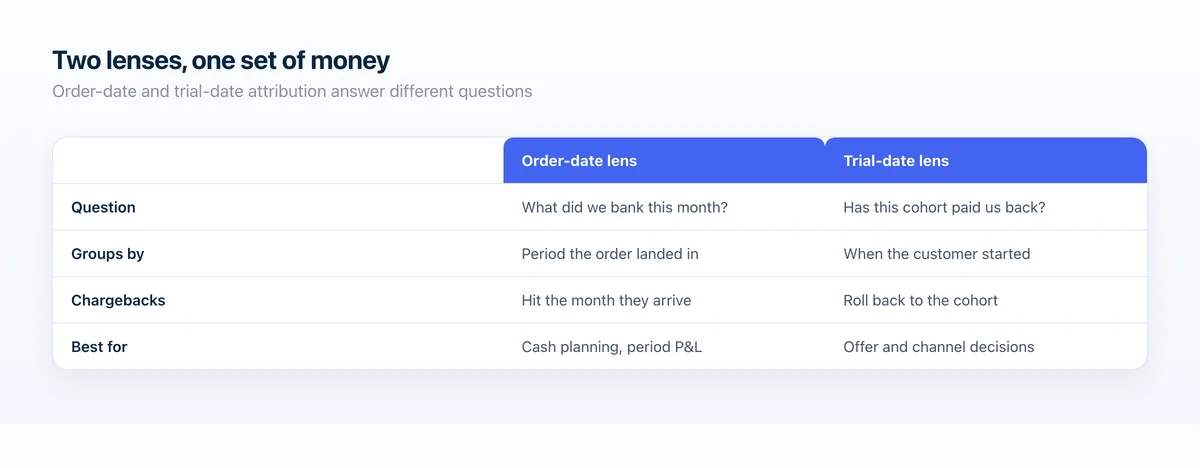
You can attribute the same money in two defensible ways. You can assign it to the period the order landed in, or to the cohort of the customer who produced it. Both are correct. They answer different questions, and they produce different numbers over identical data. Most reconciliation trouble starts when a team mixes the two without noticing.
This split exists inside processor reporting itself. Stripe computes two dispute metrics over the same disputes. Dispute activity counts them by dispute date. Dispute rate assigns them back to the charge date of the payment that caused them. In the worked example, one week has 1,000 payments and 10 disputes. That week shows 1% dispute activity but a 0.3% dispute rate. Only 3 of those 10 disputes came from that week's payments.
Charge-date attribution is also provisional. Disputes can arrive for 120 days, so the rate for recent periods keeps changing as late events land. That is not a bug. The order-date lens tells you what you banked in a period, and it stabilizes quickly. The cohort lens groups money by when the customer started rather than when it moved. It tells you whether a cohort has paid back its acquisition cost, and it keeps updating as the tail arrives. Most of the discipline is choosing a lens per question, deliberately. We go deeper on the cohort side in profitability analysis.
How do you reconcile payments across several gateways and MIDs?
You reconcile payments across several gateways and MIDs in two steps. First, you normalize each provider's events into one schema. Then you attribute every event to its original transaction and its MID before totaling anything. Aggregate matching fails outright. A clean company-wide variance can hide equal and opposite errors sitting on two different merchant accounts.
The average business already runs 3 to 5 payment gateways. Each one reports in its own dialect: different identifiers, statuses, file formats, cut-off times, and settlement calendars. Even fee treatment differs structurally. One processor nets fees per transaction while another bills a monthly lump sum. As a result, two MIDs on the same books need two different matching models.
Subscription businesses often split renewals and one-time purchases across separate MIDs deliberately. That means one customer's lifetime spans several merchant accounts. Per-MID attribution is therefore non-negotiable, because network programs measure each MID on its own. Visa runs the Visa Acquirer Monitoring Program (VAMP) and tracks its ratio at the merchant ID level. The program has set the excessive threshold at 1.5% since April 1, 2026, down from the 2.2% that applied before that date. A dispute attributed to the wrong MID distorts two ratios at once.
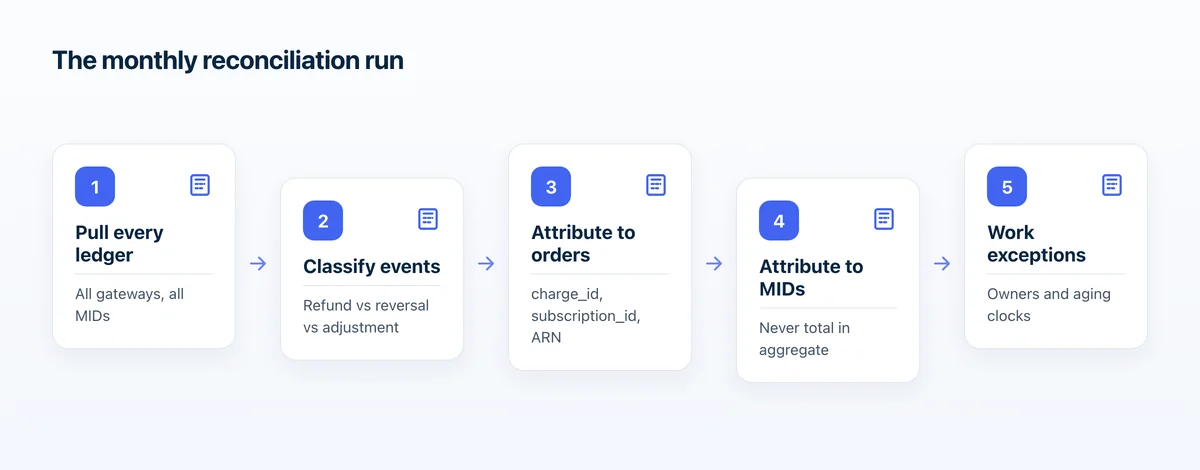
The practical playbook has five steps. You pull every provider's export. You translate it into one event schema. You join post-sale events to their originals. You tag every event with its MID. Only then do you compare totals. If you are still deciding how many gateways to run, see our guide to running multiple payment gateways. For the tooling landscape, see payment profitability tools for multiple processors.
A payment reconciliation report and process you can run monthly
A payment reconciliation report is an event-level table, not a summary. It lists every money movement, its type, its original transaction, its MID, and its dates. It also lists gross, fee, and net amounts for each movement. The monthly process below assumes nothing fancier than exports from each gateway and a place to track exceptions.
The joins you need mostly exist, if you use them. In Stripe reporting, charge_id appears on charges, refunds, and disputes alike. Subscription businesses also get subscription_id on all three. That lets post-sale events roll up to the subscription that produced them. Across parties, the acquirer reference number (ARN), a 23-digit identifier, traces a payment through settlement and disputes. Refunds receive their own ARN rather than sharing the original sale's.
- Event type and reporting category, not just the raw ledger type (disputes arrive as generic adjustments otherwise)
- Original transaction keys: charge_id, subscription_id, and ARN where present
- Gateway and MID the event settled under
- Three dates per row: event created, funds available, payout expected
- Gross, fee, and net amounts, with currency
- Payout or batch identifier
- Exception status and owner if unmatched
Timing works in your favor. A day's report data is generally complete by noon the following day. A monthly run kicked off on the 1st therefore works from finished data by the 2nd. Here is the process itself.
- Export event-level ledgers from every gateway and MID for the period, plus the trailing 120 days for late-landing disputes
- Classify every event by reporting category so reversals, partial-capture releases, and true refunds separate cleanly
- Join post-sale events to their original transactions via charge_id, subscription_id, and ARN
- Attribute every event to the MID it settled under before computing any total
- Recompute the period on both lenses: order date for cash, trial-date cohort for payback
- Log every unmatched event as an exception with an owner and an aging clock
- Reopen prior periods for chargebacks, representment credits, and late wins that landed this month
- Hand the fully attributed event file to accounting for bank matching and journal entries
Where reconciliation stops and accounting begins
For a subscription business, reconciliation ends when you have attributed every money event to the transaction, customer, and MID it belongs to. Accounting begins after that. Bank-statement matching, journal entries, and closing the books belong to your accounting stack. Doing attribution first makes the accounting step mechanical instead of forensic.
Even vendors in the multi-PSP (payment service provider) space define reconciliation as linking orders to normalized payment events, settlement records, fees, refunds, disputes, and bank credits. The event-linking step is part of reconciliation itself, not an optional preamble. Skipping it is how teams end up debugging a 150 USD mystery debit inside a general ledger tool that has no idea rebills exist.
When you get attribution right, everything downstream gets boring in the best way. The exceptions queue shrinks to genuinely odd items. The per-MID ratios that networks measure you on become trustworthy. The choice between period and cohort views becomes an explicit setting, not an accident of whichever report happened to be open.
Frequently Asked Questions
What are the three types of reconciliation?
The three commonly cited types are bank reconciliation, internal ledger reconciliation, and payment reconciliation. Bank reconciliation matches your books to bank statements, ledger reconciliation matches accounts within your own records, and payment reconciliation matches processor transactions against what you were owed. Card payment reconciliation is the hardest of the three because one order fans out into many separately dated events before any money reaches the bank.
What happens if you don't reconcile payments?
You lose the ability to trust your revenue number. Fee errors and double refunds go unnoticed, chargebacks silently consume prior-period revenue, and because cardholders can dispute up to 120 days after a payment, unreconciled books drift further from reality every month. You also lose the per-MID visibility that network programs like Visa's VAMP are enforced against.
How do you reconcile payments across multiple processors?
Normalize first, then match. Each processor uses its own identifiers, statuses, file formats, and settlement calendars, so translate every export into one event schema, attribute each event to its original transaction and its MID, and only then compare totals. Never reconcile in aggregate: a zero variance across the company can hide offsetting errors on two different MIDs.
What is a reconciliation break?
A reconciliation break, or exception, is a record on one side of the match with no counterpart on the other. Common causes include partial captures typed as refunds, refunds landing after the payout they should have offset, chargeback reversals arriving months later, and multi-currency rounding drift. Each break needs an owner and an aging clock, not a quiet write-off.
What is payment settlement reconciliation?
Payment settlement reconciliation matches each settlement batch, the payout, to the bank deposit it produced and to the transactions inside it. A payout is a net batch grouped by category rather than a list of orders, so this step depends on transaction-level attribution having already happened. For instant or manual payouts, the processor may not be able to attribute the contents at all.