Cross-Border vs. Local Acquiring: What Every Global Merchant Needs to Know
Local acquiring cuts fees and lifts approval rates by 5 to 16 points. Learn which model fits your market, volume, and growth stage before cross-border routing bleeds more revenue.
What Is the Difference Between Cross Border and Local Acquiring?
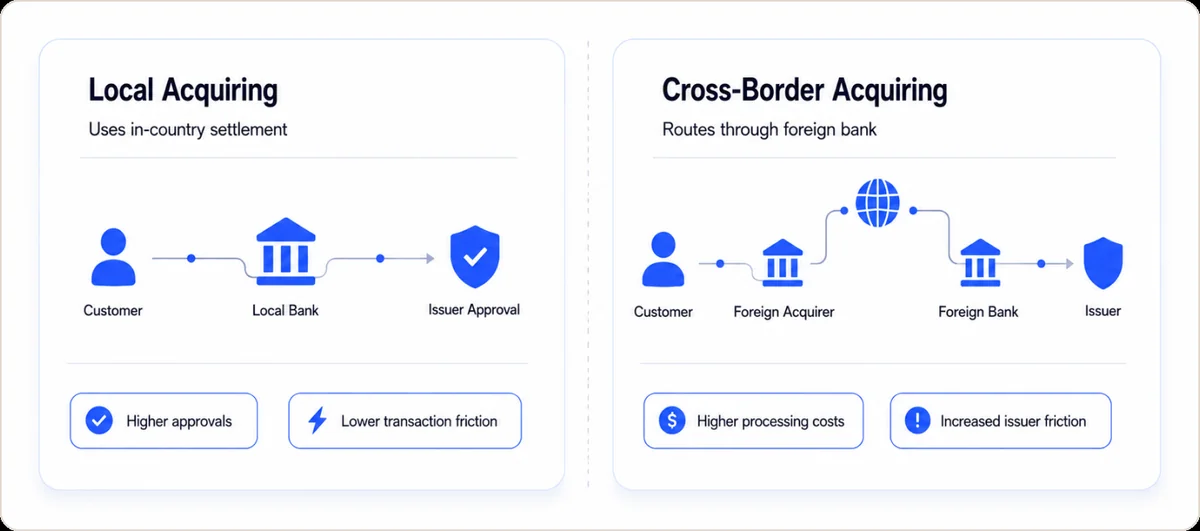
Local acquiring means your payment is processed by a bank or acquirer licensed in the same country as your customer. Cross-border acquiring means a bank in a different country, typically where you are headquartered, handles the transaction instead.
That distinction sounds technical, but it has a very direct commercial consequence. When a card issuer sees a transaction routed through a foreign acquirer, it applies stricter fraud rules, applies higher fee categories, and often declines at a higher rate. When the same card is charged through a local acquirer with a domestic BIN (Bank Identification Number), the issuer treats it like any domestic transaction: lower friction, better approval odds.
In practical terms, this is the difference between 70-90% authorization rates for local acquiring and 30-50% for international/cross-border processing, according to EBANX payment data. Cross-border rates are often 5-15% lower than domestic benchmarks (e.g., 85-90% typical global/domestic), per industry sources like Payments & Risk.
Why Do Cross-Border Payments Get Declined More Often?
Cross-border payments are declined more frequently because card issuers apply stricter fraud scoring to foreign-routed transactions, and the mismatch between the acquiring country and the cardholder's country triggers automatic risk filters.
Here is what is actually happening at the network level. When your customer in Germany pays with a Visa card and the acquiring BIN is registered in the United States, Visa's routing logic flags this as an international transaction. The German issuer then applies cross-border risk rules, which are by design more conservative. The result is a higher decline rate, often with vague response codes like "do not honor" that are impossible to retry successfully.
Local acquiring eliminates this friction. A German acquirer with a German BIN processes the same transaction as domestic. The issuer applies standard domestic rules. The transaction clears.
This issuer trust gap is particularly pronounced in markets like Mexico and Brazil. In Mexico, local acquiring methods produce 20 to 30% higher approval rates than international processing on the same card volume. In Brazil, switching from an international acquirer to a domestic one can shift approval rates by double-digit percentage points. These are not edge cases. They are the norm in markets where issuer systems are sensitive to cross-border routing.
How Do Local Acquiring and Cross-Border Acquiring Compare on Cost?
Local acquiring reduces per-transaction costs through lower interchange rates, domestic scheme fees, and the elimination of foreign transaction assessments. Cross-border processing adds 0.4 to 1.0% in scheme fees on top of already higher interchange.
The cost structure breaks down into three layers.
Interchange fees. In the European Economic Area, EU regulations cap domestic interchange at 0.2% for consumer debit cards and 0.3% for consumer credit cards. These caps are set by Regulation (EU) 2015/751, which applies to most consumer debit and credit card transactions within the EU/EEA. Cross‑border transactions from outside the EEA do not benefit from these caps and can face rates of 1.15% or higher, so that difference compounds fast(Source).
Scheme assessments. Visa and Mastercard apply additional cross-border assessment fees when the acquirer and cardholder are in different countries. These typically range from 0.60% to 1.40% per transaction (e.g., Mastercard 0.60% base + currency conversion up to 1.40%; Visa 0.80%-1.20%) and remain separate from interchange fees(Source).
Foreign exchange and processing markup. If the transaction requires currency conversion, the acquiring bank applies an FX spread, typically 1.5 to 3.0%, on top of the base rate.
Put together, cross-border processing on a £1 million monthly volume can cost £15,000 to £25,000 more per year than local acquiring in the same market. That figure comes from modeling domestic vs cross-border fee structures across typical UK transaction volumes. At enterprise scale, that gap is a meaningful budget line.
Local Acquiring vs Cross-Border Acquiring: Side-by-Side Comparison
| Factor | Local Acquiring | Cross-Border Acquiring |
|---|---|---|
| Authorization rate | 85 to 95% (typical) | 70 to 85% (typical) |
| Interchange category | Domestic rate (regulated in EEA) | International rate (unregulated) |
| Scheme assessment fees | Standard domestic | Additional 0.4 to 1.0% |
| FX conversion required | No (local currency settlement) | Often yes (adds 1.5 to 3.0%) |
| Fraud friction | Lower (issuer treats as domestic) | Higher (cross-border risk flags) |
| Compliance complexity | In-country licensing required | Single entity can serve globally |
| Time to launch | Weeks to months per market | Days (via existing global acquirer) |
| Recommended volume threshold | $2 to 5M+ per year in target market | Lower volumes or market-testing phase |
| Local payment method support | Yes (domestic debit, installments) | Limited or unavailable |
When Does Local Acquiring Make More Sense Than Cross-Border?
Local acquiring makes more sense when you are processing above $2 to 5 million annually in a single market, seeing high decline rates on international routing, or competing in markets where local payment methods dominate.
The volume threshold matters because local acquiring involves setup costs: finding an in-country acquiring partner, completing local licensing or registration, and integrating a new payment path into your stack. Below a certain volume, those costs outweigh the savings on fees and recovery from declines.
Above that threshold, the calculus flips quickly. If you are losing 10 to 15 points of approval rate to cross-border friction, you are also losing the downstream LTV of those declined customers. One payments intelligence study found that merchants using local acquiring see a 17.9% improvement in customer lifetime value, driven by fewer declined transactions and better checkout completion on retry flows.
Cross-border processing still makes sense in three scenarios. First, when you are testing a new market and do not yet know whether volume will justify local investment. Second, when a market lacks robust local acquiring infrastructure. Third, when your transaction volumes in a given country are small enough that the fee differential is immaterial.
Many enterprise merchants run a hybrid model. They use cross-border acquiring for small or emerging markets and local acquiring for their top five to ten revenue markets. Payment orchestration platforms make this manageable by routing each transaction to the optimal acquirer based on BIN, market, card type, and real-time performance data.
What Is the Impact of Local Acquiring on Approval Rates in Key Markets?
Local acquiring consistently improves authorization rates by 5 to 16 percentage points across major markets. The lift is highest in Latin America, Southeast Asia, and Eastern Europe, where issuer sensitivity to cross-border routing is strongest.
I have seen this pattern repeated across market after market. The authorization rate improvement is not uniform globally, but it is consistent directionally. Here is what the data shows by region.
Europe. Merchants using local EEA acquirers see acceptance rates up to 16% higher than those relying on a single foreign acquirer. The EEA interchange caps create an additional cost incentive layered on top of the approval rate benefit.
Mexico. Local payment methods and domestic acquiring deliver 20 to 30% higher approval rates than international processing. This is partly structural: Mexican issuers are configured to scrutinize cross-border BINs aggressively, and many customers use debit cards that simply cannot clear on foreign-routed flows.
Brazil. The approval rate shift from international to domestic acquiring can be double digits. Brazil also has market-specific requirements around installment payments (parcelamento) that are only available through local acquiring rails.
United Kingdom. Even within a single-language, high-trust market like the UK, a UK company selling to UK customers through a UK acquirer sees fewer declines than if those same transactions were routed through a US or European acquirer. Stripe has documented this dynamic explicitly in their local acquiring guidance.
According to a 2024 Nuvei analysis of global payment acceptance, merchants routing payments locally can see noticeably higher acceptance rates than those relying on a single, often foreign, acquirer.” Source: Nuvei, The 2026 Guide to Global Payment Acceptance & Local Acquiring
How Should You Implement a Local Acquiring Strategy?
A local acquiring strategy starts with identifying your top two or three markets by volume, then partnering with a licensed in-country acquirer or a global PSP with local acquiring infrastructure in those markets.
The implementation path has four steps.
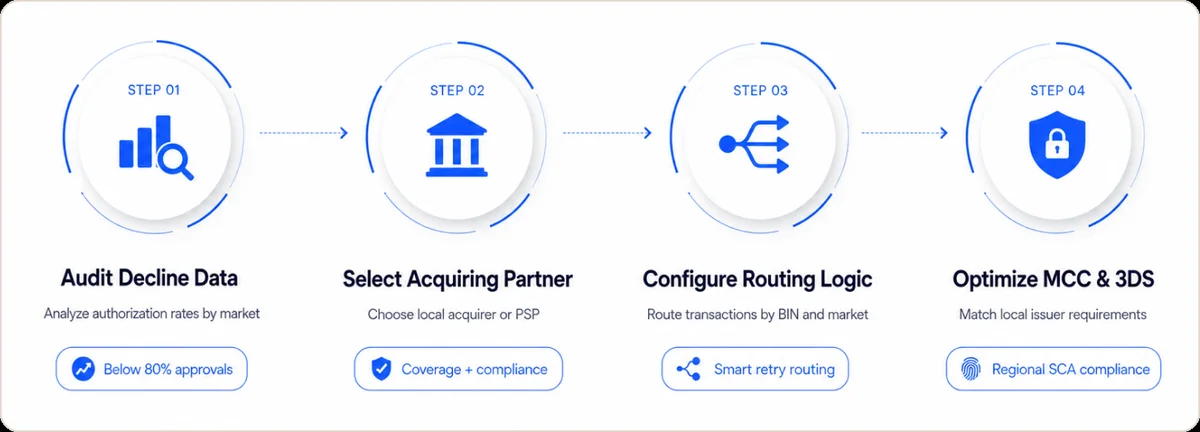
Step 1: Audit your current decline data by market. Pull your authorization rates segmented by the country of the cardholder. Any market where you are consistently below 80% authorization is worth investigating for local acquiring uplift.
Step 2: Select the right acquiring partner. You can either work directly with an in-country acquirer (lower fees, more complexity) or use a global PSP with local acquiring licenses in your target markets (faster, with managed compliance). Providers like Nuvei, Stripe, and Adyen operate local acquiring infrastructure across dozens of markets.
Step 3: Configure payment routing logic correctly. If you are using a payment orchestration layer, set routing rules to direct transactions to local acquirers when a customer's card BIN matches a target market. Smart routing also handles retry logic, sending a soft-declined transaction to an alternative acquirer or payment path automatically.
Step 4: Ensure correct MCC coding and 3DS configuration per market. Merchant Category Code errors are a common and avoidable cause of issuer declines. 3DS flows also vary by region and must be configured to match local SCA requirements rather than applied uniformly.
For teams building a multi-acquirer architecture, the key principle is: do not sacrifice simplicity for theoretical optimization. Start with your two highest-volume non-domestic markets. Measure the authorization rate improvement after 30 days. Then expand.
What Are the Risks of Multi-Acquirer Local Acquiring Setups?
Multi-acquirer setups introduce operational complexity, integration costs, and reconciliation challenges that single-acquirer merchants do not face.
Running local acquirers across five or more markets means managing five or more commercial relationships, integration endpoints, settlement currencies, and reporting formats. Reconciliation becomes genuinely difficult without a unified data layer. Chargeback handling across multiple acquirers requires clear ownership rules or it becomes a blind spot.
The mitigation is payment orchestration. Orchestration platforms sit above your acquirers and provide a single API, unified reporting, and intelligent routing logic. They abstract away most of the operational complexity of multi-acquirer environments. The tradeoff is a platform fee and one more vendor relationship, but for merchants above $20 million in annual global volume, orchestration typically pays for itself within months through approval rate improvements alone.
Conclusion: What Should You Actually Do?
The core decision is straightforward. If you are processing meaningful volume in a market and your authorization rates are below 80%, cross-border routing is costing you real revenue. Local acquiring is the structural fix. The question is not whether it works; it demonstrably does, but whether your volume in each market justifies the setup investment.
My recommendation: start with your one highest-volume non-domestic market. Run a 30-day pilot with a local acquiring partner or a PSP with local infrastructure. Measure the before-and-after authorization rate and fee structure. The ROI case will be obvious or it will not, and you will know quickly.
For most global merchants processing above $5 million annually in Europe, Latin America, or Asia, local acquiring is not optional. It is table stakes for a competitive checkout experience.
Frequently Asked Questions
What is local acquiring in payments?
Local acquiring is a payment processing model where the merchant uses an acquirer bank licensed in the same country as the customer. This allows the transaction to be treated as domestic, resulting in lower fees and higher authorization rates compared to cross-border processing.
What is cross-border acquiring?
Cross-border acquiring is when a merchant's payment is processed by an acquirer in a different country from the customer. The transaction is treated as international by the card issuer, which typically leads to stricter fraud checks, lower approval rates, and higher fees.
How much can local acquiring improve authorization rates?
Local acquiring typically improves authorization rates by 5 to 16 percentage points compared to cross-border processing in the same market. The improvement is most significant in Latin America, Southeast Asia, and Eastern Europe.
Is local acquiring worth the cost for smaller merchants?
Local acquiring generally makes financial sense when a merchant exceeds $2 to 5 million in annual transaction volume in a single country. Below that threshold, cross-border processing may be more cost-effective despite the lower approval rates.
Does local acquiring reduce fraud chargebacks?
Local acquiring does not directly reduce fraud, but it reduces the number of false declines triggered by cross-border fraud filters. Fewer false declines mean fewer frustrated customers and less revenue loss from legitimate transactions being blocked.
Can a single PSP provide local acquiring globally?
Several large PSPs, including Stripe, Adyen, and Nuvei, operate local acquiring licenses across dozens of markets. These providers offer local acquiring through a single integration, reducing the complexity of managing multiple direct acquirer relationships.
What is the difference between local acquiring and a local payment method?
Local acquiring refers to how and where a card transaction is processed. Local payment methods refer to non-card payment options preferred in specific markets, such as PIX in Brazil or UPI in India. Local acquiring supports local payment methods in many cases, but they are distinct concepts.
How can I tell if cross-border routing is costing me approvals?
Compare approval rates for the same card volume across acquirers, markets and BIN ranges. A BIN is the card number prefix that identifies the issuing bank. Beast Insights breaks declines down by decline code, issuer, BIN, gateway or MID, acquirer, card brand and billing cycle. A MID is the merchant account ID your acquirer assigns you. That breakdown shows whether a foreign acquirer, not the customer, is causing the drop. You get that answer before you invest in a local entity.
Does local acquiring help with subscription renewals?
Yes. Renewals on a domestic acquirer get scored under standard domestic rules. Recurring charges therefore face fewer cross-border risk filters. Track approval rates by billing cycle, issuer and MID, the merchant account ID your acquirer assigns you. Subscription merchants then see which renewal cohorts improve after a local acquirer goes live.