False Decline: The $81 Billion Revenue Problem Your Payments Data Is Hiding
False declines block legitimate payments and cost e-commerce merchants $81B annually. Learn how to identify, measure, and reduce false declines without increasing fraud risk.
Every declined transaction tells a story. Most payment teams read only one chapter. They see a decline code, log it, and move on. What they miss is the chapter that follows: the legitimate customer who walked away, never complained, and never came back. That is what a false decline costs. Not the transaction value. The relationship.
I have spent years working in payments performance and the pattern is consistent: merchants who treat their decline rate as a single number are systematically blind to a recoverable revenue problem sitting inside their own data. This post gives you the framework, the benchmarks, and the exact fixes to change that.
Quick Answer
What Exactly Is a False Decline, and What Is It Not?
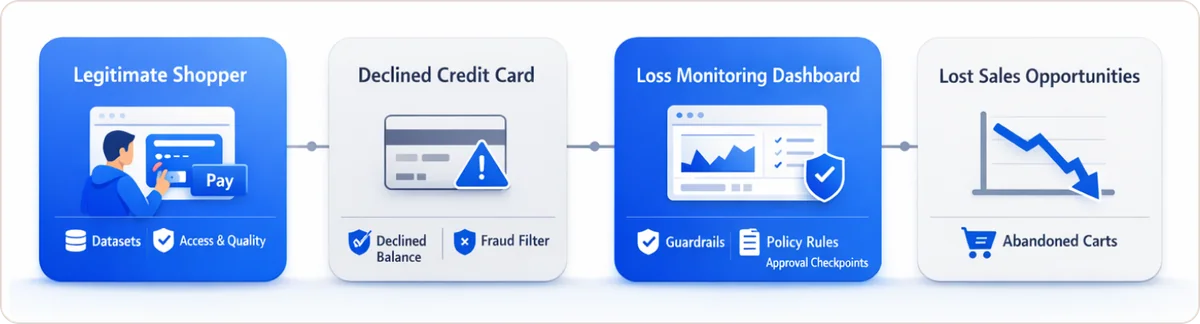
A false decline occurs when a valid payment from a legitimate cardholder with sufficient funds is blocked by a payment system. The card is not stolen. The funds are present. The buyer is genuine. The system made an error. It is also called a false positive in fraud management: the fraud filter fired, but it fired on an innocent transaction.
The distinction between a false decline and a legitimate decline matters enormously for how you respond. A legitimate decline is the system working correctly: expired card, genuine fraud, insufficient funds. A false decline is a system failure that punishes your customer for your tooling's imprecision.
There is a third category that often gets missed: technical failures, gateway timeouts, network errors, processor outages, that produce a decline-like outcome but are not a fraud decision at all. Grouping these three into a single decline rate metric is one of the most expensive measurement mistakes in e-commerce payments.
| Decline Type | Decision Maker | Is the Customer Legitimate? | Typically Recoverable? |
|---|---|---|---|
| Issuer false decline | Issuing bank (wrong call) | Yes | Partially: retry, updated data |
| Merchant fraud tool false decline | Your fraud rules or ML model | Yes | Yes: threshold tuning, manual review |
| Technical failure | Gateway, network, or processor | Yes | Yes: usually on intelligent retry |
| Legitimate decline | Issuing bank (correct call) | Not always | No |
| Hard decline | Bank: card invalid, lost, or stolen | Usually no | No |
Before you touch a single fraud rule or retry threshold, you need to know which of these buckets each declined transaction falls into. Without that segmentation, you are optimizing blind. For a deeper look at what specific issuer response codes mean in practice, see our guide to credit card decline codes.
What Does a False Decline Actually Cost Beyond the Transaction?
The transaction value is the smallest part of the cost. When a fraud system blocks a legitimate customer, it does not just prevent a sale. It communicates that your brand suspects them of criminal behavior. That is not a recoverable moment for most shoppers.
Research from Javelin Strategy & Research (2015) found that nearly 4 in 10 (39%) of cardholders who experience a false decline abandon the merchant or issuer. For high-value customers, analyses estimate the lost lifetime value can exceed the original transaction by 3-4 times or more.
This is why false decline reduction belongs on the retention and customer lifetime value dashboard, not just the payments operations report. If you track customer lifetime value through payment data, false decline rates should be one of your primary signals.
How Large Is the False Decline Problem in E-Commerce?
Larger than almost every merchant team believes, and the gap between perception and reality is itself a documented problem.
PYMNTS Intelligence estimated $157 billion in e-commerce sales at risk from false declines in 2023, with $81 billion projected permanently lost even after recovery attempts. That figure is specific to North American e-commerce and tied to actual transaction volume data, not a global extrapolation.
Datos Insights, publishing report through Cybersource, calculated the industry average false decline rate at 1.51% of e-commerce sales, translating to approximately $175 billion in lost sales in 2024 and $265 billion by 2027 as transaction volumes. Their research also captured something more important than the headline number: merchants who self-report their false decline rate consistently estimate a lower figure than what transaction data actually shows. Most teams believe they have a 0.3 to 0.5% problem. The calculated reality is typically two to three times higher.
According to PYMNTS Intelligence research, 82% of firms report difficulty determining the root cause of failed payments, a category that includes false declines. That measurement gap is why most merchants underestimate their own exposure. You cannot track what your pipeline does not surface.
What Causes False Declines in E-Commerce Transactions?
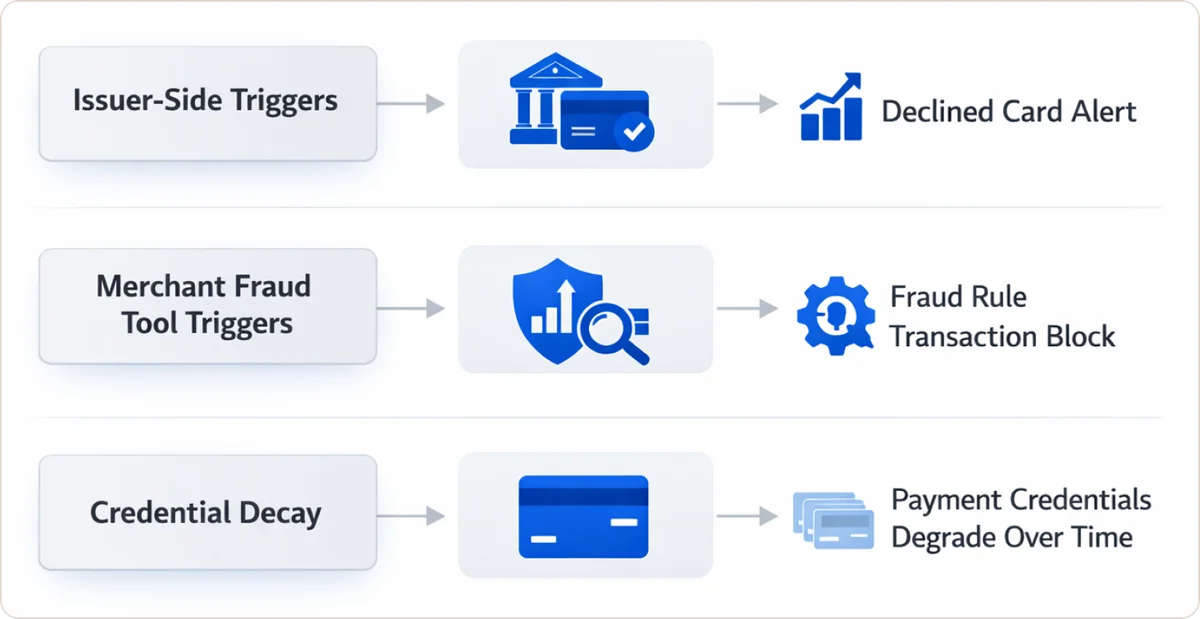
False declines cluster around three distinct sources, each with different root causes and different remedies. Treating them as a single category is where most optimization efforts fail.
Source 1: Issuer-Side Triggers
Issuing banks use velocity checks, geographic anomaly detection, and behavioral models calibrated to the average cardholder, not your specific customer base. A loyal international buyer, a B2B purchaser using a corporate card across multiple geographies, or a high-spend consumer making an unusually large order can all trigger issuer flags that have nothing to do with fraud.
Source 2: Merchant Fraud Tool Triggers
This is the category where you have the most leverage. Your fraud rules and machine learning thresholds are the primary driver of merchant-side false declines. The most common trigger is AVS (Address Verification System) mismatch: a customer enters '123 Main St' against a stored record of '123 Main Street' and your rule fires. The address is correct. The format differs. The order is blocked.
Other frequent triggers include CVV entry errors by legitimate customers, order characteristics that pattern-match fraud profiles such as high value, ship-to-work address, or gift purchase, new accounts with no transaction history hitting conservative auto-decline thresholds, and fraud rules that have not been audited against actual outcomes in 12 or more months. Stale rules are one of the most consistent sources of avoidable false declines in merchant payment stacks.
Source 3: Credential Decay
When stored card data ages, expired cards, updated card numbers, closed and re-issued accounts, recurring transactions and subscriptions generate declines that have nothing to do with fraud risk. This is involuntary churn, and it is a silent revenue drain for any merchant with a subscription or repeat-purchase model. Network tokenization and account updater services exist specifically to solve this. Our guide on card account updater strategies covers implementation in detail.
How Do You Diagnose and Attribute a False Decline?
Most merchant teams manage declines reactively. A customer complains. Support investigates. Occasionally an order is manually approved. More often the customer has already left. A proactive attribution model works from the pipeline outward, not from the complaint inward.
Step 1: Instrument Four Data Points Per Decline
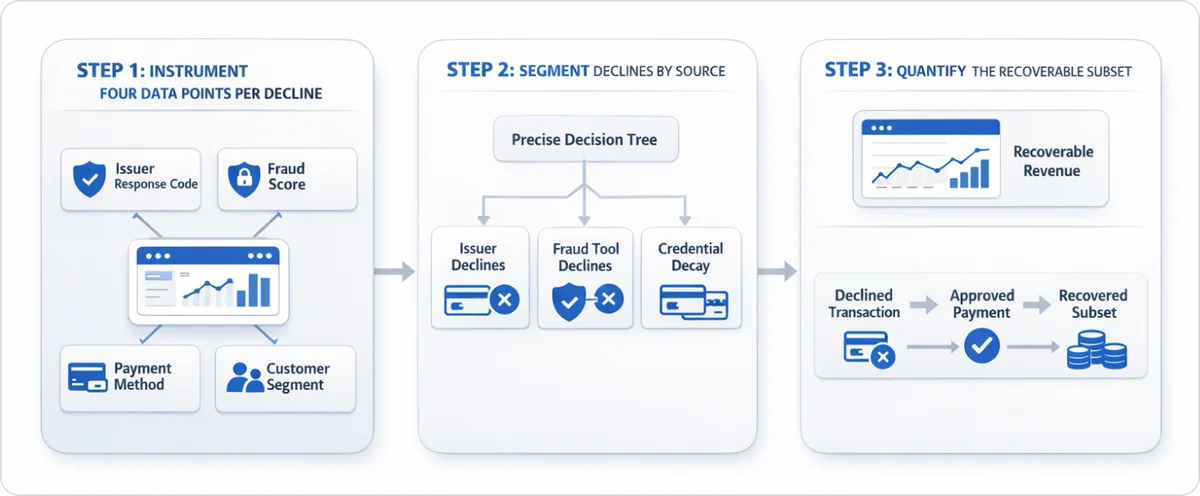
You need, at minimum: the issuer decline code, the fraud tool decision output, the retry outcome if attempted, and whether the customer contacted support. Without all four, you are diagnosing with partial evidence. The issuer code tells you what the bank decided. The fraud tool output tells you whether the decision even reached the bank. The retry outcome tells you whether the decline was soft and recoverable. The support contact rate is a proxy for false decline volume: customers who were genuinely blocked and frustrated enough to reach out.
Step 2: Segment Declines by Source
Sort every decline into one of three buckets: issuer-driven, merchant fraud tool-driven, or technical failure. Issuer declines surface with response codes like 05 (Do Not Honor), 51 (insufficient funds), or 57 (transaction not permitted). Merchant fraud tool blocks appear upstream of the issuer, the authorization request never left your stack. Technical failures correlate with gateway timeouts or processor errors, not issuer responses. These three require fundamentally different fixes, and conflating them produces solutions that do not address the actual source.
Step 3: Quantify the Recoverable Subset
Not all false declines are recoverable. But a meaningful portion, particularly merchant-side fraud blocks and credential decay failures, are recoverable with the right intervention. Calculate the retry win rate for each decline code class over a 90-day window. Transactions that succeed on a second attempt with no data changes are very likely false declines.
Transactions that succeed after credential refresh confirm credential decay as the source. The transactions that fail on every retry with the same code are genuinely unrecoverable in the current period. For a structured approach to this, see our failed payment recovery framework.
How Do You Reduce False Declines Without Increasing Fraud Risk?
The framing of 'reduce friction or prevent fraud' is the wrong model. The actual goal is precision: approving more of what is legitimate while maintaining the same accuracy on what is not. That requires controlled experimentation, not blanket rule relaxation.
Run Controlled Threshold Tests, Not Blanket Changes
Define a test cohort, a specific customer segment, geography, or transaction value band, adjust one threshold, and measure approval rate improvement and fraud rate change side by side over a defined window. If fraud stays flat while approvals increase, expand the change. If fraud ticks up, revert. Never change more than one variable per test window or you cannot attribute the outcome to either change.
Audit AVS Rules Against Actual Fraud Outcomes
A 90-day audit comparing AVS mismatch orders against confirmed fraud outcomes almost always reveals the rule is generating substantially more false declines than fraud catches. In most merchant audits, AVS mismatches account for under 5% of actual fraud but a disproportionate share of blocked legitimate orders. This is the highest-ROI investigation available to most fraud teams.
Build Intelligent Retry Logic
Effective retry logic spaces retries over time based on issuer cooling-off periods, rotates acquiring banks where available, and applies updated credentials before resubmission for any transaction where credential decay is plausible. For subscription merchants, account updater integration eliminates the majority of credential-decay declines before they happen rather than recovering them after. See payment retry strategies for the full implementation guide.
What Do the Research Benchmarks Say, and How Do You Use Them?
Three data sources are authoritative in this space. Knowing what each one measures, and what it does not, is what separates a credible internal business case from a stat dump.
PYMNTS Intelligence (2023 Fraud Management report): $157B U.S. eCommerce sales at risk from false declines, $81B permanently lost. Use for executive framing on payment optimization. It accounts for the gap between attempted payment recovery and actual recovery rates, the money you tried to get back but could not.
Datos Insights via Cybersource (2024 E-Commerce Fraud Landscape and Trends report): Global average false decline rate of 1.51% of e-commerce sales, resulting in nearly US$175 billion lost in 2024 and projected to reach nearly US$265 billion by 2027. Use 1.51% as your target benchmark. If your false decline rate exceeds 1.51%, you have a measurable gap against the industry average.
Merchant Risk Council (MRC) annual payments risk survey: MRC members consistently rank false declines as a top-three payment performance concern alongside chargebacks and authorization rates. The MRC framework separates authorization rate, approvals from the issuer as a share of authorization requests, from approval rate, completed payments as a share of all attempted transactions including merchant-side blocks that never reach the issuer. If your authorization rate is strong but your approval rate is weak, the problem is in your stack, not at the issuer.
Conclusion: False Declines Are a Measurement Problem Before They Are a Technology Problem
Every framework for reducing false declines starts in the same place: you cannot fix what your pipeline does not surface. The merchants who recover the most revenue from false declines are not the ones with the most sophisticated fraud tools. They are the ones who instrument their decline data well enough to know exactly which bucket each declined transaction falls into, issuer, merchant fraud tool, or credential decay, before they attempt to optimize anything.
The three things worth remembering: false declines cost more than the transaction value because they cost you the customer. The industry average false decline rate is 1.51%, and most merchants are above it without knowing it. And every false decline reduction lever, AVS audit, controlled testing, intelligent retry, account updater, has a different owner, a different implementation path, and a different expected lift. None of them work if you are treating declines as a single undifferentiated problem.
Start with instrumentation, not optimization. Once you know which bucket is driving your largest volume of blocked legitimate transactions, the remedies become obvious. Our failed payment recovery service is built specifically to help payment and fraud teams build that instrumentation layer, identify the recoverable subset, and execute the right fix for each source, without loosening controls across the board.
Frequently Asked Questions
What is a false decline in payments?
A false decline is a transaction rejection where the cardholder is legitimate and has sufficient funds, but the payment system, whether the issuing bank or the merchant's fraud tool, incorrectly blocks the payment. False declines are also called false positives. They are distinct from legitimate declines, where the system correctly identifies fraud or an account problem.
How is a false decline different from a soft decline?
A soft decline is a temporary rejection that can be retried, often caused by technical issues, temporary authorization holds, or issuer system states. A false decline is a legitimate transaction incorrectly identified as suspicious. Not all soft declines are false declines. A soft decline can be a correct issuer decision that resolves on retry; a false decline is an incorrect decision regardless of whether it is coded as soft or hard.
What is the average false decline rate for e-commerce?
Datos Insights calculates the average e-commerce false decline rate at 1.51% of total sales as of 2024. Most merchants self-report a rate significantly below this figure. The gap between self-reported and calculated false decline rates is a consistent finding in industry research, meaning most teams are underestimating their actual exposure.
What happens to customers after a false decline?
Research from Javelin Strategy and Research indicates approximately 40% of customers who experience a false decline will not return to that merchant. The downstream impact includes reduced repeat purchase rates, negative reviews, and social sharing of the negative experience. The customer lifetime value cost of a false decline on a high-value segment typically exceeds the original transaction value by a significant multiple.
What does 'do not honor' mean on a payment decline?
Do Not Honor (decline code 05) is a generic issuer response that provides no specific reason for the decline. It is one of the most common and most ambiguous decline codes in e-commerce. Do Not Honor can cover both legitimate fraud blocks and false declines. Transactions declined with code 05 require additional triage, including retry behavior analysis and customer contact rate review, to determine whether they represent false declines.
How do you reduce false declines without increasing fraud?
Reduce false declines through controlled threshold testing rather than blanket rule relaxation. Audit AVS mismatch rates against confirmed fraud outcomes, implement intelligent retry logic with timing and acquirer rotation, and build a manual review queue for high-value edge cases. Measure fraud rate changes in each test cohort before expanding any change. Precision is the goal, not looseness.
What is the difference between authorization rate and approval rate?
Authorization rate is the share of authorization requests sent to the issuer that receive an approved response. Approval rate is the share of all attempted transactions that result in a completed payment, including declines that occur within the merchant's stack before the authorization request reaches the issuer. A high authorization rate with a low approval rate means your fraud tools are blocking legitimate transactions before they reach the bank.