Multi-Acquirer Strategy: Routing, Redundancy and Risk
Learn how a multi-acquirer strategy reduces payment shutdowns, improves authorization rates, and keeps high-risk merchants compliant with Visa VAMP and Mastercard ECP.
What Is an Acquirer in Payments, and Why Does It Matter for High-Risk Merchants?
A payment acquirer, also called an acquiring bank or merchant acquirer, is the financial institution that processes card transactions on a merchant's behalf, connects with card networks like Visa and Mastercard, and settles funds into the merchant's account. The acquirer carries direct financial liability for every transaction it touches. That liability is why it sets underwriting standards, holds reserves, and retains the legal authority to terminate a merchant account without notice. For the market numbers behind that decision, from approval gaps between processors to outage costs, see our payment processing statistics.
For high-risk merchants, that termination authority is not abstract. Acquirers regularly offboard businesses in dispute-prone verticals, including nutraceuticals, subscription services, firearms accessories, adult content, and travel, when chargeback ratios spike or fraud patterns emerge. When it happens on a single acquiring relationship, payment processing stops entirely.
I have seen businesses with strong, consistent revenue lose their entire payment stack inside 48 hours because one acquirer's risk team issued a termination notice. No warning letter. No grace period. No appeal window. The multi-acquirer conversation almost always starts after that moment. It needs to start before it.
Understanding how credit card decline codes signal acquirer-level risk decisions before a termination event gives you an earlier warning than most merchants realize they have.
What Is the Difference Between Multi-Acquirer, Multi-PSP, and Multi-MID?
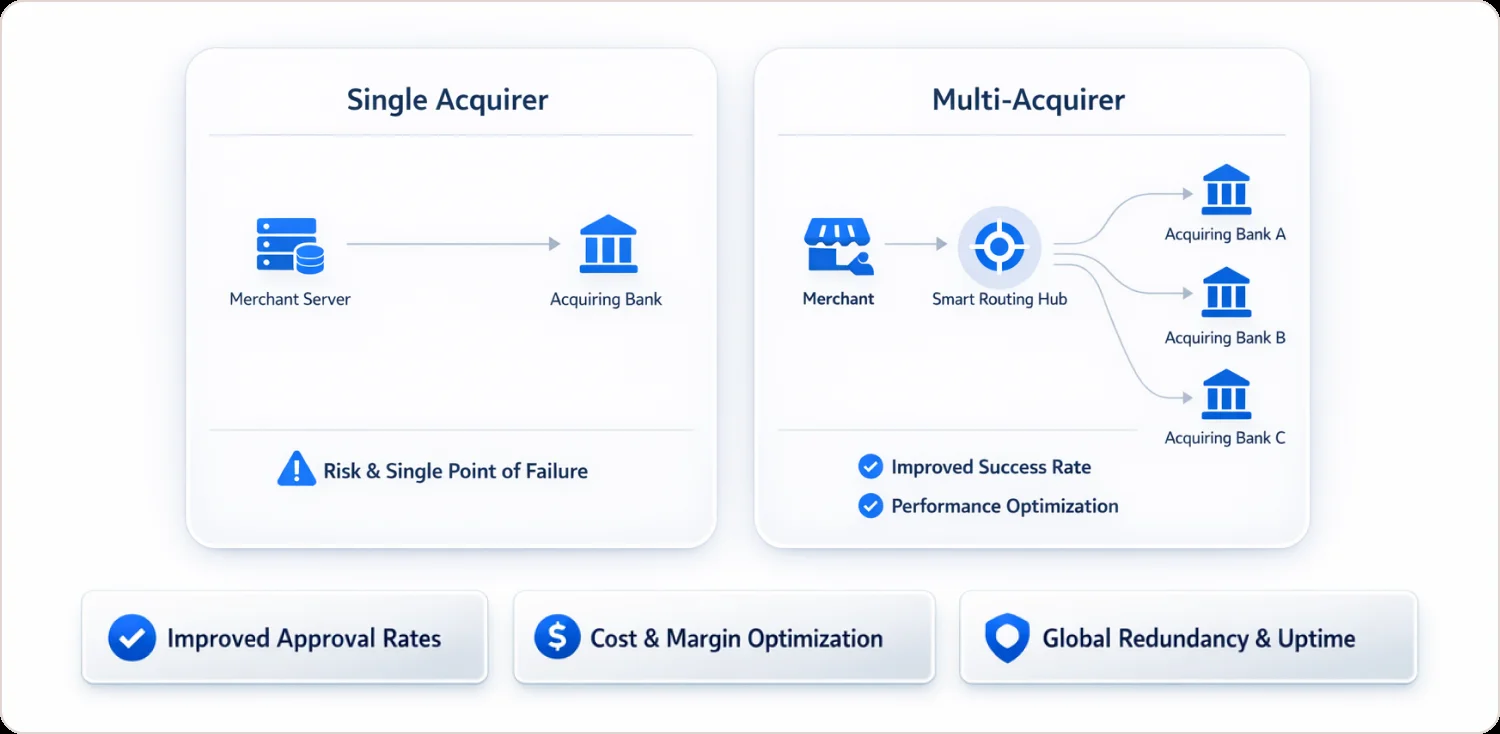
A multi-acquirer setup means two or more independent acquiring banks, each with separate underwriting and settlement. A multi-PSP arrangement may still run through a single underlying acquirer, providing no protection if that acquirer terminates the relationship. A multi-MID setup creates separate merchant IDs but does not remove concentration risk if those IDs sit under the same acquiring institution.
| Term | What It Means | Key Risk Consideration |
|---|---|---|
| Multi-Acquirer | Two or more independently underwritten acquiring bank relationships | Most resilient structure. Requires separate integrations or an orchestration layer |
| Multi-PSP | Multiple payment service providers that may share one underlying acquirer | Less resilient than it appears if PSPs use the same acquiring bank |
| Multi-MID | Multiple merchant IDs under one or more acquirers, segmented by product or geography | Improves routing flexibility but does not eliminate acquirer concentration risk |
| Payment Orchestration | A technology layer managing routing logic across acquirers and PSPs | Orchestration is the management system. Multi-acquirer is the structure it manages |
For high-risk merchants, multi-MID under a single acquiring bank is not a continuity strategy. If that bank exits the relationship, every MID under its umbrella goes with it. Understanding how multiple payment gateways interact with this structure is a useful starting point before committing to an architecture model.
Why Do High-Risk Merchants Adopt a Multi-Acquirer Approach?
High-risk merchants adopt multi-acquirer architecture for five distinct reasons. Authorization rate optimization is not the most important one, and the ordering matters when deciding where to direct your effort first.
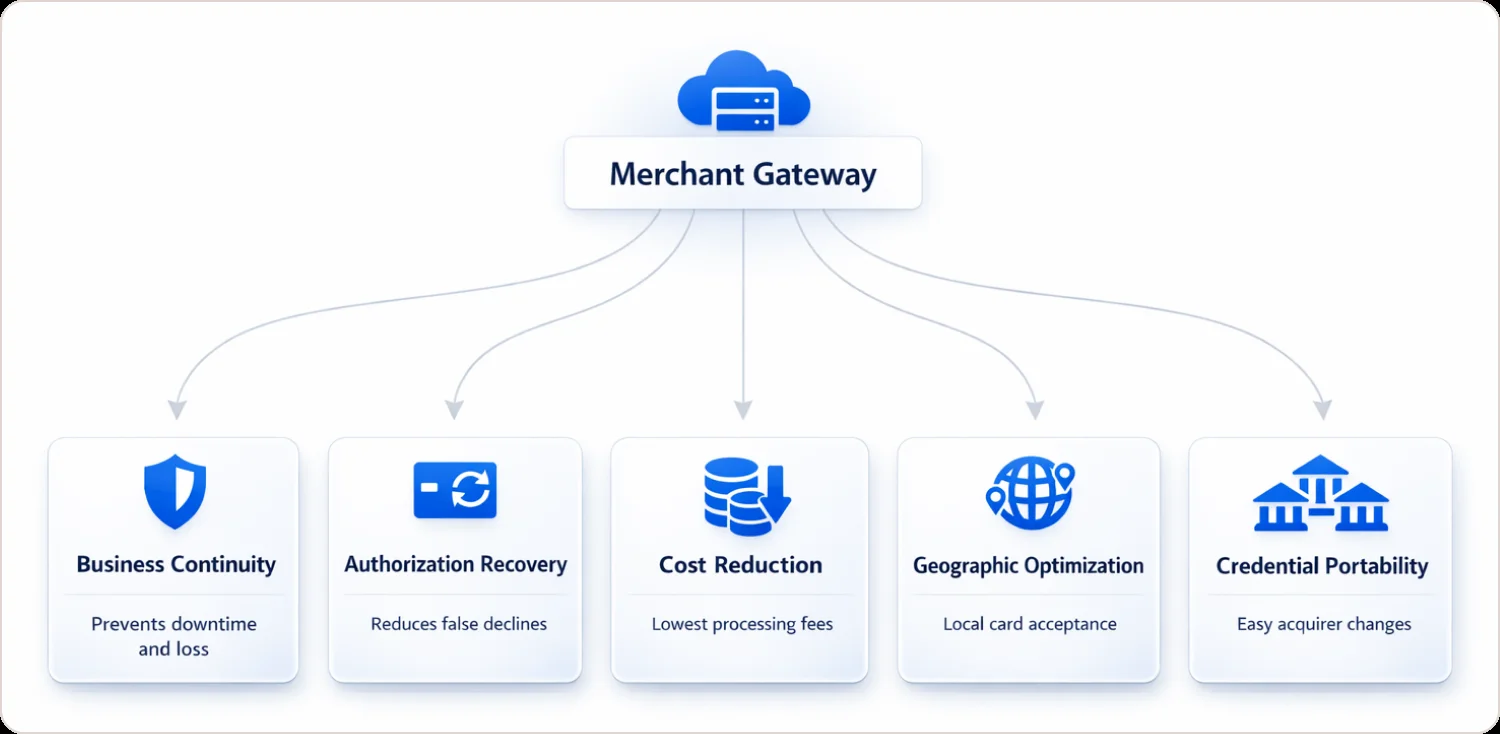
1. Business Continuity When an Acquirer Offboards You
When Wirecard collapsed in 2020, merchants who depended on it as their sole payment acquirer lost all processing capability overnight. The Merchant Advisory Group cited this as a defining illustration of sole-partner dependency at failure. If a single acquiring relationship is the entire payment infrastructure, the business continuity plan is not a plan.
2. Authorization Rate Recovery on False Declines
A 1% improvement in authorization rate sounds marginal. At $10 million in monthly processing volume, it is $100,000 in recovered revenue every month. PaymentsJournal, citing ACI research, found that roughly 40% of merchants who adopted multi-acquirer architecture saw acceptance rate improvements averaging around 1%, with nearly two-thirds reporting cost reductions of at least 2%. Reviewing your approval rate drop analysis before building routing rules identifies the highest-return segments to target first.
3. Negotiating Leverage and Cost Reduction
A merchant with a single acquiring relationship accepts the rate sheet that is given. Two or three relationships introduce competitive dynamics. When acquirers compete for volume share, interchange-plus margins and fee structures become negotiable.
4. Geographic and Local Acquiring Optimization
Cross-border transactions carry higher decline rates and incremental costs because card networks treat them as international. Local acquiring payments, routing a transaction through an acquiring bank domiciled in the same country as the cardholder, improve authorization rates and reduce scheme fees by treating the transaction as domestic. For merchants with meaningful cross-border volume, this is often where multi-acquirer economics are most immediately measurable.
5. Credential Portability and Subscription Protection
If stored card tokens live exclusively in one acquirer's vault, moving to another bank requires re-credentialing the entire active customer base. For a subscription business with 50,000 stored cards, a forced migration typically causes a 15% to 25% drop in recurring revenue during the transition window.
What Are Visa VAMP and Mastercard ECP, and What Do They Mean for Multi-Acquirer Decisions?
Visa VAMP and Mastercard ECP are the two primary card network monitoring programs that determine whether a high-risk merchant faces fines, remediation mandates, or processing restrictions. Understanding how each ratio is calculated is more operationally useful than knowing the program names alone.
Visa VAMP took effect April 1, 2025, consolidating the previously separate Visa Dispute Monitoring Program and Visa Fraud Monitoring Program into a single ratio-based system. According to PayPal/Braintree's published VAMP documentation, the VAMP ratio is calculated by adding total disputes and enumeration events (carding attempts flagged by Visa) and dividing by total transactions over a rolling period.
A merchant with 10,000 transactions, 75 disputes, and 35 enumeration events has a VAMP ratio of 1.1%. Exceeding defined thresholds triggers a notification period, followed by escalating fines if the ratio is not remediated. The Visa Acquirer Monitoring Program breakdown goes deeper into how these thresholds apply at the merchant level.
Mastercard ECP operates on two tiers. According to Braintree's published ECP documentation, the Excessive Chargeback Merchant (ECM) tier activates when the chargeback-to-transaction ratio exceeds 1.5% in a calendar month, and the High Excessive Chargeback Merchant (HECM) tier activates above 3.0%. Monthly fines escalate the longer a merchant remains in program status.
| Program | Network | How the Ratio Is Calculated | Entry Threshold | Consequence |
|---|---|---|---|---|
| VAMP | Visa | (Disputes + Enumeration Events) / Total Transactions | Typically above 0.9% for standard merchant segments | Notifications, escalating fines, potential processing restrictions |
| ECM | Mastercard | Chargebacks / Total Transactions (calendar month) | Above 1.5% | Monthly fines, mandatory remediation plan |
| HECM | Mastercard | Chargebacks / Total Transactions (calendar month) | Above 3.0% | Escalating fines, potential network-level termination |
What most guides on this topic miss: splitting volume across three acquirers does not reduce the underlying dispute rate. If chargebacks run at 2% and volume splits across three acquirers, the result is three separate monitoring program exposures, each running at 2%. Multi-acquirer routing is not a compliance escape mechanism.
Where it legitimately helps is segmentation. Routing product lines with different risk profiles to separate MIDs prevents a high-chargeback product from contaminating the ratio metrics of lower-risk lines. Deploying chargeback alerts across each MID independently gives the earliest possible signal before a ratio breaches the threshold.
What Are the Three Multi-Acquirer Architecture Models?
Three implementation approaches exist. The right one depends on engineering capacity, transaction volume, and the level of routing control needed day-to-day.
| Architecture | How It Works | Best Fit | Real Tradeoff |
|---|---|---|---|
| Full-Stack Orchestration Platform | Single integration to a platform managing multiple acquiring relationships | Merchants needing speed with minimal internal engineering | Dependency on the platform's processor network. Switching platforms later is operationally painful |
| API-First Orchestration Layer | Custom integration to an orchestration engine with direct bank connections managed in-house | High-volume merchants needing full routing governance | Requires dedicated payments engineering and ongoing rule maintenance |
| Routing Layer Over Existing Contracts | Routing logic added above acquiring connections already in place | Merchants who already hold two or more independent relationships | Fastest path to optimization, but only viable if the second relationship already exists |
The most common mistake: purchasing an orchestration platform before securing a second acquiring relationship. A platform has nothing to route to if only one institution has underwritten the business. The relationship comes first.
How Should High-Risk Merchants Implement Multi-Acquirer in Five Phases?
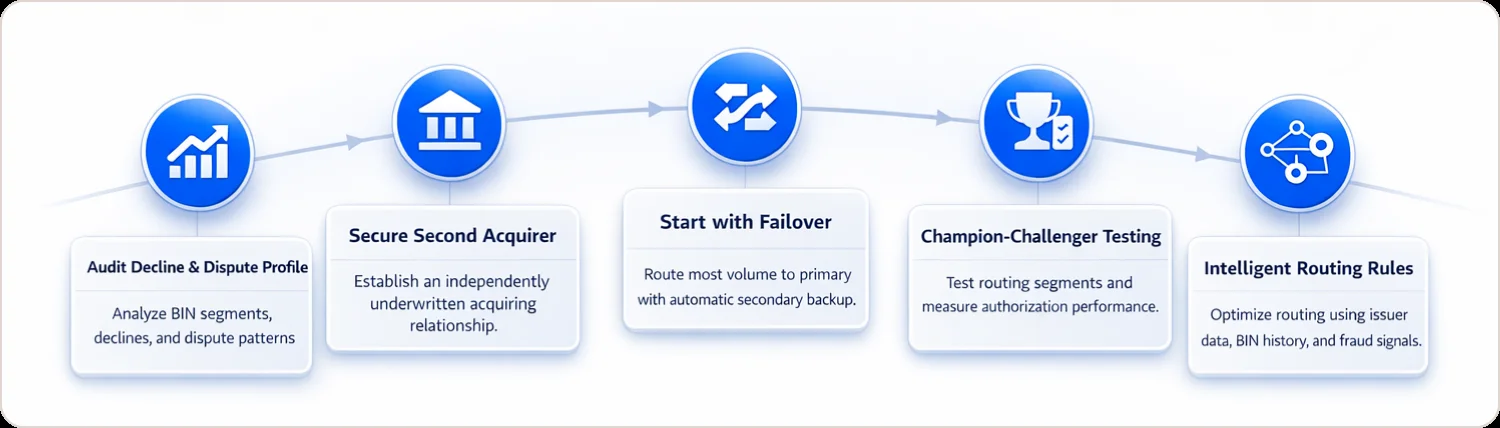
Phase 1: Audit Your Decline and Dispute Profile
Before approaching a second acquirer, understand what is happening with current transactions. Which BIN ranges carry the highest decline rates? Which product lines generate the most disputes? Reviewing BIN data at the segment level shapes every routing decision that follows and makes the underwriting application substantially more credible.
Phase 2: Secure a Second, Independently Underwritten Acquiring Relationship
This means a separate legal entity acquirer, not a sub-MID under an existing bank. Acquirers share information through MATCH (Member Alert to Control High-Risk Merchants) and informal network relationships. Misrepresenting a business model or chargeback history in underwriting is the fastest path to permanent blacklisting across multiple institutions. Underwriting typically takes four to eight weeks. Begin before the relationship is needed.
Phase 3: Start with Failover, Not Optimization
Route 90% to 95% of volume to the primary acquirer and configure automatic failover to the secondary when the primary declines or goes offline. Pairing this with tested payment retry strategies at the gateway layer captures recoverable transactions before failover triggers.
Phase 4: Run Champion-Challenger Testing
Once both acquirers have at least 60 days of transaction history, route defined segments, a single region, a card type, or one product line to the challenger. Measure authorization rates, decline reason codes, and dispute rates per segment independently. This is the safest way to expand routing without creating sudden drops that attract monitoring program scrutiny.
Phase 5: Build Intelligent Routing Rules
Layer in routing logic driven by issuer performance data, BIN history, transaction value thresholds, and fraud scores. In practice: if issuer X declines transactions above $250 at 28% on the primary acquirer but only 11% on the secondary, the routing rule sends those transactions to the secondary by default. Adding 3D Secure authentication as a routing signal at this stage improves fraud scoring accuracy across both relationships.
What KPIs Should You Track Across Multiple Acquirers?
Without unified reporting, performance differences that justify routing decisions are invisible, and compliance signals go undetected until a threshold is already breached.
| KPI | Why It Matters | Target Benchmark |
|---|---|---|
| Authorization rate by acquirer | Shows which partner performs better for specific BINs, issuers, or geographies | A 1% lift at $10M monthly volume equals $100K recovered monthly |
| Chargeback ratio by MID | Tracks compliance exposure per relationship in isolation | Hold below 0.65% for buffer from Mastercard ECM entry at 1.5% |
| VAMP ratio by MID | Monitors combined dispute and enumeration exposure | Target below 0.9%: (Disputes + Enumeration Events) / Total Transactions |
| Retry and reroute recovery rate | Revenue recovered by rerouting declined transactions | Track separately from initial authorization rate |
| Uptime and latency per acquirer | Operational health of each connection | Latency degradation precedes outages; set infrastructure alerts |
| Cost per transaction by acquirer | Total acceptance cost including interchange and scheme fees | A 2% reduction is achievable, per ACI research |
Tracking MID health and approval rates at the individual merchant ID level, rather than aggregated across the full account, is what makes the compliance segmentation benefit visible and measurable.
Conclusion: Build the Architecture Before You Need It
High-risk merchants face a combination of pressures that makes single acquiring bank dependency genuinely dangerous: strict underwriting standards, network monitoring programs with escalating financial penalties, and relationships that can terminate without warning or appeal.
A multi-acquirer approach addresses that structural vulnerability, but the order of operations matters. Two independently underwritten acquiring relationships with failover configuration and segment-level KPI monitoring will outperform the most sophisticated single-acquirer setup the moment that the acquirer decides to exit the relationship. Intelligent routing, local acquiring payments optimization, and credential portability are performance layers built on top of that foundation, not substitutes for it.
The merchants who get this wrong treat multi-acquirer architecture as a compliance workaround. It is not. The merchants who get it right treat it as the infrastructure that keeps the business operational while they solve the actual problems underneath.
FAQ
What is the difference between a payment acquirer and a payment gateway acquirer?
A payment acquirer is the bank that underwrites and settles card transactions. A payment gateway acquirer combines data transmission and settlement under one entity. In a multi-acquirer setup, a single gateway typically connects to multiple separate acquiring banks.
Does a multi-acquirer strategy reduce chargebacks?
No. Chargebacks are driven by disputes, fraud, and fulfillment issues, not routing architecture. Multi-acquirer segmentation can protect clean MIDs from contamination, but the dispute rate must be addressed directly. Stopping disputes before they become chargebacks is the intervention that moves the metric.
How many acquirers does a high-risk merchant actually need?
Two is the minimum for resilience and basic routing. Three enables more granular segmentation but adds governance complexity that requires dedicated resources.
What is local acquiring in payments?
Local acquiring payments means processing through an acquiring bank in the same country as the cardholder. It improves authorization rates and reduces scheme fees by treating the transaction as domestic.
How long does it take to get approved by a second acquirer?
Four to eight weeks for most high-risk verticals. Acquirers review chargeback history, website compliance, and business model before underwriting. Start the process early.
What happens to stored card tokens if the primary acquirer terminates a merchant?
Tokens issued by a single acquiring bank are non-portable and become unusable on termination. A card account updater service reduces revenue loss by refreshing credentials before rebill failures compound.
What is the VAMP ratio?
The VAMP ratio equals (Disputes + Enumeration Events) / Total Transactions, effective April 1, 2025. Exceeding Visa's threshold triggers notifications, fines, and potential processing restrictions.
What is the Mastercard Excessive Chargeback Program?
The Mastercard ECP monitors chargeback ratios monthly. The ECM tier begins at 1.5%, the HECM tier at 3.0%. Fines escalate each month a merchant stays in violation.
How do you decide which acquirer should get a transaction?
Route on evidence, not intuition. Compare approval rate, decline reasons and chargeback rate per acquirer on the same traffic. Then send each segment to the acquirer that performs best on it. Beast Insights breaks recovery, declines and disputes down by decline code, issuer, BIN, gateway/MID, acquirer and card brand. A BIN is the bank identification number, the first digits of a card that name the issuing bank. A MID is the merchant ID, the account number your acquirer assigns you. Routing rules then follow the actual leak.
Does a multi-acquirer strategy reduce chargebacks?
Splitting volume alone does not lower chargebacks. It spreads exposure across card brand monitoring programs. It leaves the underlying dispute rate where it was. Chargebacks fall when you fix the cause. The causes are descriptor clarity, refund policy, retry behavior and prevention alerts. Track chargeback rate per acquirer and per MID, the merchant ID on each account. Remediation then targets the account that is actually drifting.