Chargeback Alerts in 2026: Cost, Coverage, and Whether Yours Are Working
Complete guide to chargeback alerts: Verifi CDRN, Ethoca, and Visa RDR comparison. Learn how to prevent disputes before VAMP's April 2026 deadline hits your merchant account.
Your payment processor just flagged your account. You have 60 days to drop your chargeback ratio below 0.9%, or they terminate your merchant services. Every dispute now feels like a countdown timer.
If that is where you are, the order of operations matters more than the effort you spend. Prevention alerts are the fastest lever available, because they act in the window before a dispute becomes a chargeback that counts against your ratio. This guide covers how the alert networks actually work, what they cost, and how to tell whether the alerts you already pay for are working.
Quick Answer
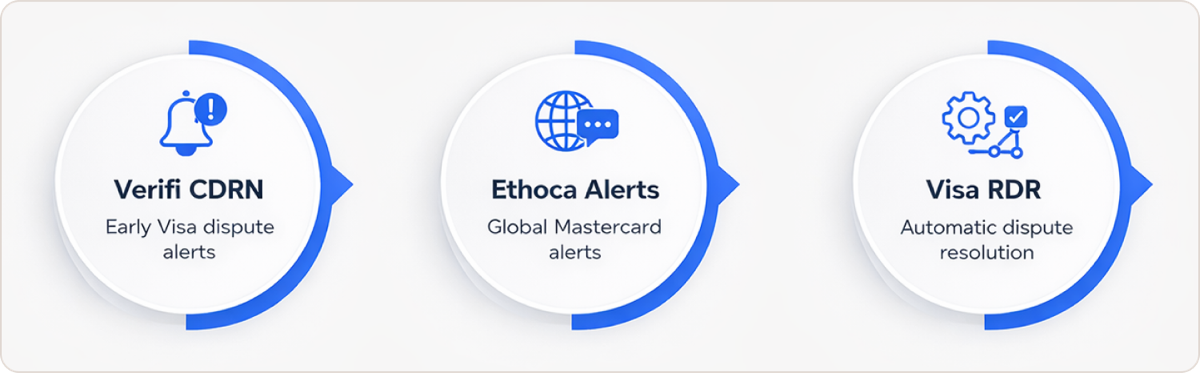
Chargeback alerts notify merchants within 24-72 hours when cardholders initiate disputes, enabling refunds that prevent formal chargebacks. Verifi CDRN covers Visa disputes, Ethoca Alerts handle Mastercard globally, and Visa RDR automates resolution through preset rules for qualifying Visa transactions only.
Why Are Chargeback Alerts Critical for U.S. Merchants in 2026?
According to Visa's official Acquirer Monitoring Program documentation, the Excessive chargeback threshold drops from 1.5% to 0.9% effective April 1, 2026, requiring most merchants to implement proactive prevention strategies.
Traditional chargeback timelines offer zero prevention opportunity. A customer disputes on February 1st, their bank investigates for weeks, and you receive notification on February 28th. By then, the transaction already counts against your VAMP ratio.
Chargeback alerts compress this timeline from weeks to hours. When cardholders contact their bank to dispute transactions, participating banks send immediate notifications through Verifi or Ethoca networks. You receive transaction details within minutes and have 24-72 hours to refund and prevent the formal chargeback entirely.
Gartner's "Emerging Tech: The Future of Online Fraud Prevention" aligns thematically, emphasizing unified platforms over point solutions. It predicts buyers will demand orchestration of multiple tools into unified decision engines by 2027, and over 50% of vendors will offer consolidated stacks by 2029.
How Do Mastercard's Monitoring Programs Fit Alongside VAMP?
Visa's VAMP thresholds get the attention. VAMP is the Visa Acquirer Monitoring Program, the scheme that tracks your fraud and dispute counts. Mastercard runs separate merchant monitoring for scam and dispute activity. So part of your dispute exposure sits outside the VAMP math. Ethoca alerts cover the Mastercard side. Ethoca is Mastercard's alert network, which flags a dispute before it turns into a chargeback. Beast Insights breaks disputes down by card brand, issuer, BIN and MID. BIN means the first card digits that identify the issuing bank. MID means your merchant ID at the processor. That breakdown shows which brand is pushing your ratio up.
- Track your dispute ratio per card brand, not blended, because each network counts and reviews you separately.
- Match tools to brand mix: Ethoca for Mastercard volume, CDRN and RDR for Visa volume.
- Split alert outcomes by gateway or MID and acquirer so one weak MID does not drag the whole portfolio.
- Review issuer and BIN concentration monthly: a handful of issuers usually drives most alert volume.
Alerts are one layer. Pair them with a clean billing descriptor, order insight data and fast refunds. Those three together stop disputes before they become chargebacks on both networks. Then review your alert-to-chargeback ratio by MID each month. That monthly review shows where the layer is leaking.
How Do Verifi CDRN, Ethoca Alerts, and Visa RDR Actually Work?
Understanding the mechanics of each chargeback prevention tool determines whether you're protecting 50% or 95% of your transaction volume.
What Is Verifi CDRN (Cardholder Dispute Resolution Network)?
Verifi's CDRN operates as Visa's alert network, primarily covering Visa disputes, though it catches some Mastercard transactions depending on issuer participation. When a cardholder from a participating bank initiates a dispute, CDRN sends you transaction details within hours.
You receive approximately 72 hours to review and respond. If you refund within this window, the dispute stops and never becomes a formal chargeback on your record.
CDRN strengths: Strong U.S. issuer coverage, 72-hour response window (longer than competitors), integration with Visa's ecosystem, including Order Insight and RDR, and resolved disputes excluded from VAMP ratio.
CDRN limitations: Historically U.S.-focused with international coverage gaps, requires manual review unless automated through platforms, can overlap with Ethoca on 15-20% of Visa disputes, costs $30-40 per alert.
What are Ethoca Alerts?
Ethoca (acquired by Mastercard in 2019) operates a global alert network with strong Mastercard coverage plus participation from some Visa, American Express, and Discover issuers.
When cardholders contact banks to dispute charges, participating issuers send Ethoca Alerts to enrolled merchants within hours, typically with a 24-48 hour response window.
Ethoca claims network coverage of approximately 95% of Mastercard transactions globally, making it particularly valuable for international customer bases or heavy Mastercard volume.
Ethoca strengths: Excellent global issuer coverage, especially outside the U.S., near real-time alerts, fraud intelligence data included, and prevented chargebacks excluded from VAMP.
Ethoca limitations: Shorter 24-48 hour window requires faster response, Mastercard-focused coverage means Visa gaps exist, same $30-40 per-alert costs, requires 24/7 monitoring capability.
Mastercard's Ethoca platform documentation reports network coverage exceeding 95% of global Mastercard transactions, with participating issuers spanning over 90 countries.
What Is Visa Rapid Dispute Resolution (RDR)?
Visa Rapid Dispute Resolution represents a completely different prevention model. Instead of alerting you to decide, Visa RDR makes decisions automatically based on rules you configure upfront.
You define resolution criteria like "auto-refund any Visa dispute under $40" or "auto-refund all subscription canceled reason codes." When issuers submit qualifying disputes into Visa's platform, RDR evaluates against your rules in real-time. Matches trigger immediate refunds through Visa's messaging system. The dispute resolves in seconds without manual intervention.
RDR strengths: Complete automation eliminates operational burden, resolves disputes excluded from VAMP calculations, prevents both chargeback fees and ratio impacts, has highly customizable rules, and instantaneous processing.
RDR limitations: Visa network only, requires issuer participation (not all Visa banks adopted RDR yet), careful rule configuration needed to avoid refunding winnable disputes, only works on full transaction disputes, setup required through processor or Verifi.
Is It Better to Use a Chargeback Alert Reseller or Go Direct to Verifi?
Verifi runs a formal tiered partner channel: Authorized Reseller, Acquirer Reseller, Referral and Enablement. Verifi designed that channel itself. Buying through an intermediary is its own distribution model, not a workaround. You can contract with Verifi directly. Most merchants take the common path and buy from a partner that already holds the Visa relationship. The alert payload is identical on either route. Partners differ in service layer, not in data.
- Go direct if you process millions in volume and do not need the added services. The hidden cost is operational: you own transaction matching and refund logic in-house.
- Go through a partner for one enrollment covering RDR, CDRN and Order Insight instead of three integrations, and for a single portal across both networks.
- Coverage forces the issue: Verifi alone does not cover Mastercard, and RDR is Visa-only, so a direct Visa deal leaves a structural gap.
- Price the route, not just the product: every intermediary layer can add its own markup, and there is no public Verifi rate card to benchmark against.
- Ask four questions before signing: is the counterparty Verifi or a reseller, what triggers a billable event, what is the full fee and contract structure, and what is the markup.
On either route, judge the outcome per MID, the merchant ID that identifies each account to the card networks, not in aggregate. Beast Insights is a Visa Verifi reseller. It covers RDR, CDRN (Cardholder Dispute Resolution Network), Ethoca and representment, the work of fighting a chargeback with evidence. Its MID Performance view shows approval rate and chargeback percentage per MID. That puts MID health and approval rates next to your alert spend.
Which Chargeback Prevention Tools Do You Actually Need?
After implementing these systems across our subscription business and consulting with other merchants, I've developed a decision framework based on business profile. Shopify merchants who would rather run these alerts through a single app often start with a Shopify-native tool, so it helps to review the best Verdivo alternatives on price and measured effectiveness first.
| Business Profile | Recommended Alert Strategy | Expected Prevention Rate |
|---|---|---|
| Under $100K monthly, low risk | CDRN or Ethoca (choose based on card mix) | 35-45% |
| $100K-$500K monthly, moderate risk | CDRN + Ethoca (comprehensive coverage) | 50-65% |
| Over $500K monthly, any risk | CDRN + Ethoca + RDR (full automation) | 65-75% |
| Card-not-present subscription businesses (any volume) | All three tools mandatory | 70-80% |
When Should You Implement All Three Tools?
You need comprehensive coverage (Ethoca + CDRN + Visa RDR) if you process both Visa and Mastercard with chargeback ratios above 0.8%, operate in card-not-present industries like digital services or subscriptions, face processor warnings about VAMP compliance, or handle international transactions requiring global issuer coverage.
Our subscription box company implemented all three tools when we hit 1.62% ratio. We configured RDR to auto-refund Visa disputes under $35 (handling 40% of our alert volume automatically). CDRN and Ethoca caught remaining disputes, giving us manual review opportunities for higher-value orders where we had delivery confirmation.
Within 90 days, our dispute ratio dropped to 0.41%, saving approximately $28,000 monthly in combined chargeback fees and lost revenue.
Am I Paying for Chargeback Alerts That Do Nothing?
Yes, some of that spend is wasted. You pay per alert received, whatever the outcome. You can decline the refund and still owe the fee. A generic or newly changed billing descriptor quietly cuts your alert volume to nothing. A partial refund ends a Visa transaction's eligibility for RDR (Rapid Dispute Resolution, Visa's auto-refund rule) in most cases. Alerts also never touch friendly fraud, where a real customer disputes a purchase they made. Providers differ on whether they ever report that back to you, which is the axis the roundup of Chargeback Gurus alternatives compares them on.
- Dead spend: alerts you ignore, alerts that fail to match an order, and duplicate Ethoca plus Verifi alerts on the same Visa dispute where resolving one does not refund the other.
- Ratio spend that buys nothing: since 1 April 2025, TC40 fraud resolved through RDR still counts toward VAMP, so fraud-coded alerts buy chargeback avoidance, not ratio relief.
- Coverage holes: if the issuing bank is not in the Ethoca or Verifi network, no alert fires and the dispute goes straight to chargeback.
- Wrong tool: alerts cannot help disputes that already got through, so you still need chargeback representment capability alongside them.
- Flat or rising alert volume quarter over quarter means the alerts work but the root cause is untouched.
What Results Can You Expect From Chargeback Alerts?
Our implementation delivered measurable results within 90 days of full deployment across all three chargeback prevention tools.
90-Day Implementation Results:
| Metric | Baseline (Pre-Alerts) | After 90 Days | Improvement |
|---|---|---|---|
| Monthly Disputes Initiated | 63 | 61 | Stable |
| Alerts Received & Refunded | 0 | 42 | 69% prevention |
| Disputes Becoming Chargebacks | 63 | 19 | 70% reduction |
| Chargeback Ratio | 1.62% | 0.46% | 72% improvement |
| VAMP Ratio | 2.08% | 0.52% | 75% improvement |
| Monthly Chargeback Fees | $2,520 | $760 | $1,760 saved |
| Customer Service Hours on Disputes | 22 hours | 7 hours | 15 hours saved |
| Total Monthly Costs | $19,845 | $2,440 | $17,405 saved |
| ROI on Alert Investment | N/A | 935% | After 3 months |
The 69% prevention rate exceeded industry averages of 40-50% because we combined all three chargeback prevention tools plus improved root causes (clearer billing descriptors, better cancellation flow).
How Do I Know If My Chargeback Alerts Are Actually Working?
Alerts received is not chargebacks prevented. An Ethoca alert stops a chargeback only when you refund inside the 24-hour window. You also have to report the outcome back to the card issuer. So measure three things: time to action, outcome submission rate, and unactioned alerts. Every unactioned alert turns into a chargeback. Then check whether your chargeback ratio actually moved.
- Time-to-action: hours from alert receipt to refund. Ethoca wants 24 hours, CDRN allows 72.
- Outcome-submission rate: percentage of actioned alerts reported back via portal or API.
- Unactioned alerts: ignore one and the chargeback proceeds, every time.
- Match-failure rate: tokenized wallet payments can break the transaction match, so track this separately from response time.
- Fee clawbacks: reconcile refunded-alert transactions against later chargebacks; Ethoca waives the alert fee where the credit landed in time.
- Cohort read: dispute rate by charge date, not dispute activity by dispute date, since the same week can read 1% or 0.3% depending on which you use.
How Do You Set Up Chargeback Alerts Quickly?
Implementation follows a three-phase approach: enrollment, configuration, and optimization.
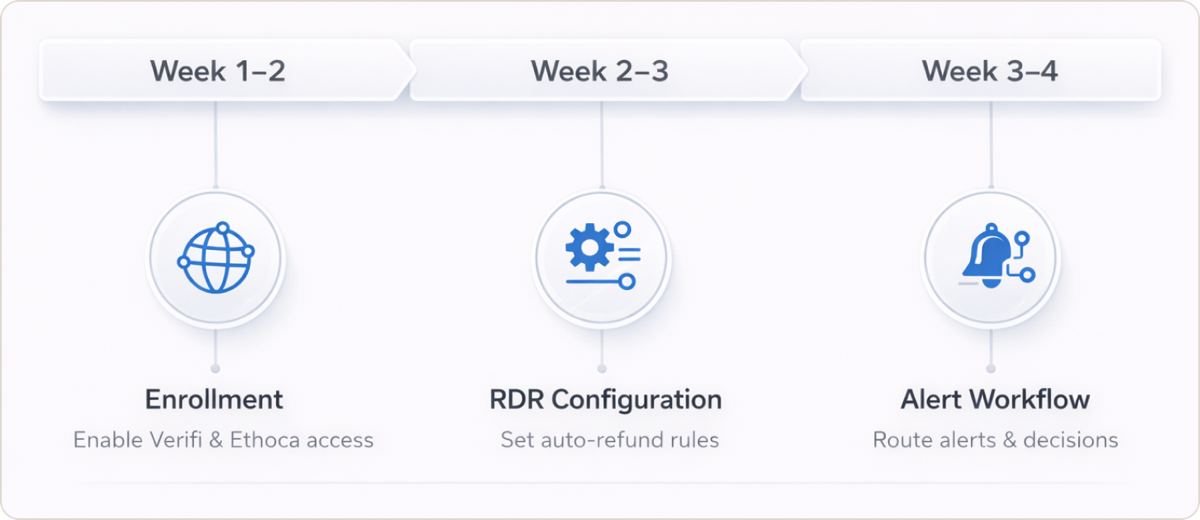
Week 1-2: Enrollment and Network Access
Start by contacting your payment processor about native alert access. Stripe, Shopify Payments, and Adyen all offer built-in integrations with Verifi and Ethoca that simplify enrollment significantly. Activation typically takes 2-5 business days with minimal technical work.
The 2024 Forrester Wave™: Enterprise Fraud Management Solutions report (Q2 2024) identifies purpose-built chargeback management and flexible authentication policies as critical components, with top-performing merchants showing 65-75% dispute prevention rates when combining alert networks with automation. Shopify-native apps such as Verdivo bundle Verifi RDR and Ethoca alerts with automated dispute handling in a single app; see Beast Insights vs Verdivo.
For direct enrollment with Verifi or Ethoca, you'll need merchant IDs, acquirer information, technical contacts for API integration, and, for CDRN specifically, an addendum to the seller agreement.
Most mid-market merchants work with aggregator platforms (Chargeblast, Disputifier, ChargebackHelp, Chargeback.io) that provide unified access to both Verifi and Ethoca through a single dashboard. Verify whether platforms automatically detect and refund duplicate alerts, resulting in a 10-20% reduction in alert costs. Guarantee-model fraud platforms sit in a different category and do not resell these alerts, a distinction worth understanding before you assume one vendor covers both, as Beast Insights vs Signifyd sets out. If you are weighing Chargeblast against vendors that also measure which alerts actually prevented a chargeback, our roundup of the best Chargeblast alternatives compares them on pricing and effectiveness.
Week 2-3: RDR Rule Configuration
Pull six months of dispute data and identify segments where you refund 80%+ currently. These become your initial Visa RDR auto-refund rules.
Our initial RDR ruleset: Auto-refund any Visa dispute under $35 with "subscription canceled" reason code, auto-refund any dispute under $25 regardless of reason, auto-refund "duplicate processing" disputes under $100, exclude customers with 3+ successful prior orders (manually review for potential friendly fraud).
Week 3-4: Alert Response Workflow
Configure notification routing. We implemented tiered notifications: CDRN alerts route to a dedicated Slack channel, Ethoca alerts (shorter deadline) trigger Slack and email, alerts over $150 send SMS to fraud manager, and Visa RDR resolutions generate weekly email summary reports.
Create decision workflows: For alerts under $50, if order hasn't shipped, refund immediately and cancel shipment; if shipped, check delivery status. For alerts over $50, escalate to fraud manager for review within 48 hours.
How Much Do Chargeback Alerts Cost Per Alert?
Resellers charge roughly $15 to $40 per alert. Most prices land in the $20 to $40 band. Chargeback.io publishes $29 per Ethoca alert. It publishes $15 each for Visa RDR and CDRN. Chargeflow charges $29 per deflected chargeback. It offers volume terms above 50 alerts monthly. List prices commonly stop at $40.
- Headline rates are not standing rates: one provider advertises $15.00 introductory while its FAQ states $25 for the same Ethoca and Verifi notifications.
- The fee understates true cost. An alert resolves by refunding the order in full, so a deflection costs the fee plus the order value.
- On low-ticket subscription orders, fee plus refunded principal can exceed the chargeback fee you avoided.
- Benchmark against Stripe: a $15 dispute-received fee, plus a separate countering fee since 17 June 2025 that is returned only if you win.
- Practical model: take last quarter's median disputed order value and add the per-alert fee. That sum is the real cost of one prevented dispute.
- Because per-alert prices sit close together across networks, cost rarely decides between RDR, CDRN and Ethoca.
Your Next Steps Before April 2026
Merchants have less than four months before the stricter 1.5% threshold takes effect on April 1, 2026. Every month you delay is another month of chargebacks counting against your ratio without protection.
While chargeback alerts reduce existing disputes by 65-75%, combining them with liability shift protections through 3D Secure authentication prevents disputes from initiating in the first place, particularly effective for card-not-present fraud claims.
Calculate your current VAMP ratio using the formula (TC40 + TC15) divided by total transactions. If you're above 0.8%, you need chargeback alerts immediately. Between 0.5% and 0.8%, you need a prevention strategy before crossing into dangerous territory.
Contact your payment processor first to determine if you have native alert access. If your processor offers built-in integrations, activate those immediately. If not, evaluate aggregator platforms based on pricing, duplicate detection capability, and automation features. Because several of those portals quote rather than publish a rate, our roundup of the best ChargebackHelp alternatives lines the main aggregators up on pricing transparency and on whether they report which alerts actually prevented a chargeback.
Configure Visa RDR rules conservatively if implementing automation. Start with disputes under $25-30 and specific reason codes you'd refund anyway, then adjust monthly based on results.
FAQ: Common Questions About Chargeback Alerts
What is the difference between chargeback alerts and RDR?
Chargeback alerts (CDRN and Ethoca) notify you when disputes initiate, giving you 24-72 hours to decide whether to refund manually. Visa Rapid Dispute Resolution is an automated system that refunds qualifying Visa disputes instantly based on preset rules with no manual review required.
Do chargeback alerts prevent friendly fraud?
Chargeback alerts don't prevent friendly fraud but help you avoid fees and ratio impacts. To identify and combat friendly fraud patterns in your transaction data, merchants need complementary strategies including 3D Secure authentication and improved billing descriptors.
How quickly must I respond to chargeback alerts?
CDRN alerts require response within approximately 72 hours. Ethoca alerts typically allow 24-48 hours depending on issuing bank. Missing response deadlines means the alert was wasted expense with no prevention benefit as the dispute proceeds to formal chargeback anyway.
Are RDR refunds excluded from VAMP calculations?
Yes. TC15 disputes resolved through Visa RDR and CDRN are excluded from VAMP calculations, including resolutions handled via Verifi and Ethoca. However, the resolution and original dispute must fall within the same month for disputes to be excluded from your VAMP ratio.
Can I use chargeback alerts if I'm on Stripe or Shopify?
Yes. Both Stripe and Shopify offer native integrations with chargeback alert networks. Stripe provides access to RDR and Order Insight through their Radar fraud prevention platform. Shopify includes Shopify Protect, which leverages Ethoca and Verifi networks.
How much do chargeback alerts cost?
Alert costs range from $30-40 per alert through most providers, though volume discounts often apply for merchants receiving 100+ monthly alerts. Visa RDR resolution fees typically run $20-30 per dispute resolved. Despite these costs, chargeback alerts remain cost-effective because average chargebacks cost $315, including fees, lost merchandise, administrative time, and VAMP ratio impacts.
Do chargeback alerts work for subscription and recurring billing?
In most cases, yes. The alert lands on the disputed transaction. Recurring merchants can cancel the plan, refund the charge and stop the next rebill inside the response window. Beast Insights breaks disputes down by billing cycle, issuer and MID, the merchant ID at your processor. That view shows which renewal number produces most of your alert volume.
How do you tell whether chargeback alerts are actually reducing your ratio?
Compare alerts you refunded against disputes that still posted, month over month. Read the ratio by card brand rather than blended. Beast Insights splits chargebacks, refunds and alerts by decline code, issuer, BIN, gateway or MID and acquirer. That split shows whether one processor or one issuer is carrying the problem.
Do chargeback alerts lower my VAMP ratio?
The exclusion is only partial. RDR keeps non-fraud disputes, which Visa codes TC15, out of the VAMP ratio. VAMP is Visa's Acquirer Monitoring Program, which tracks your disputes as a share of transactions. Since 1 April 2025, fraud reports resolved through RDR count anyway. Visa also ties the pre-dispute exclusion to data-extract timing. A late-month alert may not remove that dispute at all.
Why am I getting almost no chargeback alerts after signing up?
Check your billing descriptor first. The networks match alerts to merchants by descriptor. A missing, generic or newly added descriptor quietly suppresses volume even when the integration looks correct. Check coverage next. If the cardholder's issuing bank sits outside the Ethoca or Verifi network, the network generates no alert at all.