Shopify Chargeback Protection: Proactive Strategies to Stop Disputes Before They Start
Shopify chargeback protection goes beyond Shopify Protect. This guide covers the fraud settings, billing fixes, and communication workflows that prevent most disputes before they start.
What Is Shopify Chargeback Protection, and Why Does It Catch Most Merchants Off Guard?
Shopify chargeback protection covers two distinct layers: Shopify Protect, a native program covering fraud-based disputes on eligible Shop Pay orders, and the operational systems merchants build to prevent disputes from happening at all. Shopify Protect handles one narrow scenario. Everything else is your responsibility.
By 2025, global chargeback losses are projected to reach $33.79 billion. Each disputed transaction costs an average of more than $120 when you factor in processing fees, lost merchandise, and staff time spent responding, and that figure does not include the longer‑term cost of a flagged or terminated Shopify Payments account.
Between 75% and 80% of cases fall under friendly fraud or merchant-related errors, including slow shipping, unclear product pages, and unrecognizable billing statements. The majority of your exposure is preventable before a case is ever filed. This guide covers the full prevention picture, including fixes that are free and take under an hour.
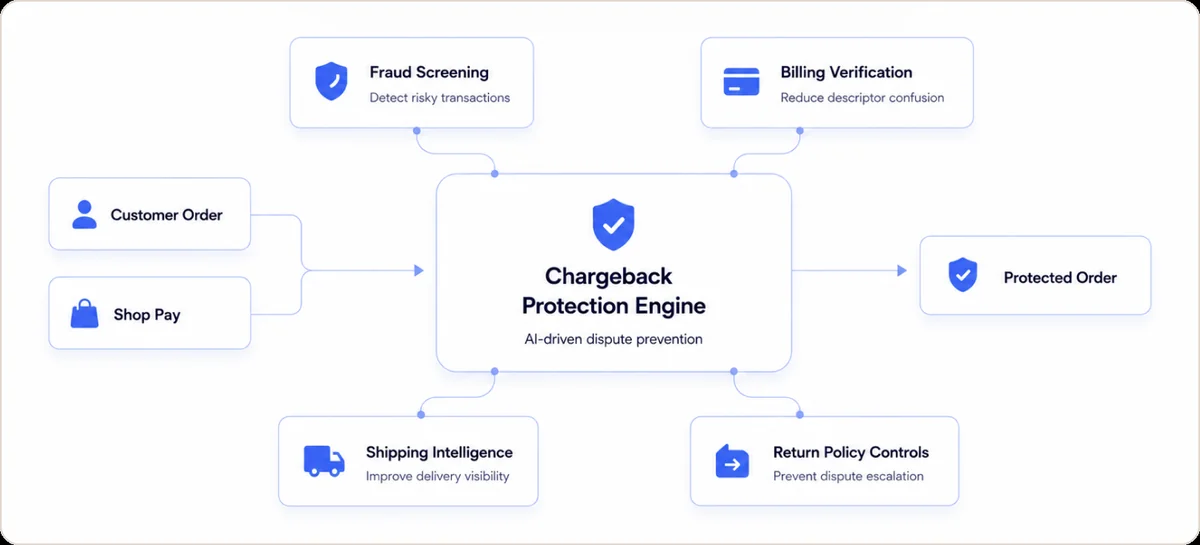
What Does Shopify Protect Actually Cover?
Shopify Protect is Shopify's free built-in program for eligible Shop Pay orders. When an order qualifies, Shopify reimburses the full order amount plus the chargeback fee and handles the dispute response on your behalf.
Eligibility is strict. The order must be placed through Shop Pay, processed via Shopify Payments, shipped with a valid tracking number to a US address, and fulfilled within seven days. Coverage is available to US-based merchants only.
Critically, Shopify Protect only applies to fraud-related reason codes, meaning unauthorized transaction disputes where a stolen card was used. If a customer disputes because an item arrived damaged, did not match the description, or they simply forgot the purchase, Shopify Protect does not apply.
Shopify Protect: Covered vs. Not Covered
| Chargeback Type | Shopify Protect Coverage |
|---|---|
| Fraud, unauthorized transaction via Shop Pay | Yes, order amount and fee reimbursed |
| Item not received | No |
| Item not as described | No |
| Duplicate charge | No |
| Subscription cancelled | No |
| Non-Shop Pay orders | No |
| Non-US merchants | No |
| Orders shipped without tracking | No |
| Orders fulfilled after 7 days | No |
For a breakdown of how chargeback reason codes affect your dispute options and win rates, the Shopify chargeback reason codes guide covers each category with response strategies.
Why Are Chargebacks Happening on Your Shopify Store?
Chargebacks fall into three categories. Knowing which one is driving your rate determines where to focus first.
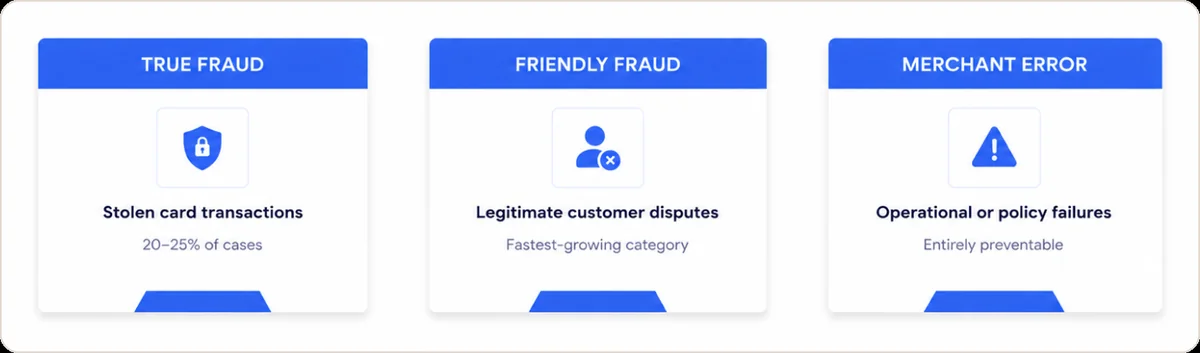
True fraud accounts for roughly 20% to 25% of cases. A stolen card is used, the real cardholder disputes the transaction, and the merchant loses both goods and payment. Fraud filters, AVS matching, and 3D Secure authentication are your primary defenses here.
Friendly fraud is the largest and fastest-growing category. A legitimate customer receives their order, then files a dispute claiming they never got it, that it was not as described, or that they do not recognize the charge. According to Chargebacks911’s 2024 Chargeback Field Report, 72% of merchants reported an increase in chargebacks over the past three years, driven largely by friendly fraud. This category is not slowing down.
Merchant error rounds out the rest. Late shipments, vague product pages, confusing billing statements, and inaccessible return policies drive a significant share of disputes that have nothing to do with fraud. These are entirely within your control.
According to Mastercard’s 2025 State of Chargebacks Report (titled “The chargeback window of opportunity”), global chargeback volume is projected to reach 324 million chargebacks by 2028, representing a 24% increase from 2025. For Shopify Payments, a dispute (chargeback) rate above 1% typically triggers a formal review; sustained high rates can lead to account termination and placement on card network monitoring programs such as the Visa Risk Measurement Program or Mastercard NDRP. The Visa Acquirer Monitoring Program overview explains what thresholds trigger scrutiny and how to stay clear of them.
How Do You Fix Your Billing Descriptor Before It Creates More Disputes?
Your billing descriptor is the name that appears on your customer's credit card statement. If it does not clearly match your store brand, customers who forgot the purchase, or who share a card, will dispute it as an unrecognized transaction. That dispute costs $315 whether you win or not.
Visa’s merchant guidance on friendly fraud explains that many disputes start when customers don’t recognize a charge, and it recommends clearer billing descriptors and better post-purchase communication as a low-cost, high-impact fix.
Go to Shopify Admin, then Settings, then Payments, then Shopify Payments. Under the Statement descriptor field, enter the name customers know your brand by. Avoid abbreviations, legal entity names, or parent company identifiers. Match it to your storefront name and your confirmation emails exactly. One setting. One entire dispute category removed.
How Do You Prevent "Item Not Received" Disputes with Shipping Automation?
The most effective defense against "item not received" cases is automated shipping communication. Customers who receive timely tracking updates rarely file a dispute over a delayed package because they already know where it is.
According to Notify Rush, Shopify merchants can automate shipping and post-purchase notifications to reduce support requests and improve customer communication.” This version stays consistent with the available source material.
Build a three-email sequence into your fulfillment workflow. Send an order confirmation the moment a purchase completes, with the order number, item summary, and expected delivery window. Send a shipping notification the moment the order leaves your facility, with the tracking number and a direct link to the carrier page. When the carrier marks the order delivered, trigger a final automated message asking the customer to confirm receipt and contact you with any issues.
Shopify's built-in notification system handles the first two emails natively. The post-delivery step requires a Shopify Flow automation triggered by the carrier delivery event. Setup takes under 30 minutes and creates a communication record that is admissible evidence if a case is later filed.
What Shopify Fraud Protection Settings Should Every Merchant Enable?
Shopify fraud protection requires layered verification that catches suspicious orders before they ship. Shopify's built-in tools cover the fundamentals. Third-party platforms extend coverage for higher-volume stores.
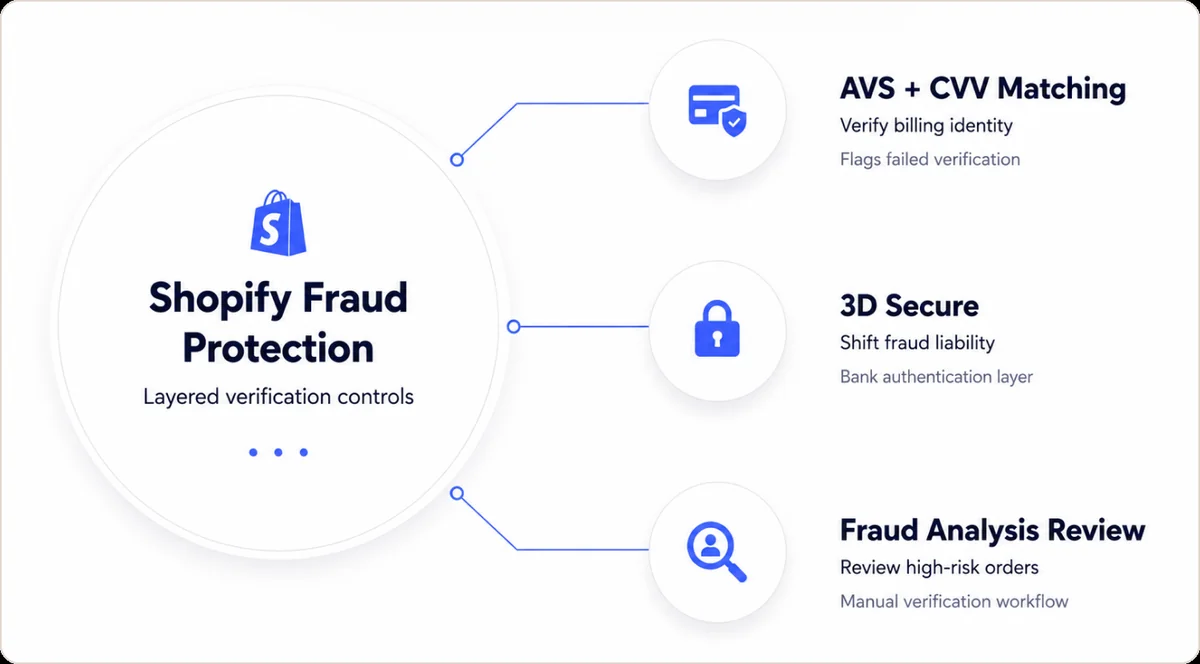
Enable AVS and CVV matching in Shopify Payments. Address Verification System matching checks whether the billing address at checkout matches the card issuer's records. CVV verification confirms the buyer has physical possession of the card. Both are in Shopify Admin under Settings, then Payments. Orders that fail either check are flagged automatically.
Activate 3D Secure for high-risk transactions. 3D Secure adds a second authentication step for the cardholder, typically a one-time code through their bank. When a transaction clears 3D Secure, fraud chargeback liability shifts from you to the card issuer. This is one of the most important liability protections available and is consistently underused by Shopify merchants.
Review Shopify's fraud analysis score before fulfilling high-value orders. Every Shopify Payments order receives a fraud indicator. For any order flagged as medium or high risk, check whether shipping and billing addresses match, whether the email domain looks legitimate, and whether the order volume makes sense. A first-time customer ordering ten units of a high-ticket item with overnight shipping to a freight forwarder is worth a brief hold before you fulfill.
As Monica Eaton, founder of Chargebacks911, has noted: "Merchants who rely on a single layer of protection are always going to be one chargeback wave away from a serious account risk problem." Chargebacks911 Resources
Does Your Return Policy Prevent Chargebacks or Guarantee Them?
A vague or buried return policy is one of the most consistent predictors of a high dispute rate. When customers cannot figure out how to return something or feel trapped by restrictive terms, filing a chargeback through their bank becomes the easiest option.
A chargeback-resistant return policy has four characteristics. It is written in plain language. It is accessible from every page of your store, including the footer, product pages, and cart. It gives customers a reasonable return window (30 days is standard). And it explains exactly how to initiate a return, with a direct contact method included.
A "No Refunds" policy does not protect you from chargebacks. Card networks give cardholders the right to dispute charges regardless of what your policy says. A restrictive policy only eliminates the merchant-controlled resolution path and routes the customer straight to their bank.
At checkout, add a required acknowledgment checkbox confirming the customer has read and accepted your return policy. This creates a timestamped consent record that carries real weight if you contest a case. Every customer who contacts you instead of their bank is a dispute you never had to fight. The chargeback versus a refund guide covers the cost difference between these two resolution paths.
Which Third-Party Tools Actually Reduce Shopify Chargebacks?
Shopify buyer protection through Shopify Protect covers one scenario. For everything else, third-party tools fill the gap. The right choice depends on whether your primary exposure is fraud, friendly fraud, or fulfillment disputes.
Chargeback Prevention and Dispute Response Tools
| Tool | Best For | Pricing Model | Chargeback Guarantee |
|---|---|---|---|
| Chargeflow | Automated dispute response, all types | Success fee on won disputes | No, recovers revenue |
| Signifyd | Fraud screening, enterprise volume | Subscription plus coverage fee | Yes, on approved orders |
| NoFraud | Real-time fraud scoring, mid-market | Subscription plus per-transaction | Yes, on approved orders |
| Disputifier | Pre-dispute alerts, dispute filing | Subscription | No, focuses on prevention |
| Chargeback Gurus | Managed dispute representment | Success fee | No, managed service |
Chargeflow automates dispute response using AI to compile evidence across all case types, not just fraud. Signifyd and NoFraud offer a financial guarantee model: if either platform approves a transaction that later results in a fraud case, the platform reimburses you, transferring your risk on screened orders; see Beast Insights vs Signifyd for where that guarantee model ends and dispute-side measurement begins, or the wider roundup of Signifyd alternatives if you are weighing the guarantee against tools that price per alert or per recovery. Verdivo takes a similar Shopify-native, pay-on-win approach, managing Verifi RDR and Ethoca alerts and auto-building dispute evidence, and charges a fee only when it wins; see Beast Insights vs Verdivo.
Disputifier connects to Ethoca and Verifi alert networks, which notify merchants of a dispute before it becomes a formal case. That 24-to-72-hour window lets you issue a refund and keep the case off your merchant account entirely. The chargeback alerts guide explains how these networks work and how to access them.
Accurate product pages, a clean billing descriptor, automated shipping communication, and a clear return policy prevent more cases than any app. For stores processing significant volume, the right tool layered on top of strong operations produces a measurable reduction. If a Shopify-native, pay-on-win app is your starting point, weigh the best Verdivo alternatives before you commit to one.
How Do You Monitor Chargeback Trends Before They Damage Your Account?
Reactive dispute management leaves you perpetually behind. Merchants who maintain low rates treat this as a data problem and review patterns monthly.
Track three numbers: your dispute rate as a percentage of total transactions (stay below 0.9% as a practical buffer), your win rate on contested cases (the industry average is roughly 43%), and your top three dispute reason codes. Those codes tell you exactly where your operation is failing.
Shopify Payments provides case data under Finances, then Disputes. If "item not as described" is rising, fix your product pages. If "item not received" is climbing, look at fulfillment speed and carrier reliability. Shopify reports those cases one at a time, so to see the same disputes grouped by product and traffic source, the Beast Shopify integration builds that view from your order data.
Under Visa's updated CE3.0 framework, merchants can use order history, prior delivery confirmations, and customer IP data as evidence to contest repeat friendly fraud. Your delivery confirmation emails and post-purchase communication records are not just good service. They are admissible evidence.
What Should You Do Today, This Week, and This Month?
Chargebacks are not random. They are the measurable result of specific gaps in billing clarity, shipping communication, product accuracy, and fraud verification. Most are fixable in under a week and cost far less to address than the cases they generate.
Today: Log into Shopify Payments settings and confirm your billing descriptor matches exactly what customers know your brand as. This is the fastest, highest-ROI change in this guide.
This week: Check your three most recent "item not received" cases and verify whether automated shipping notifications were sent. If not, build the three-email sequence using Shopify Flow. This single workflow has reduced this case category by up to 60% for merchants who implement it.
This month: Enable AVS and CVV matching, review your return policy for clarity and accessibility, add a consent checkbox at checkout, and set up a monthly review of your dispute reason codes in Shopify Payments.
Merchants who lose payment processing access do not lose it in one bad month. They lose it because small, fixable gaps compound until the rate crosses a threshold that card networks cannot ignore.
FAQ
What is Shopify's chargeback protection?
Shopify chargeback protection refers to Shopify Protect, which covers eligible fraud-based disputes on Shop Pay orders, combined with merchant-operated prevention strategies including fraud screening, billing descriptor accuracy, and shipping communication.
What is Shopify Protect?
It is Shopify's free program that reimburses merchants for the order amount and chargeback fee on fraud-based disputes for eligible Shop Pay orders. Shopify handles the dispute response on the merchant's behalf.
Does Shopify have buyer protection?
Yes. Shop Pay includes Shopify buyer protection for eligible purchases, giving customers recourse on unauthorized fraud disputes. Merchants get equivalent coverage through Shopify Protect on qualifying Shop Pay orders.
What does Shopify Protect not cover?
Items not received, items not as described, duplicate charges, cancelled subscriptions, and any orders outside Shop Pay are all excluded. Coverage is also limited to US merchants shipping to US addresses with valid tracking.
How do I reduce chargebacks on Shopify?
Fix your billing descriptor, automate shipping notifications, write a plain-language return policy, enable AVS and CVV matching in Shopify Payments, activate 3D Secure for high-risk transactions, and review dispute reason codes monthly.
What chargeback rate is acceptable for Shopify merchants?
Shopify Payments flags accounts above 1% of total transactions. A practical safe target is below 0.9%, with a fraud-specific rate under 0.3%.
What is the difference between a chargeback and a refund on Shopify?
A refund is merchant-initiated, resolves quickly, and carries no fee. A chargeback is bank-initiated, triggers a formal dispute process, and results in a fee of typically $15 through Shopify Payments, regardless of outcome.
What is Shopify fraud protection?
Shopify fraud protection combines the platform's built-in fraud analysis scoring, AVS, and CVV verification through Shopify Payments, and the Shopify Protect program for eligible Shop Pay orders. Together, they address a subset of fraud exposure but do not cover friendly fraud or merchant error cases.