Mastercard GMAP: the April 2027 Program and Its Reported Thresholds
Mastercard's GMAP is now reported for April 1, 2027, consolidating fraud and dispute monitoring. The reported thresholds and fees, what replaced the rumor, and what to prepare first.
Update, August 2026. This post originally separated GMAP fact from rumor, and the rumor has firmed up. Acquirer summaries of a Mastercard bulletin now put a Global Merchant Audit Program into effect on April 1, 2027, replacing the Excessive Chargeback Merchant framework and folding fraud and dispute monitoring into one program. The bulletin is not public, so every number below is an attributed industry report. What is enforceable today is still SMMP and the standing programs.
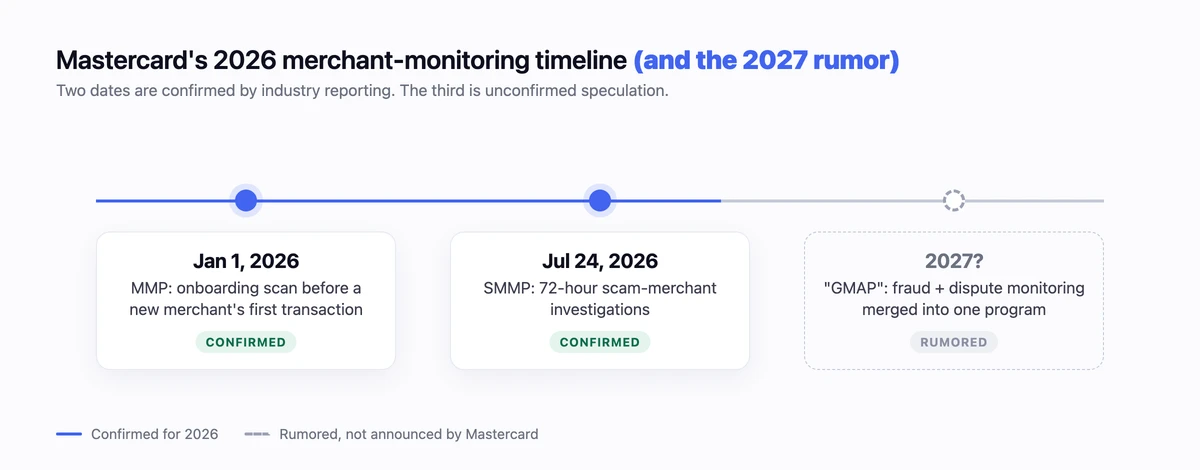
Mastercard GMAP: what is confirmed and what is reported
The question comes from a real change on the Visa side. In 2025 Visa merged its fraud monitoring and dispute monitoring into one program, the Visa Acquirer Monitoring Program (VAMP). VAMP is Visa's. Naturally, people ask whether Mastercard will copy the move, and the industry name for the Mastercard answer, GMAP, has stuck. In mid-2026 it stopped being a rumor.
The status changed in late July 2026. Chargeback Gurus and Chargeflow, both working from acquirer summaries of Mastercard bulletin GLB 14127.1, published matching specifics: an effective date of April 1, 2027, new dispute categories, and a stepped tightening of the excessive-chargeback threshold. Mastercard has not published the bulletin publicly, so treat every figure as an industry report and confirm it with your acquirer.
| Program | Status | What we know |
|---|---|---|
| SMMP (Scam Merchant Monitoring) | Confirmed | Live July 24, 2026. Acquirers must investigate flagged card-not-present merchants within 72 hours. |
| MMP onboarding scan | Confirmed | In effect since January 1, 2026. New merchants get scanned before their first transaction. |
| "GMAP" fraud + dispute merge | Rumored | Reported effective date: April 1, 2027. Source: acquirer summaries of an unpublished Mastercard bulletin, reported consistently by at least two independent industry write-ups. Not yet published by Mastercard. |
| "Mastercard VAMP" | Does not exist | VAMP is a Visa program. Mastercard runs its own separate programs. |
The confirmed 2026 items are reported consistently across payments-industry sources. The 2027 program is now also reported consistently, by at least two independent summaries of the same bulletin, but the bulletin itself is not public.
There are two different "GMAPs"
This is where the confusion starts. "GMAP" already refers to an older, unrelated Mastercard program: the Global Merchant Audit Program. It is tied to legacy chargeback reason code 4849, "Questionable Merchant Activity". It flags merchants suspected of fraud and can end in termination. It has been around for years and has nothing to do with a Visa-style consolidation.
What the April 2027 GMAP reportedly includes
Everything in this section is attributed: it comes from acquirer summaries of Mastercard bulletin GLB 14127.1 as reported by Chargeback Gurus (July 30, 2026) and Chargeflow (August 4, 2026, updated August 21). The two reports match on dates, categories, and thresholds. Mastercard has not published the bulletin.
- Effective April 1, 2027, GMAP reportedly replaces the Acquirer Chargeback Monitoring Program (ACMP) and folds the Excessive Fraud Merchant (EFM), Excessive Chargeback Merchant (ECM), and High Excessive Chargeback Merchant (HECM) categories into one framework.
- Two new merchant categories are reported: High Dispute Merchant (HDM) at 5 or more cleared transactions, $5,000 or more in disputes, and a 5% dispute ratio; and Excessive Dispute Merchant (EDM) at $10,000 or more and a 50% ratio.
- Reported EDM assessments escalate monthly: $5,000 in month one, $25,000 in month two, $100,000 for months three to eleven, up to $300,000 for sustained noncompliance beyond 19 months.
- The excessive-chargeback trigger reportedly steps down over time: 1.5% through 2028, then 1.3% in 2029, 1.1% in 2030, and 0.9% from 2031. A ratio that is safely under the line today can breach it by 2031 with no change in merchant behavior.
- Acquirer-level categories are also reported (High Dispute Acquirer at 0.5% and Excessive Dispute Acquirer at 0.7%), which gives your acquirer direct financial exposure to your dispute performance and a reason to act on it earlier.
The practical read for subscription merchants: GMAP is reported to monitor fraud that never becomes a chargeback, which makes prevention alerts and refund-before-dispute workflows more valuable, not less. Our guides to the chargeback ratio and Visa VAMP thresholds cover the same mechanics on the measurement side.
What is actually confirmed for 2026
The headline change for card-not-present and subscription merchants is SMMP. It went live July 24, 2026, and requires acquirers to investigate a flagged merchant within 72 hours. For newer merchants it counts refunds and chargebacks together, not chargebacks alone. We break down the triggers, the 5% threshold, and who it applies to in our Mastercard Scam Merchant Monitoring Program guide.
The second confirmed change is the updated MMP. Since January 1, 2026, merchants onboarded after that date must pass an initial content and transaction-laundering scan before they can process their first transaction.
Here is the key contrast with Visa. Mastercard has not merged its programs. It still runs its Excessive Chargeback Program and its Excessive Fraud Merchant program separately, with SMMP layered on top as a scam-signal check. Visa is the network that consolidated. If you want the Visa side, start with our VAMP 2026 explainer and our guide to card scheme compliance.
What subscription merchants should do now
Prepare in order. The rules that can get a merchant terminated today are SMMP and the standing chargeback and fraud programs. Then use the runway to April 2027: if your dispute ratio sits near the current 1.5% trigger, the reported step-down to 0.9% by 2031 means the same performance drifts into penalty range with no change on your side.
- Track your combined refund and chargeback rate per MID, not just chargebacks. For newer merchants, SMMP counts the two together.
- Watch new MIDs (under six months old) most closely. They face the strictest SMMP trigger.
- Keep authorization rates stable. A sudden drop is its own SMMP signal.
- Ask your acquirer for the GMAP specifics that apply to your merchant category. The bulletin is distributed through acquirers, and your acquirer's summary is the version that will be enforced on your account.
Is Mastercard launching a program called GMAP?
Yes, by industry report. Acquirer summaries of Mastercard bulletin GLB 14127.1 put the Global Merchant Audit Program into effect on April 1, 2027, replacing the Excessive Chargeback Merchant framework and adding new dispute categories. Mastercard has not published the bulletin publicly, so confirm the specifics with your acquirer.
Is GMAP the same as Visa's VAMP?
Functionally close. VAMP combined Visa's fraud and dispute monitoring in 2025. GMAP is reported to do the same on the Mastercard side from April 1, 2027, with its own categories and thresholds. There is still no official public Mastercard rules page for it.
Is this the same as Mastercard's Global Merchant Audit Program?
No. The Global Merchant Audit Program tied to reason code 4849 is an older and separate fraud-audit program. It shares its name with the April 2027 program, which Mastercard is reportedly reviving for a much broader scope.
When would a Mastercard GMAP take effect?
April 1, 2027, by industry report. That date comes from acquirer summaries of Mastercard bulletin GLB 14127.1 published by Chargeback Gurus and Chargeflow in late July and August 2026. Mastercard has not yet published the rules publicly.
What Mastercard changes are actually confirmed for 2026?
Two. SMMP (scam merchant monitoring) went live July 24, 2026, and the updated MMP onboarding scan has applied since January 1, 2026.