Chargeback Ratio: The Visa VAMP Formula, 2026 Thresholds, and What Most Guides Get Wrong
Learn how Visa and Mastercard calculate chargeback ratio differently, what the 2026 VAMP thresholds mean for your account, and which actions actually reduce your ratio.
What Is a Chargeback Ratio, and Why Does It Put Your Account at Risk?
A chargeback ratio, also called a chargeback rate, is the share of monthly transactions that result in chargebacks. Card networks use it as the primary signal to identify merchants who create systemic financial risk across the payments ecosystem.
The metric matters for one specific reason: it triggers enforcement. A high chargeback ratio can cause Visa and Mastercard to place you in a formal monitoring program, levy monthly fines that escalate the longer you remain enrolled, require your acquirer to submit remediation plans, and ultimately terminate your ability to accept card payments.
Most merchants assume staying below 1% keeps them safe. That assumption is outdated. The programs that actually govern enforcement today, Visa's VAMP and Mastercard's Excessive Chargeback Program, each use their own formulas, their own thresholds, and their own definitions of what counts.
The gap between what your system reports and what the network measures is exactly where merchants get blindsided. A refund you initiate has no impact on your ratio. A chargeback filed by the cardholder does, regardless of how it eventually resolves.
How Do You Calculate a Chargeback Ratio?
Chargeback ratio calculation uses a straightforward formula: divide the number of chargebacks received in the current month by the number of transactions processed, then multiply by 100.
Basic formula:
Chargeback ratio = (Chargebacks in current month / Transactions in current month) x 100.
Example:
60 chargebacks on 5,000 transactions = 1.2%.
This is the baseline for how to calculate chargeback ratio, but Visa and Mastercard do not apply it in the same way. The formula gives you a starting number. The network-specific adjustments are what determine your actual compliance position.
One thing most merchants miss: networks assign disputes and fraud reports to the month they are received, not the month the original transaction was processed. Stripe's dispute monitoring documentation calls this the "data month." A January purchase disputed in March counts toward March's ratio.
This is why your internal dashboard and your acquirer's report will rarely match. If your processor gives you a single blended ratio, it is almost certainly obscuring the network-specific number that governs your compliance exposure.
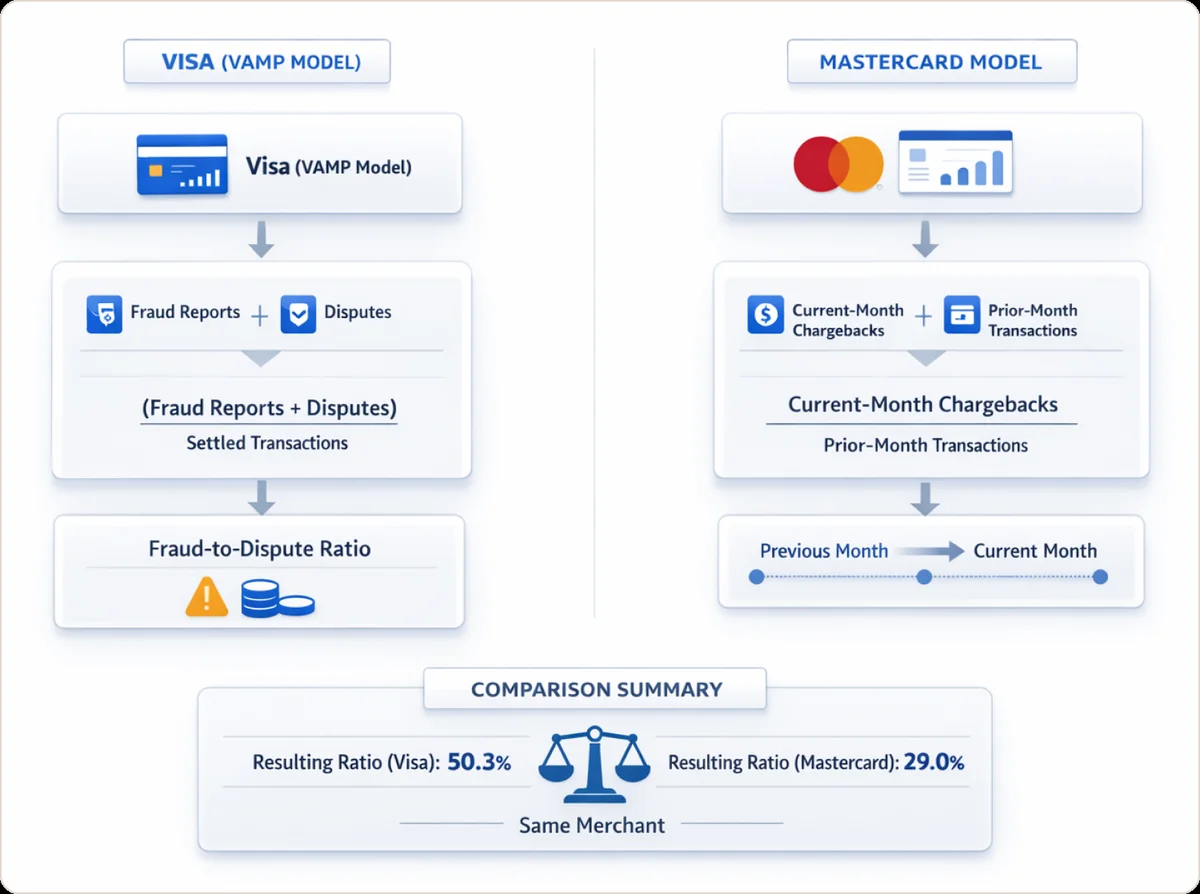
How Do Visa and Mastercard Calculate Chargeback Ratio Differently?
Visa chargeback thresholds and Mastercard thresholds are enforced using different formulas. Using the wrong one to model your risk means you could cross a threshold without realising it.
| Factor | Visa (Classic Dispute Ratio) | Mastercard (Chargeback Threshold Ratio) |
|---|---|---|
| Numerator | Current month chargebacks | Current month first chargebacks |
| Denominator | Current month transactions | Prior month transactions |
| Scope | All Visa transactions | All Mastercard transactions |
| Safe target | Below 0.65% | Below 1.0% (100 basis points) |
| Enforcement program | VAMP (see below) | Excessive Chargeback Program (ECM / HECM) |
The denominator offset is what catches merchants off guard. Mastercard uses the prior month's transaction volume as the denominator. A high-volume February followed by elevated disputes in March will make your March Mastercard ratio look lower than current activity warrants. The reverse is equally dangerous: a quiet month followed by a high-dispute month spikes your Mastercard ratio in a way your Visa number will not reflect.
What Is Visa's VAMP Ratio, and How Does It Differ From a Standard Chargeback Ratio?
The Visa Acquirer Monitoring Program (VAMP), effective June 2025, is Visa's current enforcement framework. It replaces older dispute monitoring programs and uses a formula that captures more signal than a standard chargeback count because it includes fraud data that never reaches the formal dispute stage.
VAMP ratio formula:
(TC40 fraud reports + TC15 disputes) / TC05 settled transactions
Where:
- TC40 = fraud reports filed by issuing banks against your transactions
- TC15 = formal dispute transactions
- TC05 = settled transactions (the denominator)
The VAMP ratio is almost always higher than your standard chargeback ratio. A cardholder's bank can file a TC40 fraud report on a transaction it flagged as suspicious without the cardholder ever filing a chargeback. That report still counts in your VAMP numerator.
There is also a double-counting risk that Stripe's VAMP documentation explicitly flags: if a single fraudulent transaction generates both a TC40 fraud report and a TC15 dispute, it is counted twice. Most merchants have no visibility into TC40 volume through standard reporting tools. To calculate your VAMP ratio accurately, request TC40, TC15, and TC05 data directly from your acquirer.
For a full breakdown of how VAMP is monitored and what triggers acquirer-level action, the Visa Acquirer Monitoring Program guide covers the complete program mechanics.
What is excluded from the VAMP ratio?
- Disputes resolved through Visa pre-dispute solutions (Order Insight or RDR) before formal filing, provided the resolution meets Visa's timing requirements
- TC40 fraud reports qualifying for Compelling Evidence 3.0 (CE3.0), Visa's framework for challenging friendly fraud using prior legitimate transaction data
These exclusions matter. Merchants with pre-dispute infrastructure in place structurally produce a lower VAMP ratio than merchants processing the same volume without it.
What Are the Current Visa VAMP Thresholds for US Merchants?
The thresholds below are sourced from Visa's published 2025 VAMP fact sheet. Both conditions, ratio and case count, must be met simultaneously for a merchant to be classified as excessive.
Current threshold (effective June 1, 2025): VAMP ratio ≥2.2% (220 basis points) with ≥1,500 monthly count of fraud (TC40) + disputes (TC15) (Source).
Updated threshold (effective April 1, 2026): 1.5% (150 basis points). The case count minimum is adjusted alongside the ratio. Several guides online claim this drops to 0.9%. That figure does not appear in Visa's published documentation (Source).
Enumeration threshold (card testing): 20% (2,000 basis points) enumerated authorization rate AND 300,000 or more enumerated authorizations per month (Source).
The dual-condition structure is significant. A merchant running a 2.5% VAMP ratio with only 800 combined cases does not currently meet the excessive threshold. That protection narrows on April 1, 2026. Merchants sitting between 1.5% and 2.2% today are in the window where the upcoming threshold change flips their compliance position without any increase in dispute volume.
Card testing attacks feed the enumeration threshold independently of the chargeback ratio.
What Are the Mastercard ECM and HECM Thresholds, and How Do Fines Escalate?
Mastercard's Excessive Chargeback Program (ECP) operates in two tiers. The thresholds are drawn from Mastercard's published program rules.
| Program Tier | Monthly Chargeback Count | Chargeback Ratio | Starting Monthly Fine | Escalating Assessment |
|---|---|---|---|---|
| Excessive Chargeback Merchant (ECM) | 100 to 299 | 1.50% to 2.99% | $1,000 (increases monthly) | None at entry |
| High Excessive Chargeback Merchant (HECM) | 300 or more | 3.00% or higher | $5,000 to $200,000+ | $5 per chargeback above 300 |
Both count and ratio conditions must be met to trigger enrollment. A merchant with 350 chargebacks but a 1.2% ratio does not meet the HECM threshold.
Fines escalate each month a merchant remains enrolled. Mastercard also requires acquirers to submit formal remediation plans. If the acquirer fails to comply, Mastercard holds the acquirer financially liable, which means your acquirer has a direct incentive to escalate pressure on you well before you reach program thresholds.
From month four, Mastercard also applies an Issuer Recovery Assessment fee on top of the above fines. This is a charge of $5 for every chargeback above 300 in each month. For example, if you had 500 chargebacks in a HECM month, that's 200 chargebacks over the 300 threshold, resulting in an extra $1,000 fee (200 × $5) (Source).
Does Winning a Chargeback Dispute Reduce Your Ratio?
No. Winning a chargeback does not reduce your ratio. Card networks count the dispute when it is received, not when it is resolved.
Merchants who invest in chargeback representment recover disputed funds, which matters for revenue. But the chargeback has already been recorded in the monthly count before the representment process starts. A successful win returns the money. The compliance metric does not move. Teams outsourcing that recovery work often shortlist vendors first, so it helps to see Chargeback360 next to Beast Insights.
This distinction affects how you allocate dispute management budget. Representment is a revenue recovery tool. It is not a compliance tool. The only activity that lowers your ratio is preventing disputes from being filed in the first place. If you are sizing up a full-service dispute management vendor for that recovery work, see how Beast Insights compares to Chargebacks911.
How Do Chargeback Alerts and Pre-Dispute Tools Change Your Ratio?
Chargeback alerts lower your ratio by stopping disputes before they are formally filed with the card network. Because no filing occurs, the event is not counted in your monthly ratio or VAMP calculation.
Verifi Order Insight (Visa): Shares transaction details with issuing banks when a cardholder contacts them about a potential dispute. If the information resolves the concern before a dispute is filed, nothing is counted.
Ethoca Alerts (Mastercard): Notifies the merchant when a cardholder contacts their bank. The merchant can refund before the dispute is submitted. No filing means no count in the ECP ratio.
Rapid Dispute Resolution (RDR): Automates refund issuance in response to Verifi alerts using merchant-defined rules. Effective for subscription businesses where speed of resolution matters more than review.
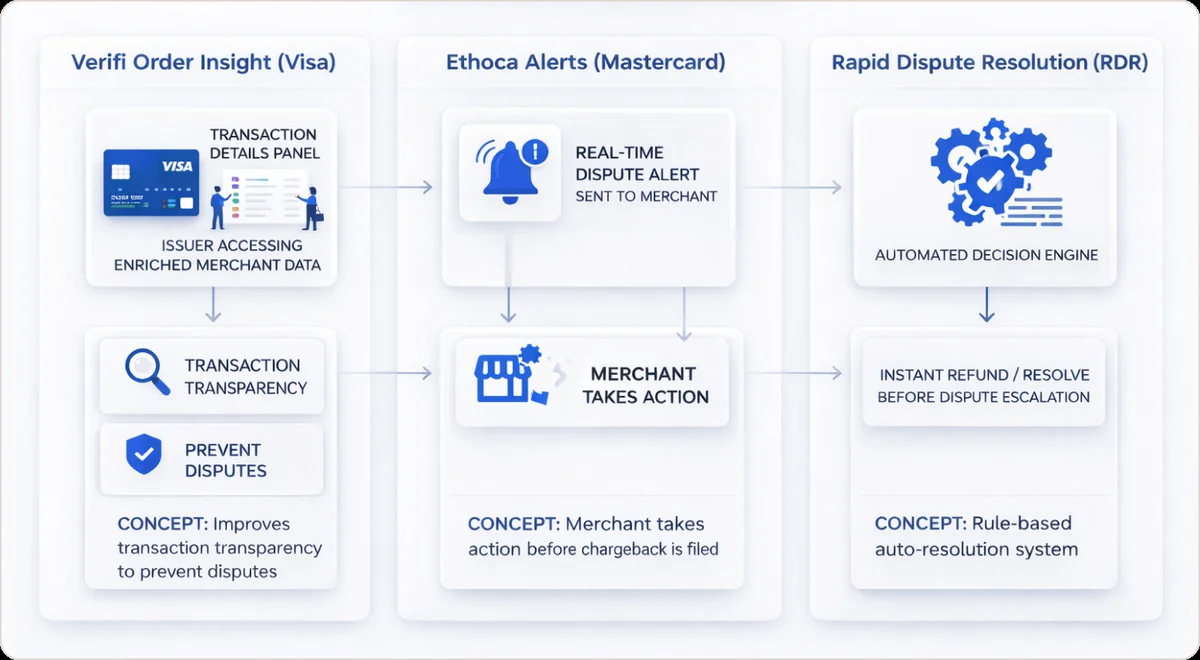
Visa's VAMP fact sheet confirms that disputes resolved through qualifying pre-dispute solutions are excluded from the VAMP ratio. Two merchants with identical dispute volumes will show different VAMP ratios if one has alert infrastructure and the other does not. The ratio responds to the tools you operate, not just transaction volume.
The chargeback alerts guide covers implementation detail and expected impact by merchant type and volume. Some vendors bundle Order Insight, Ethoca and RDR into a single portal, so it is worth weighing the best ChargebackHelp alternatives on coverage and pricing before you commit to one.
Visa VAMP vs Mastercard ECP: Side-by-Side Comparison
| Factor | Visa VAMP | Mastercard ECP |
|---|---|---|
| Ratio formula | (TC40 + TC15) / TC05 | Current month chargebacks / prior month transactions |
| Transaction scope | Card-not-present VisaNet only | All Mastercard transactions |
| Excessive threshold | 2.2% now, 1.5% from April 1, 2026 | 1.5% (ECM), 3.0% (HECM) |
| Case count minimum | 1,500 per month | 100 per month (ECM) |
| Does winning reduce ratio? | No | No |
| Pre-dispute exclusions? | Yes, with Visa timing rules | Partial, Ethoca and CDRN |
| Who is fined directly? | Acquirer (cost passed to merchant) | Merchant directly |
How Do You Reduce Your Chargeback Ratio?
The only way to reduce chargeback ratio sustainably is to stop disputes from being filed. Winning existing chargebacks does not move the metric. The right approach depends on the category driving your volume.

Descriptor-related disputes happen when cardholders do not recognise the charge and call their bank. Match your merchant descriptor to your trading name, not your legal entity. Add a customer service phone number if your processor supports it. This single change eliminates a share of confusion-driven chargebacks without any other intervention.
Subscription and recurring billing disputes are the dominant category for SaaS and membership businesses. The root cause is forgotten subscriptions and failed card recoveries that generate unrecognised charges. Pre-charge notifications 5 to 7 days before billing, visible cancellation flows, and immediate cancellation confirmation emails reduce this category significantly. Addressing involuntary churn in your billing infrastructure also prevents the downstream disputes that failed payment recovery creates.
Fulfillment and delivery disputes (item not received, item not as described) require tighter logistics communication. A proactive shipping delay notification and a visible resolution path that the customer finds before contacting their bank reduce this category more reliably than any fraud tool.
True fraud and card testing require velocity rules, device fingerprinting, and 3D Secure. Implementing 3D Secure authentication shifts fraud liability to the issuer for authenticated transactions and directly reduces the fraud-origin chargebacks feeding your TC40 numerator.
Friendly fraud, where a legitimate cardholder disputes a transaction they received, is where Compelling Evidence 3.0 has the most impact. CE3.0 lets merchants challenge TC40 fraud reports using prior legitimate transaction data, removing qualifying reports from the VAMP calculation entirely. The friendly fraud prevention guide covers CE3.0 eligibility and how to build the transaction evidence library that supports it.
Conclusion: Five Actions Before April 2026
The gap between a 1% rule of thumb and the actual enforcement mechanics Visa and Mastercard operate is wide enough to expose well-run businesses to monitoring program enrollment they did not anticipate.
The five actions that matter most before the April 2026 threshold tightening:
- Calculate separately for each network. A blended figure hides where your real exposure is.
- Use data-month methodology, not transaction-date. Your acquirer's numbers are the ones that trigger enforcement, not your dashboard's.
- Run your own VAMP ratio. Request TC40, TC15, and TC05 from your acquirer and calculate it directly. Most merchants who do this discover their VAMP ratio is higher than their standard dispute count suggested.
- Invest in prevention before representment. Alerts, descriptors, and billing communication stop disputes at the source. Representment recovers money but does not move the compliance metric.
- Pressure-test your current ratio against 1.5%, not 2.2%. If you are between those two numbers today, the April threshold change alters your compliance position without any increase in dispute volume.
If your ratio is above 0.8% and trending upward, or if you have received a warning from your acquirer, the window for pre-monitoring action is shorter than it feels. Monitoring program enrollment comes with escalating fines, acquirer pressure, and remediation deadlines that limit your options fast.
The most effective place to start is stopping disputes before they register as chargebacks. See how Beast Insights approaches chargeback prevention, including the alert and exclusion strategies that reduce your VAMP ratio exposure before a dispute is ever filed.
Not sure if your processor is reporting the right number?
Get a ratio review from Beast Insights and find out what your network-reported VAMP ratio actually looks like.
FAQ
What is a chargeback ratio?
A chargeback ratio is the number of chargebacks received in a given month divided by total transactions processed, expressed as a percentage. Card networks use it to identify merchants placed in dispute monitoring programs.
How is chargeback ratio calculated?
Divide current-month chargebacks by current-month transactions and multiply by 100. Visa uses current-month transactions as the denominator. Mastercard uses prior-month transactions, so the two networks will produce different figures for the same merchant in the same period.
What chargeback ratio is considered high?
A ratio above 0.65% typically draws acquirer attention. Above 1.0%, most merchants are within range of formal network monitoring. Visa's VAMP excessive threshold is 2.2% now, dropping to 1.5% on April 1, 2026. Mastercard's ECM program begins at 1.5%.
What is Visa's VAMP ratio?
The Visa VAMP ratio is TC40 fraud reports plus TC15 dispute transactions divided by TC05 settled transactions, applied to card-not-present VisaNet transactions only. It is Visa's current primary monitoring metric under the Visa Acquirer Monitoring Program, effective June 2025.
Does winning a dispute reduce your chargeback ratio?
No. Networks count chargebacks when received, not when resolved. Representment recovers funds but does not affect the compliance metric. Prevention, stopping the dispute from being filed, is the only way to reduce the ratio.
What is the difference between a chargeback ratio and a VAMP ratio?
A standard chargeback ratio counts only formal chargebacks. Visa's VAMP ratio also includes TC40 fraud reports filed by issuing banks, which may never become formal disputes. A transaction generating both a TC40 and a TC15 is counted twice. The VAMP ratio is typically higher than the standard figure.
Why does my ratio differ from what my acquirer reports?
Networks assign disputes to the month they are received, not the month the transaction occurred. Most internal tools track by transaction date. That gap is permanent and predictable, not an error in either system.
What is the difference between a chargeback ratio and a dispute ratio?
The terms are often used interchangeably. In Visa's framework, "dispute" is the formal term for what was previously called a chargeback. The VAMP ratio is broader because it includes TC40 fraud reports alongside TC15 dispute transactions. Mastercard uses "chargeback" throughout its ECP documentation and does not separate fraud reports in its threshold formula.