Friendly Fraud Prevention: 10 Strategies to Cut Disputes
Ten controls that reduce friendly fraud for subscription and card-not-present businesses, from billing descriptors and renewal reminders to chargeback alerts and the evidence that wins a representment.
If you're an online merchant in 2026, friendly fraud is likely costing you more than you realize. This is not about stolen credit cards. It is your own customers disputing legitimate purchases they received, claiming they never got their order or don't recognize the charge. You lose the sale and the product, and pay a chargeback fee on top: published processor schedules run from $0 at Square to $15 at Stripe and $20 at PayPal, and Adyen notes acquiring-bank fees can reach far higher.
According to the Merchant Risk Council, first-party misuse (friendly fraud) accounts for up to 80% of all fraud-related chargebacks for many of its merchant members. Unlike criminal fraud with stolen cards, it involves legitimate cardholders filing unjustified disputes post-receipt.
This guide covers ten controls that reduce friendly fraud, ordered by how quickly they take effect.
Quick Answer
Friendly fraud occurs when legitimate cardholders file unwarranted chargebacks after receiving goods or services. Subscription and card-not-present merchants prevent it through clear billing descriptors, proactive customer communication, chargeback alert systems, and robust evidence collection for representment.
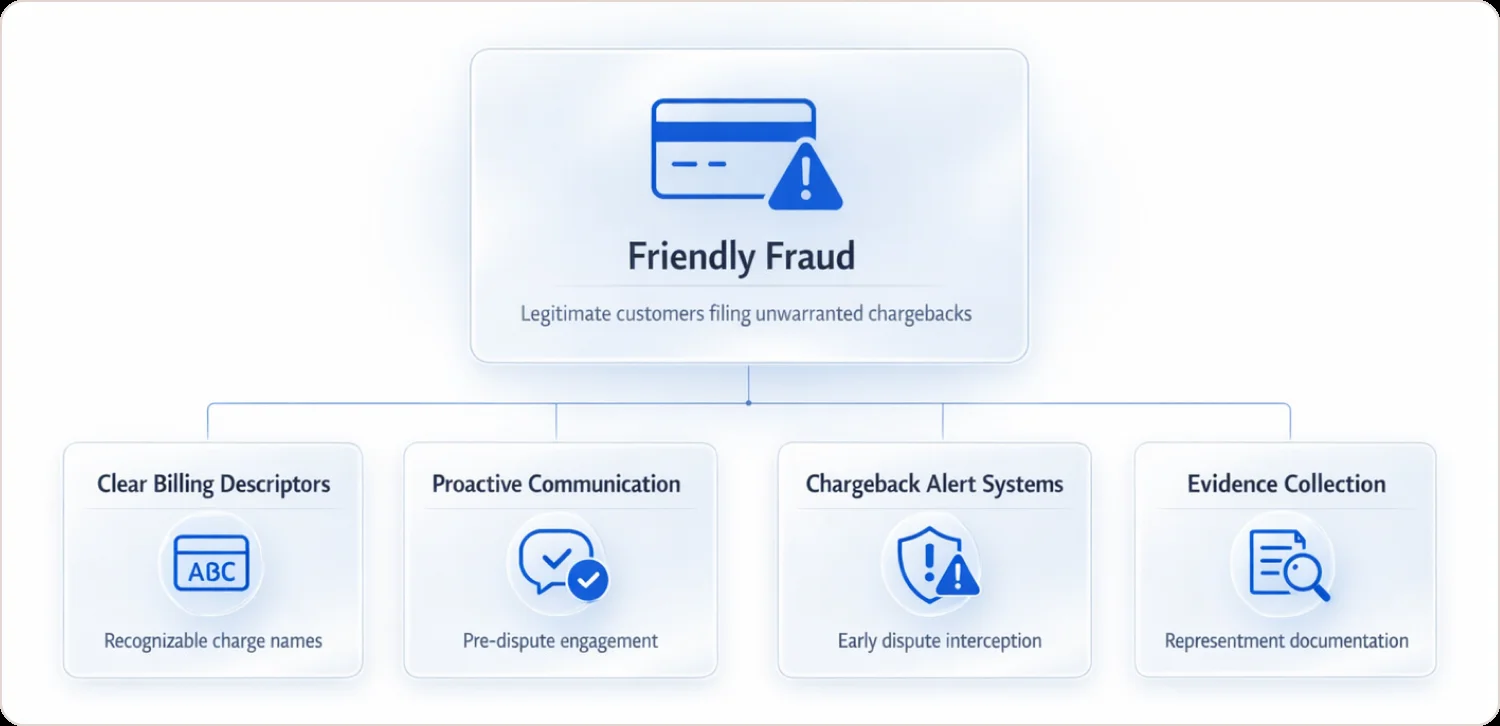
What Is Friendly Fraud and Why Does It Matter?
Friendly fraud happens when a legitimate cardholder makes a purchase, receives the product or service, then disputes the charge with their bank. Unlike criminal fraud with stolen cards, this involves the actual account holder filing an unjustified chargeback.
Published estimates vary widely because the denominator does. Visa puts friendly fraud at around 20% of all fraudulent disputes globally, rising to 30% for high-volume online merchants. The Merchant Risk Council reports up to 80% of fraud-related chargebacks for many of its members. Check which denominator a number uses before you benchmark against it.
How Much Does Friendly Fraud Cost?
According to LexisNexis Risk Solutions' 2025 True Cost of Fraud™ Study, US ecommerce and retail merchants lose $4.61 in total for every $1 of fraud, once operational, reputational and compliance costs are counted. Subscription and card-not-present merchants face steeper consequences, because the acquiring bank monitors your chargeback ratio closely.
Under Visa VAMP, a merchant counts as excessive at a 1.5% ratio, reduced from 2.2% effective 1 April 2026, and acquirers report a charge of $8 per fraud or dispute transaction for merchants in that category. Disputes resolved through pre-dispute tools, and fraud that qualified for Compelling Evidence 3.0, are excluded from the ratio.
Why Do Customers Commit Friendly Fraud?
Accidental Friendly Fraud
- Statement confusion: Your billing descriptor doesn't match your customer-facing brand name,
- Family fraud: Unauthorized purchases by family members on shared devices or accounts
- Forgotten purchases: Impulse buys, subscription renewals, or purchases that don't align with expected delivery dates
Deliberate Friendly Fraud
Deliberate friendly fraud is intentional exploitation of consumer protection mechanisms. These customers know exactly what they're doing.
- Buyer's remorse: the customer received and used the product, then chose the bank over the merchant's return process
- Cyber shoplifting: Falsely claiming items weren't received or were defective. in a November 2023 survey of 1,016 US adults for fraud-prevention vendor Sift, 42% of Gen Z respondents admitted to first-party fraud such as disputing a legitimate charge
- Refund-as-a-Service (RaaS): Professional scammers offering to "get your money back" for a 20-30% commission through sophisticated social engineering
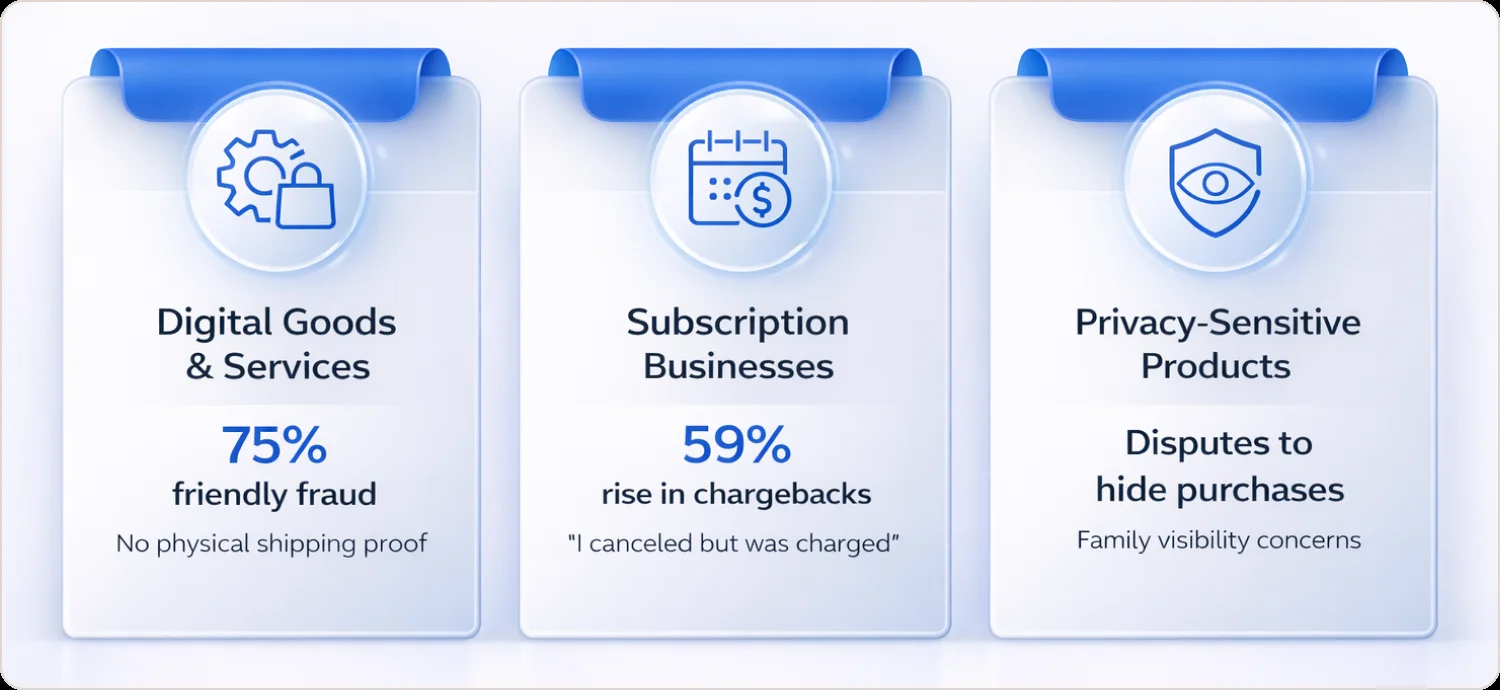
Which Business Models See the Most Friendly Fraud?
- Digital goods and services: there is no shipping record to submit as evidence, because delivery is instant
- Subscription businesses: vulnerable to "I canceled but was still charged" disputes; Sift's Q4 2025 Digital Trust Index recorded chargeback rates up 83% for B2C SaaS and services
- Privacy-sensitive products: Adult content, dating services face disputes to hide purchases from family members
What Are the 10 Most Effective Friendly Fraud Prevention Strategies?
1. Use Clear, Recognizable Billing Descriptors
Billing descriptor confusion is the single largest driver of accidental friendly fraud. When customers see "ABC HOLDINGS LLC" on their credit card statement instead of "YourBrandName," they assume it's fraud and dispute the charge. Ethoca, citing Aite Group research, reports that nearly 25% of disputes could be avoided by showing cardholders richer purchase detail, including merchant logos, on their statement.
Implementation steps:
- Include your recognizable brand name in the descriptor
- Add your customer service phone number or website
- Use dynamic descriptors that include the specific product name when possible
- Update descriptors for any DBA (doing business as) names
- Test how your descriptor appears on actual credit card statements before going live
2. Send Detailed Order Confirmations and Shipping Updates
Immediate email confirmations with purchase details, shipping confirmations with tracking, and delivery notifications create a paper trail that prevents "item not received" claims. When customers have records in their inbox, they're significantly less likely to file false chargebacks.
What to include:
- Order confirmation within minutes of purchase
- Detailed itemization with product names and prices
- Shipping confirmation with tracking number
- Delivery notification when tracking shows "delivered"
- Easy-to-find customer support contact information in every email
3. Implement Chargeback Alert Systems (Ethoca and Verifi)
Chargeback alert systems intercept disputes before they become official chargebacks. When a customer contacts their bank to dispute a charge, the alert system notifies you in real-time. You can then issue an immediate refund, preventing the dispute from hitting your chargeback ratio. Some merchants run those alerts through a dedicated app, so it is worth reviewing the top Disputifier alternatives before you commit.
How they work:
- Customer initiates a chargeback with their issuing bank
- Alert system notifies you within hours
- You issue a refund immediately
- Dispute is cancelled, never appears on your chargeback ratio
- You pay the refund plus an alert fee, published by resellers at roughly $15 to $29, but save the chargeback fee and the ratio impact
4. Strengthen Customer Service and Response Times
A large share of friendly fraud starts as a misunderstanding rather than deliberate abuse. Those are issues that could have been prevented with better communication.
Best practices:
- Offer multiple support channels (email, phone, live chat)
- Respond to inquiries within 24 hours maximum
- Train support representatives to identify potential chargeback situations
- Empower reps to issue refunds or credits immediately when appropriate
- Create a dedicated email address for dispute-related inquiries with priority handling
5. Offer Easy Refund and Return Options
Counter-intuitively, making returns easier reduces total fraud costs. Ethoca, a Mastercard company, reports that 84% of consumers turn to their bank to resolve a transaction issue rather than the merchant. Simplifying returns and refunds, such as clear policies and self-service options, can reduce chargebacks by 20-30%, steering customers toward direct resolutions over bank disputes.
Implementation tactics:
- Clearly communicate your return policy at checkout
- Make returns self-service through customer portals
- Offer instant store credit as an alternative to full refunds
- For non-returnable items, consider partial refunds or credits for dissatisfied customers
- Remember: a refund costs you the sale; a chargeback costs the sale plus fees plus ratio impact
6. Use Fraud Screening and Device Fingerprinting
Device fingerprinting creates an irrefutable digital trail that wins chargebacks. When customers claim "I never made that purchase," you can produce their device ID, IP address, browser fingerprint, and session data proving otherwise.
How It Works
Every device has a unique digital signature based on browser type, OS, screen resolution, fonts, timezone, and language settings. When customers browse, add to cart, and checkout, then later dispute charges, you have proof the same device completed every step.
Specific Tools to Implement:
- Sift (Enterprise) - Best for high-volume merchants
- Kount (Mid-Market) - Strong for digital goods with AI risk scoring
- Fingerprint.js (Developer-Friendly) - Open-source option
- MaxMind GeoIP2 - Identifies VPN/proxy usage
Implementation difficulty: medium. Pricing for fraud-screening and device-fingerprinting tools varies with transaction volume, so get a quote against your own volume rather than a list price. A few vendors sell the screening engine and the dispute stack together, which is convenient but makes it harder to tell which half is earning its fee; Beast Insights vs Kount unpicks that bundle. If you are pricing that bundle against tools that sell the dispute layer on its own, our roundup of the best Kount alternatives compares them on coverage and pricing.
Red Flags to Watch For:
- Velocity Anomalies: Customer makes 5 purchases in 2 hours when their average is 1 per month
- Device Switching: Same customer places orders from 6 different devices in 3 days
- Geographic Impossibility: Customer "travels" from New York to Singapore between purchases 4 hours apart
- VPN/Proxy Usage: IP address shows residential location, but device shows data center origin
- Behavioral Mismatch: Customer normally browses for 15 minutes before buying, suddenly checks out in 30 seconds
Implementation Steps:
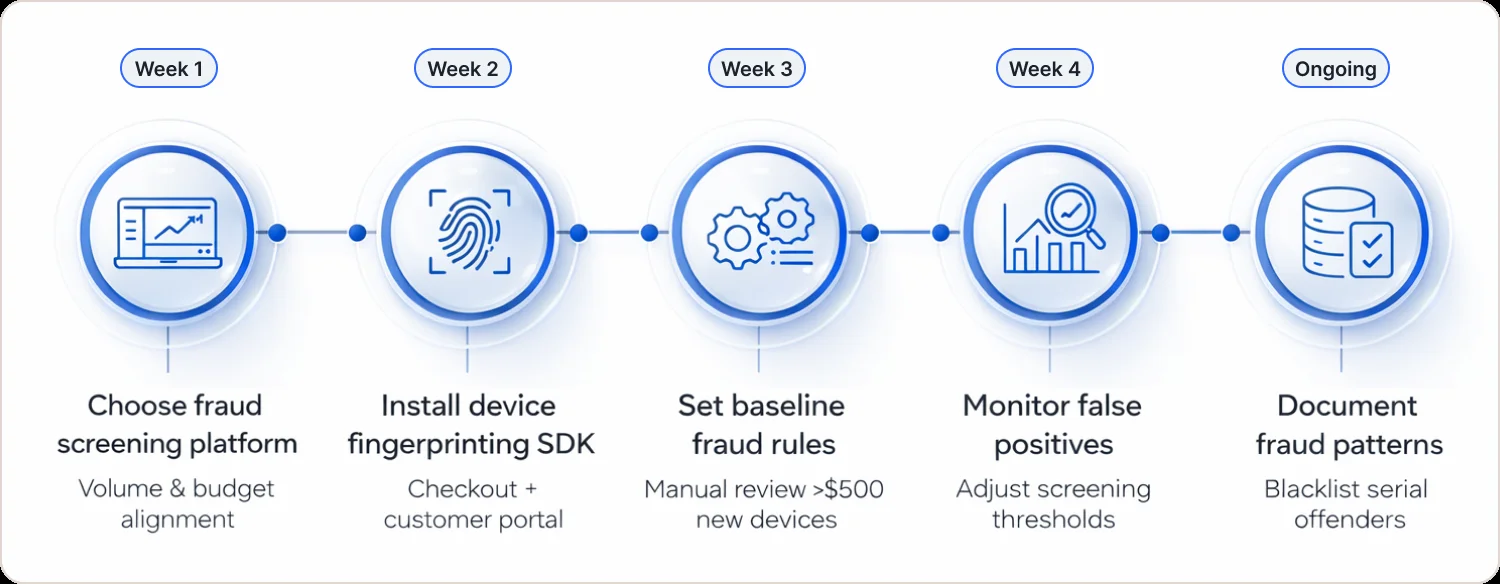
- Week 1: Choose your fraud screening platform based on transaction volume and budget
- Week 2: Install device fingerprinting SDK on checkout pages and customer portal
- Week 3: Set baseline rules (manual review for orders >$500 from new devices)
- Week 4: Monitor false positive rate and adjust thresholds
- Ongoing: Document patterns of serial friendly fraudsters for blacklist
7. Implement 3-D Secure Authentication for High-Value Transactions
Adding 3-D Secure or Strong Customer Authentication creates friction, but for high-risk, high-ticket items, requiring the cardholder to authenticate provides crucial evidence. If a chargeback occurs, you have documented proof that the customer authenticated themselves during purchase.
When to use it:
- Transactions above your average order value
- First-time customers
- Digital goods and services
- Any transaction flagged as potentially risky by your fraud tools
- Under certain Visa rules, 3-D Secure authenticated transactions shift liability, strengthening your case
8. Send Subscription Renewal Reminders
For subscription businesses, a reminder email before each renewal removes the surprise that drives "I forgot" disputes. It also gives the customer a chance to cancel deliberately instead of going to their bank.
What to include:
- Clear notification that renewal is approaching
- Exact amount that will be charged
- One-click cancellation link
- Option to skip the upcoming payment
- Reminder of the benefits they're receiving
9. Maintain a Blacklist of Serial Friendly Fraudsters
A small number of customers dispute repeatedly and deliberately. Blocking them is the cheapest control available, because every repeat dispute costs the fee twice over: once on the chargeback and again on the ratio.
What Qualifies Someone for Your Blacklist?
Don't block every chargeback customer. Target clear abuse patterns:
- 2+ unjustified disputes with delivery proof
- Refund-as-a-Service participation
- Impossible claims (signature confirmation contradicts "never arrived")
- Multiple accounts to bypass limits
How to Build and Maintain Your Blacklist
Basic: Block email, card details (BIN + last 4), billing address. Easily circumvented but free.
Advanced: Add device fingerprinting, IP ranges, shipping addresses, and name variations. Harder to bypass.
Expert: Join fraud consortiums like Ethoca/Verifi or use Kount/Sift for cross-merchant data sharing.
Legal Considerations You Must Know:
✅ Legal: Blocking documented fraudsters, refusing repeat violators, maintaining private lists
❌ Illegal: Protected class discrimination, unauthorized data sharing (GDPR/CCPA violations), public defamation
Quarterly Blacklist Review Protocol:
Every 90 days, audit your blacklist:
- Remove entries older than 2 years (people change, give second chances)
- Verify documentation (do you still have chargeback evidence?)
- Check for false positives (did you block someone by mistake?)
- Update device fingerprints (customers upgrade phones, change browsers)
10. Collect and Use Compelling Evidence for Representment
Even with perfect prevention, some friendly fraud will slip through. When it does, fight back with evidence. Chargeflow's 2024 State of Chargebacks Report, built on its own merchant data, puts the friendly-fraud representment win rate at 43.8%, against 9.3% for true-fraud cases. If you are considering an automated representment vendor to run that evidence process, weigh Beast Insights vs Justt. Visa's Compelling Evidence 3.0 program allows you to automatically deflect disputes by proving prior undisputed transactions from the same customer.
Evidence to collect:
- Delivery tracking showing signature confirmation
- Customer login logs with IP addresses and timestamps
- Usage data for digital products (download logs, license activation)
- Email correspondence showing customer acknowledged receipt
- Screenshots of customer reviews or support tickets about the product
- Previous transaction history from the same customer
- Device fingerprints matching previous purchases
Friendly Fraud vs. True Fraud vs. Merchant Error: What's the Difference?
| Characteristic | Friendly Fraud | True Fraud | Merchant Error |
|---|---|---|---|
| Who Initiates | Legitimate cardholder | Unauthorized third party | Merchant system error |
| Intent | Accidental or deliberate | Criminal | Unintentional |
| Example | Customer receives item, then disputes claiming non-receipt | Stolen credit card used for purchases | Duplicate transaction processing |
| Prevention | Clear communication, alerts, easy returns | AVS, CVV, 3DS, fraud filters | Process audits, testing |
| Win Rate | 43-45% with evidence | 5-15% (liability shifted) | 75-90% if proven |
Conclusion: Prevention Is Your Best Defense
Visa's 2024 Global Fraud Report shows merchants lose ~3% of revenue to fraud, with friendly fraud comprising up to 75% of chargebacks.
Start with the three that act fastest: a recognizable billing descriptor, pre-renewal reminders, and chargeback alert coverage. Descriptors and reminders remove the confusion disputes are built on, and alerts give you a window to refund before a dispute becomes a chargeback.
For comprehensive support, consider gateway compliance monitoring to track your chargeback ratios across all processors. Combine friendly fraud prevention with strategies to recover failed payments and you create a robust revenue protection system.
The battle against friendly fraud is continuous risk management. With the right tools, processes, and mindset, you can keep your revenue where it belongs: in your business.
Frequently Asked Questions
Can friendly fraud be eliminated completely?
No, friendly fraud cannot be completely eliminated as long as chargeback rights exist for consumers. Prevention still moves the number more than representment does, because it removes the dispute before it is filed. The reality is that chargeback mechanisms are designed to protect consumers, which means some level of abuse is inevitable.
What's the difference between friendly fraud and true fraud?
Friendly fraud involves legitimate cardholders disputing authorized purchases they received. True fraud involves unauthorized third parties using stolen cards. Friendly fraud requires communication solutions; true fraud requires security measures like fraud filters and authentication.
What happens if my chargeback ratio gets too high?
Under Visa VAMP, a merchant counts as excessive at a 1.5% ratio, reduced from 2.2% effective 1 April 2026, and acquirers report a charge of $8 per fraud or dispute transaction for merchants in that category. Disputes resolved through pre-dispute tools, and fraud that qualified for Compelling Evidence 3.0, are excluded from the ratio. Acquirers may also raise fees or close an account that stays above the line.
Should I fight friendly fraud chargebacks?
Yes, with strong evidence. Merchants win 43-45% of representments on average. Fighting back recovers revenue and deters repeat offenders. Prioritize high-value disputes. Even when you lose, the effort signals to customers that you won't accept fraud passively.
How do chargeback alerts help prevent friendly fraud?
Chargeback alerts from Ethoca and Verifi notify you when customers initiate disputes, before they become official chargebacks. You can issue immediate refunds, stopping the dispute from hitting your chargeback ratio. This protects your merchant account while still resolving customer complaints.
What role does payment routing play in fraud prevention?
Optimizing payment routing helps reduce false declines that frustrate customers and lead to chargebacks. When legitimate transactions are mistakenly declined, customers may dispute or give up entirely. Smart routing maximizes approval rates while maintaining fraud protection.
How long does a friendly fraud chargeback take?
Friendly fraud chargebacks typically take 60-90 days to resolve from initial dispute to final decision, though complex cases can extend to 120+ days. The timeline varies significantly based on card network (Visa vs. Mastercard) and whether you fight the chargeback through representment.