Chargeback Reason Codes: The 2026 Merchant Guide
Chargeback reason codes tell you exactly what evidence to submit and why disputes are happening. This guide covers all four networks, code tables, and dispute strategy.
What Exactly Is a Chargeback Reason Code?
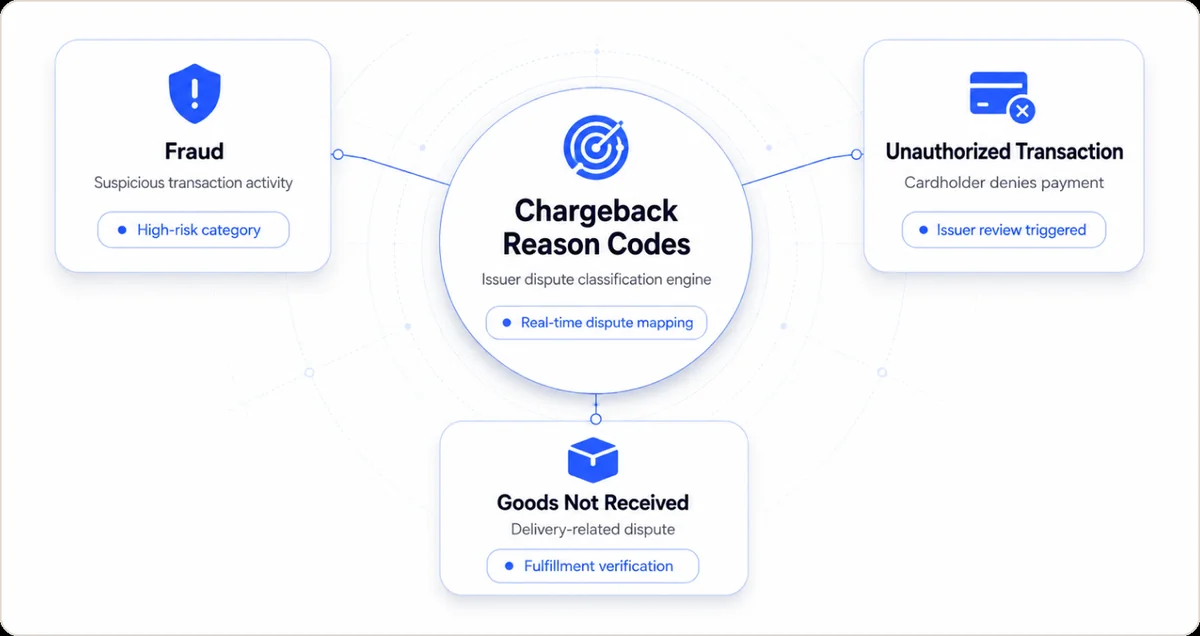
A chargeback reason code is a short alphanumeric label assigned by the cardholder's issuing bank to identify the category of a payment dispute. The code tells the merchant, the acquiring bank, and the card network what type of claim is being made and which liability framework applies.
The code does not determine guilt. It signals what liability test applies and what evidence you need to submit to pass it. If you send shipping confirmation in response to a fraud code, you will almost certainly lose. If you send an authorization log in response to a "goods not received" code, the result is the same.
Think of reason codes the way a doctor thinks of a diagnosis code. It does not explain everything that went wrong. It points directly to the right treatment. Match your evidence to the code's liability test and your representment win rate improves. Mismatch them and even a legitimate dispute becomes an automatic loss.
Why Do Chargeback Codes Matter for Your Bottom Line?
Chargeback reason codes control how you defend a transaction and how much that defense costs you. Each code maps to required documentation, a specific response timeline, and a liability framework that shifts depending on your authentication setup.
According to the 2023 LexisNexis True Cost of Fraud Study, every $1.00 in chargeback losses costs US e-commerce merchants $4.00 once fees, administrative time, and lost goods are factored in. The financial exposure is not the disputed amount. It is the multiplied total.
Beyond individual disputes, your chargeback reason code data is a real-time diagnostic tool. A spike in Visa 13.1 (goods not received) points to a fulfillment gap. A cluster of Mastercard 4853 disputes signals a mismatch between product descriptions and what customers receive. A pattern of 10.4 fraud codes on card-not-present transactions tells you your 3D Secure setup has a coverage gap.
Your chargeback ratio is the metric that sits above all of this. Visa begins formal enforcement at 0.9% monthly through the Visa Dispute Monitoring Program. Mastercard enforces at 1.0% through the Excessive Chargeback Program. The codes driving your ratio are the lever you can control. Ignoring code data means firefighting. Analyzing it means prevention.
How Does the Chargeback Process Work?
The chargeback process follows five steps. Codes enter at step one and shape every decision that follows.
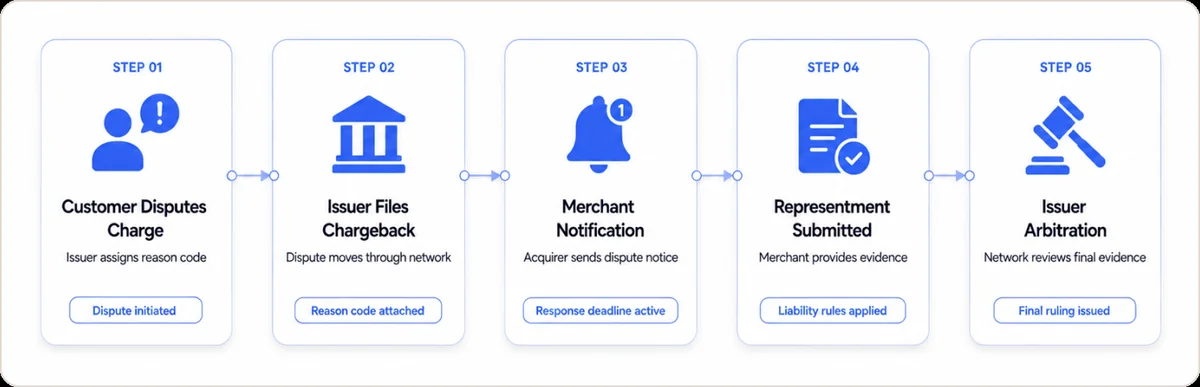
- Customer contacts their issuing bank. The cardholder disputes a charge. The bank assigns a reason code before initiating the dispute.
- Issuer files the chargeback. The coded dispute moves through the card network to your acquiring bank.
- Acquirer notifies the merchant. You receive a chargeback notice with the reason code, disputed amount, and a hard response deadline.
- Merchant submits representment. You compile evidence that directly addresses the code's liability requirements.
- Issuer or network arbitrates. Matching evidence wins. Mismatched or incomplete evidence loses, and the chargeback fee is non-refundable either way.
Response deadlines are firm. Visa allows approximately 30 days. Mastercard approximately 45 days. American Express windows are often fewer than 20 days. These are administered by your acquirer, so verify the exact window on your merchant account. Missing the deadline forfeits your right to dispute with no exceptions.
Visa Chargeback Reason Codes
Visa chargeback reason codes use a decimal format grouped into four categories. The prefix immediately signals the dispute type and the evidence required.
| Code | Name | What It Means | Key Evidence Required |
|---|---|---|---|
| 10.4 | Fraud, Card-Absent Environment | CNP fraud; cardholder denies transaction | AVS/CVV results, 3DS data, device fingerprint, IP logs |
| 10.5 | Visa Fraud Monitoring Program | Flagged by Visa internal fraud monitoring | Contact acquirer immediately |
| 11.3 | No Authorization | Transaction processed without valid authorization | Auth approval code and timestamp |
| 12.1 | Late Presentment | Transaction submitted outside the settlement window | Auth date vs. settlement date |
| 12.2 | Incorrect Transaction Code | Debit processed as credit or vice versa | Original transaction record |
| 13.1 | Goods or Services Not Received | Customer did not receive the order | Carrier tracking, delivery confirmation |
| 13.3 | Not as Described or Defective | Item materially different from listing | Product photos, listing screenshots, customer comms |
| 13.7 | Cancelled Recurring Transaction | Customer cancelled but was still billed | Cancellation confirmation, original billing terms |
Visa's Compelling Evidence 3.0 (CE3.0) changed fraud defense for 10.4 disputes. A merchant can shift liability to the issuer by presenting two prior undisputed transactions from the same cardholder, within a 120-day lookback window, matching on device ID, IP address, and shipping or billing address. CE3.0 only works if your platform captures device and session data at every checkout. Successfully authenticated 3D Secure transactions shift 10.4 liability to the issuer entirely, making CE3.0 a secondary tool.
Mastercard Chargeback Reason Codes
Mastercard reason codes are four-digit numbers primarily in the 48xx range. Each has distinct documentation requirements and different liability rules depending on whether 3DS authentication was completed.
| Code | Name | What It Means | Key Evidence Required |
|---|---|---|---|
| 4807 | Warning Bulletin File | Card was on warning bulletin at auth time | Authorization log |
| 4808 | Required Auth Not Obtained | Authorized after expiry or over floor limit | Authorization approval records |
| 4831 | Incorrect Transaction Amount | Amount charged differs from agreed amount | Signed receipt, transaction record |
| 4834 | Duplicate Processing | Same transaction billed more than once | Transaction logs with distinct IDs and timestamps |
| 4837 | No Cardholder Authorization | Cardholder denies authorizing the transaction | 3DS data, AVS/CVV, device and IP logs |
| 4853 | Goods or Services Not as Described | Item differs materially from description | Product listing, photos, customer correspondence |
| 4855 | Goods or Services Not Received | Order not delivered or service not performed | Carrier tracking, delivery confirmation |
| 4863 | Cardholder Does Not Recognize | Transaction unfamiliar; often precedes fraud claim | Auth data, IP logs, prior purchase history |
Mastercard's First Chargeback framework requires evidence that directly addresses the stated reason code. There is no CE3.0 equivalent on the Mastercard network. Your primary fraud defense is 3DS authentication. Successfully authenticated transactions shift 4837 liability to the issuer. Code 4863 is frequently the entry point for first-party fraud, where the legitimate cardholder disputes a transaction they actually made. The evidence strategy for genuine 4837 fraud and misidentified 4863 first-party fraud is materially different.
What Happens When Mastercard Reason Codes Pile Up on One MID?
Repeated 4837 and 4863 chargeback reason codes on one merchant ID (MID) cost you more than revenue. Those codes feed Mastercard's monitoring programs. One of them is Scam Merchant Monitoring (SMMP), which reviews refunds alongside chargebacks. Beast Insights breaks disputes down by gateway/MID, issuer and card brand. You see which MID is drifting before your acquirer calls.
- Track dispute count and ratio per MID, not only at the account level: monitoring programs score MIDs individually.
- Watch refunds and chargebacks together. Refunding your way out of disputes moves the number, not the underlying signal.
- Group codes by family (fraud, product, processing) so you can see which fix actually shifts the ratio.
- Flag sudden approval-rate drops on a MID. They often show up before the dispute count does.
American Express Chargeback Reason Codes
American Express uses a letter-prefix alphanumeric system where the first letter identifies the dispute category. Because Amex acts as both the card network and the issuing bank in most transactions, dispute timelines are faster and merchant escalation options are more limited than with Visa or Mastercard.
| Code | Name | What It Means | Key Evidence Required |
|---|---|---|---|
| F10 | Missing Imprint | No card imprint on card-present transaction | POS data, cardholder signature |
| F24 | No Card Member Authorization | Cardholder denies authorizing the transaction | Auth data, AVS/CVV, 3DS reference |
| F29 | Card Not Present | CNP transaction disputed as unauthorized | All available digital authentication evidence |
| C08 | Goods or Services Not Received | Order not delivered or service not rendered | Carrier tracking, delivery confirmation |
| C14 | Paid by Other Means | Customer claims payment via another method | Payment records showing single transaction |
| C31 | Goods or Services Not as Described | Item received differs from listing | Product listing, photos, correspondence |
| P05 | Incorrect Charge Amount | Amount billed differs from authorization | Auth record, signed agreement |
| R03 | Insufficient Reply | Merchant response lacked adequate evidence | Outcome code; dispute decided against merchant |
| R13 | No Reply | Merchant did not respond within deadline | Outcome code; deadline passed |
R03 and R13 are outcome codes, not dispute reasons. If you receive either, the dispute has already been decided against you because your response was late, incomplete, or absent. Treat every Amex chargeback notification as the highest priority in your dispute queue.
Discover Chargeback Reason Codes
Discover uses a two-letter prefix system. Dispute volume is typically lower than Visa or Mastercard, but the network's self-issuing structure means disputes move faster and pre-arbitration escalation is limited.
| Code | Name | What It Means | Key Evidence Required |
|---|---|---|---|
| UA01 | Fraud, Card Present | Card-present transaction disputed as unauthorized | Chip/PIN data, cardholder signature |
| UA02 | Fraud, Card Not Present | CNP transaction disputed as fraud | AVS/CVV, 3DS data, device and IP logs |
| UA05 | Fraud, Chip Counterfeit | Counterfeit chip card used | EMV chip transaction data |
| AA | Does Not Recognize | Transaction unfamiliar to cardholder | Auth data, order history, IP and device logs |
| AP | Recurring Payments | Cardholder disputes recurring charge | Cancellation records, original billing terms |
| DP | Duplicate Processing | Same transaction processed twice | Transaction logs with distinct IDs |
| RG | Non-Receipt of Goods or Services | Order not received | Carrier tracking, delivery confirmation |
| RM | Quality of Goods or Services | Item not as described or defective | Product photos, description, correspondence |
Network Comparison: All Four Card Networks at a Glance
| Feature | Visa | Mastercard | Amex | Discover |
|---|---|---|---|---|
| Code Format | 10.x, 11.x, 12.x, 13.x | 4807, 4837, 4853 etc. | F, C, R, P series | UA, AA, AP, DP etc. |
| Fraud Codes | 10.x series | 4837, 4863 | F-series | UA-series |
| Response Window | ~30 days | ~45 days | ~20 days or less | ~30 days |
| 3DS Liability Shift | Full shift | Full shift | Limited | Limited |
| Fraud Defense Framework | CE3.0 available | First Chargeback rules | Amex internal | No CE3.0 equivalent |
| Network Also Issuer | No | No | Usually yes | Usually yes |
| Monitoring Threshold | 0.9% (VDMP) | 1.0% (ECP) | Internal | Internal |
How to Win a Chargeback Dispute Using the Reason Code
Winning representment means submitting evidence that addresses the liability test the code triggers. Off-topic evidence signals to the issuer that you do not understand the dispute.
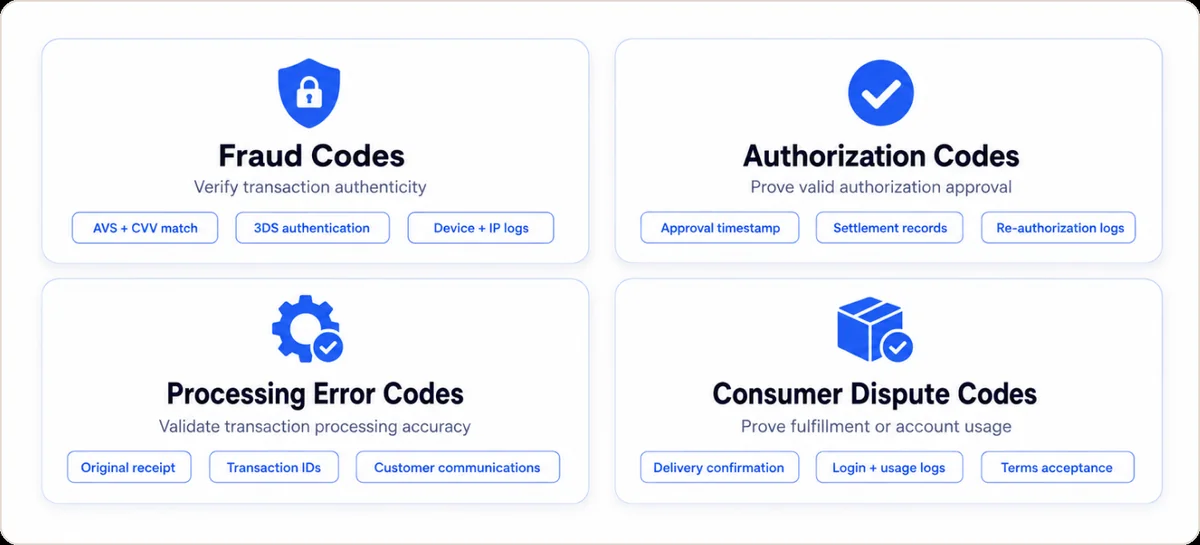
Fraud codes (10.4, 4837, F24, UA02): Submit AVS and CVV match results, 3DS authentication reference number, device fingerprint, IP address at transaction time, and session data. For Visa 10.4, check whether CE3.0 applies.
Authorization codes (11.x, 4808): Submit the authorization approval code with date and timestamp. Show the transaction was captured within the settlement window. Include re-authorization records if the order was delayed.
Processing error codes (12.x, 4834): Provide the original transaction receipt, distinct transaction IDs for each charge, and customer communications referencing the specific transaction.
Consumer dispute codes (13.x, 4853, C08, RG): For physical goods, submit carrier tracking with delivery confirmation. For digital goods, provide login timestamps, IP at login, and usage logs. Include product photos, the original listing, and signed or click-through terms of service.
"The biggest mistake merchants make is treating every chargeback the same way. The reason code is your roadmap. Ignore it and you are filing blind." Monica Eaton, Founder, Chargebacks911 — chargebacks911.com/resources
For merchants building a repeatable process, the chargeback representment guide covers documentation structure and rebuttal formatting by code type. Merchants who would rather outsource code-matched representment often weigh a managed provider, so it is worth seeing how Beast Insights compares to Chargeback Gurus.
How to Prevent Chargebacks Before They Happen
Your chargeback reason code history is the highest-signal prevention dataset you have. Review it monthly and look for clustering by code, product, channel, and geography.
According to the 2023 LexisNexis True Cost of Fraud Study, merchants who implement layered fraud controls including device intelligence, behavioral analytics, and 3DS authentication reduce fraud-related chargeback volume by 30 to 50% compared to merchants relying on basic AVS and CVV checks alone.
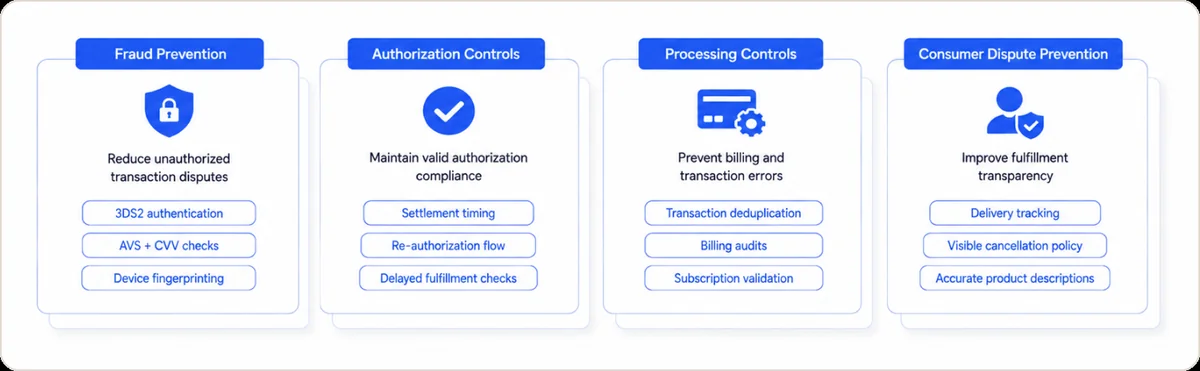
Prevention by code category:
- Fraud codes (10.4, 4837, F24, UA02): Implement 3DS2 across all card-not-present transactions. Require AVS and CVV matching. Add device fingerprinting at checkout.
- Authorization codes (11.x, 4808): Capture within the settlement window. Re-authorize when fulfillment is delayed beyond seven days.
- Processing errors (12.x, 4834): Use gateway-level transaction deduplication. Audit subscription and split-shipment billing logic quarterly.
- Consumer dispute codes (13.x, 4853, C08, RG): Write product descriptions that match what ships. Send automated delivery confirmation with tracking links. Make cancellation policy visible at checkout, not buried in terms of service.
If your dispute volume is driven by recurring billing codes (13.7, Discover AP), the problem is almost always in your cancellation and dunning management flow. Fix the process rather than fighting the resulting chargebacks individually.
The goal is to make your chargeback reason code distribution boring. Flat volume, no clustering spikes, no single code dominating. That is what a controlled payment operation looks like.
Conclusion
Chargeback reason codes are not administrative noise. Each code tells you what the issuer believes happened, what evidence is required to contradict it, and what operational failure in your business produced the dispute.
Start with your current chargeback data. Identify your top three codes by volume. Map each one to the evidence tables in this guide. Then, audit whether you are capturing that evidence at the point of transaction. That single exercise will reveal more about your chargeback exposure than any generic checklist.
If you want to stop disputes before they become chargebacks, Beast Insights connects directly to your payment stack and flags dispute patterns by code before they reach the formal stage. For teams comparing full-service dispute platforms on that same code data, our Chargebacks911 comparison breaks down the differences.
Frequently Asked Questions
What is a chargeback reason code?
A chargeback reason code is an alphanumeric code assigned by a card-issuing bank to classify the stated reason for a payment dispute. The code determines what evidence a merchant must submit to successfully contest the chargeback.
Are chargeback reason codes the same across all networks?
No. Visa, Mastercard, American Express, and Discover each use separate code systems with different formats, categories, and liability rules. Evidence requirements also differ by network.
What is the difference between a chargeback and a refund?
A refund is a voluntary return of funds initiated by the merchant, with no fee and no ratio impact. A chargeback is a forced reversal initiated by the cardholder's bank that carries a non-refundable fee and counts against your dispute ratio. See the full chargeback vs refund breakdown for operational differences.
What is a chargeback ratio and why does it matter?
A chargeback ratio is the percentage of monthly transactions that result in chargebacks, per card network. Visa begins enforcement at 0.9% monthly, Mastercard at 1.0%. Breaching either triggers monitoring programs with escalating fines and potential account termination.
Can a customer dispute under the wrong reason code?
Yes. Cardholders sometimes file under a code that does not reflect what actually happened, which is a common pattern in friendly fraud. Submit evidence addressing the code as filed, not the assumed underlying reason.
Does 3D Secure eliminate chargeback risk?
3DS2 shifts liability for fraud-coded chargebacks (Visa 10.4, Mastercard 4837) to the issuing bank when authentication is completed. It does not cover consumer dispute codes, processing errors, or authorization-related chargebacks.
What happens if I miss the chargeback response deadline?
Missing the deadline forfeits your right to dispute with no exceptions. The funds remain with the cardholder, the fee is non-refundable, and the loss counts against your ratio.
Which chargeback reason codes matter most for Mastercard monitoring programs?
Fraud codes such as 4837 and 4863 carry the most weight. Monitoring programs score fraud and dispute volume per merchant ID. Review those codes alongside refunds by merchant ID, issuer and card brand. That view shows the drift early. Codes alone tell you what happened. The pattern tells you why.
Can you dispute a chargeback if the reason code looks wrong?
Yes. Issuers sometimes file under a code that does not match the customer's actual complaint. That mismatch is itself an argument. Fight the dispute with evidence tied to the code as filed. Then note the discrepancy. Sort your representments, the evidence packages you send back to the issuer, by reason code and issuer. That sort shows which pairings are worth fighting.
How do I find the chargeback reason code for a dispute?
Your acquirer or gateway posts the reason code in the dispute notification. That posting normally happens within a day or two of the issuer filing the dispute. Open the dispute record in your payment dashboard. Match the code to its liability test before you build a response. Beast Insights groups disputes by reason code, issuer, BIN (bank identification number, the first digits of the card that name the issuer) and gateway or MID (merchant ID, your store's account number with the acquirer).