First Party vs Third Party Fraud: How to Classify and Win Disputes
Learn how to classify first party vs third party fraud, reduce chargebacks, and win disputes using CE3.0, behavioral signals, and a structured framework designed for modern payment risk teams.
Most merchants fighting a chargeback spike are applying 3rd party fraud defenses to what is actually a first-party fraud problem. The result: legitimate customers get declined while dispute after dispute is lost to cardholders who made the purchase and know it. This guide gives you the classification system, the evidence framework, and the network tools to fix that.
What Is First Party Fraud, and Why Is It So Hard to Catch?
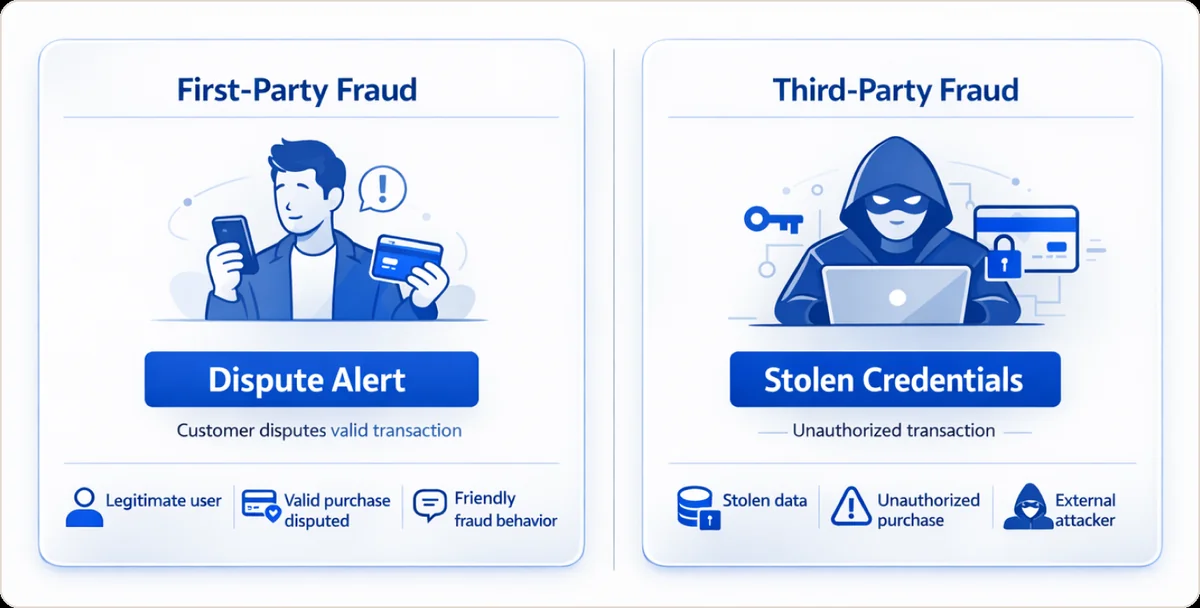
First-party fraud (1st party fraud) happens when the real, verified account holder initiates a transaction and then falsely disputes it. The customer is who they claim to be, their device matches their account, and their payment method is legitimate. The fraud only becomes visible when the chargeback arrives. That is why standard KYC checks, device fingerprinting, and IP matching all pass cleanly: the person committing it is the actual customer.
The most common first-party fraud schemes fall into four types. Friendly fraud is when a cardholder disputes a genuine purchase as unauthorized, sometimes from genuine confusion, sometimes deliberately. According to the Visa and Datos Insights Consumer Attitudes Toward Chargebacks report (2024), 10 to 16 percent of consumers admit filing disputes for transactions they actually made.
Wardrobing is buying high-value items, using them, then returning them for a full refund. GLIT fraud is falsely claiming items never arrived or returning empty boxes. Bust-out fraud is building a clean payment history to trigger credit increases, then maxing out balances before disappearing. This last type is a lending risk primarily, but relevant if you extend credit terms or run BNPL.
The emergence of refund-as-a-service (RaaS) has industrialized these schemes. According to the MRC Global Payments and Fraud Report (2025), over 1,600 professional refunding groups now operate on Telegram and Reddit, charging customers a cut of the recovered refund to file fraudulent INR or SNAD claims on their behalf.
For a breakdown of how these patterns manifest across high-risk verticals, the 2026 friendly fraud guide for high-risk merchants covers industry-specific exposure in detail.
What Is Third-Party Fraud, and How Does It Differ?
Third-party fraud (3rd party fraud) is committed by an external actor using someone else's identity or payment information without their knowledge. A genuine victim exists in every case, one who actively wants to resolve the matter and bears no liability. ATO volume alone grew 21 percent from 2024 to 2025, with unauthorized purchases through compromised accounts now making up 38 percent of successful ATO attacks.
The core question in third-party fraud is: "Is this person who they say they are?" In first-party misuse, that question is irrelevant. The right question becomes: "Does this person intend to pay, or dispute?" These two questions demand completely different detection infrastructures, which is why misclassification costs merchants so much.
Account Takeover (ATO). Criminals access existing accounts through credential theft. Stored payment methods, saved addresses, and loyalty balances are the primary targets.
Synthetic Identity Fraud. Fraudsters combine real data, often a child's Social Security Number, with fabricated details to build artificial credit histories. AI tools are cutting the time required from years to months.
Card-Not-Present (CNP) Fraud. Stolen card details used for online transactions with no physical card required. This is the most common external fraud type in e-commerce. 3D Secure authentication addresses CNP fraud directly by adding a verification step at the transaction layer and shifting liability to the issuer when authentication succeeds.
First Party vs Third Party Fraud: Key Differences at a Glance
| Feature | Third Party Fraud | First Party Fraud |
|---|---|---|
| Who commits it | External criminal or fraud ring | The legitimate account holder |
| Core detection question | Is this person who they say they are? | Does this person intend to pay? |
| Passes KYC checks | No, identity mismatch is often detectable | Yes, identity is verified and genuine |
| Identifiable victim | Yes, willing to cooperate | No, the cardholder is the perpetrator |
| Typical detection window | At point of transaction | Post-transaction, often weeks later |
| Common schemes | ATO, CNP fraud, synthetic identities | Friendly fraud, wardrobing, GLIT |
| Average revenue impact | $3.00 lost per $1.00 of fraud loss (LexisNexis 2024) | $35 in costs per $100 disputed |
| Network remedy | 3D Secure, velocity rules, strong auth | Visa CE3.0, Mastercard First-Party Trust |
What Is Second Party Fraud, and Why Do Most Guides Miss It?
Second party fraud is the blind spot neither column above captures. It occurs when a legitimate account holder willingly shares their credentials or financial access with a fraudster, often under the pretense of an "easy money" job offer on social media. The account is real, the device is genuine, the login history is clean. Standard detection tools see nothing wrong.
Detection requires network-level link analysis: rotating IP clusters sharing a consistent device fingerprint, or accounts where the time from creation to first high-value purchase falls under 90 seconds. That threshold is concrete and worth building into your velocity rules.
How Do You Detect First Party Fraud Before the Chargeback Arrives?
Detecting first party fraud means shifting focus from identity verification to behavioral intent signals. The transaction already passed identity checks. What you are looking for is whether the pattern surrounding the transaction matches a genuine purchase or a pre-planned dispute.
Behavioral biometrics. Detection tools analyze pre-authentication signals that reveal intent. Typing cadence, mouse pathing, and navigation speed all differ between a genuine customer and a professional fraudster. A real user reads descriptions and navigates with natural hesitation. A promo abuser moves from account creation to checkout in under 90 seconds with no logical browsing pattern. That threshold is measurable. Build it into your velocity rules.
Device sensor data. Analyzing accelerometer and gyroscope data confirms whether a transaction comes from a physical mobile device or a server-side emulator. Emulators running fraud scripts cannot replicate the micro-movements of a real handheld device. This is one of the most reliable signals for unmasking bot-assisted refund fraud at scale.
Transaction velocity and cluster analysis. Fraud rings share attributes basic filters miss. Grouping accounts by shared IP ranges, device fingerprint similarities, and behavioral timing reveals coordinated clusters. Ten apparently unrelated accounts with identical sensor signatures and the same IP range within a 24-hour window is an organized refunding operation.
Account history. A pattern of high-value purchases followed by disputes, or sudden behavioral shifts in previously clean accounts, needs flagging before the loss compounds. This is where behavioral context separates a genuine ATO victim from a customer running a misuse scheme.
How Should You Classify a Dispute in Under Ten Minutes?
When a chargeback arrives, classification comes first. Getting it wrong wastes resources on a response that will not succeed, or worse, fights a case you should have refunded immediately.
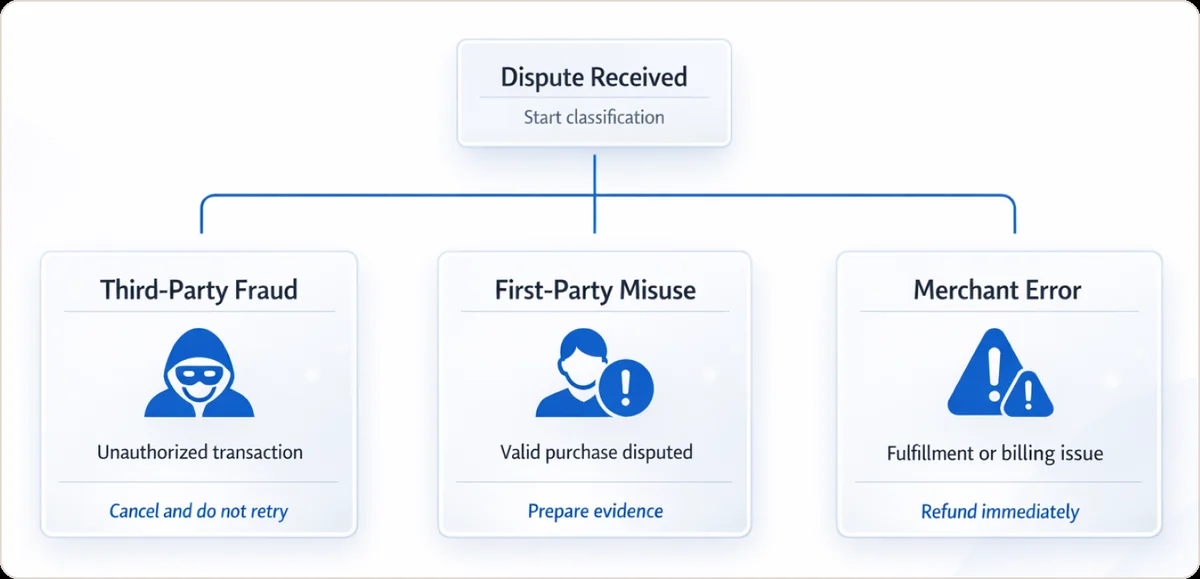
Bucket 1: 3rd party fraud (unauthorized transaction). The customer contacts you proactively, states they did not make the purchase, and shows no prior account activity linked to it. Device and IP do not match their known history. Act: cancel open shipments, do not re-attempt the charge, report organized patterns to your acquirer. Chargeback alerts give you an early warning window to cancel fulfillment before the dispute is formalized, which is the highest-value action in genuine 3rd party fraud cases.
Bucket 2: First party misuse (friendly fraud). The customer has prior undisputed purchase history on the same device and IP. Delivery confirmation exists. The dispute arrives weeks after confirmed delivery. Act: prepare your CE3.0 evidence package, update your billing descriptor, and flag the account for enhanced monitoring. If assembling that CE3.0 package by hand is not realistic, weigh the main alternatives to Justt for automated representment.
Bucket 3: Merchant error. The product was not delivered, the subscription was not cancelled properly, or the return was not processed. Act: refund immediately, fix the process failure, do not fight this category. A chargeback vs refund breakdown of your dispute data will show how much of your volume sits here. For most merchants, it is higher than expected.
According to Stripe's dispute analysis, most disputes merchants label as fraud are actually due to merchant errors or first-party misuse, not criminal third-party fraud.
What Is Visa Compelling Evidence 3.0 and How Does It Work?
Visa Compelling Evidence 3.0 (CE3.0) allows merchants to automatically shift liability back to the issuer for eligible first party misuse disputes under reason code 10.4, by demonstrating the cardholder has a prior verified relationship with the merchant on the same device or IP. Available since April 2023, it is the most actionable network-level tool merchants have for fighting friendly fraud.
To qualify, all four criteria below must be met:
| Criterion | Requirement |
|---|---|
| Prior undisputed transactions | At least 2, from the same cardholder |
| Age of those transactions | Between 120 and 365 days before the dispute date |
| Matching data elements required | 2 of 4: IP address, device ID, email address, or shipping address |
| Mandatory match | At least one must be IP address or device ID |
A customer who disputed a transaction but made two purchases on the same device and IP in the prior year without disputing them loses the chargeback automatically when you present that evidence correctly. The burden of proof shifts from the merchant to the issuer.
Visa Order Insight operates alongside CE3.0 as a pre-dispute deflection tool. It shares up to 120 order-level details with issuers in real time, often preventing the chargeback from being filed at all.
What Is Mastercard First-Party Trust and How Is It Different?
Mastercard First-Party Trust produces its most valuable outcome before the dispute ever reaches you. When a cardholder initiates a dispute, the issuer receives merchant-side behavioral and transactional data in real time and presents it during the resolution conversation. In many cases, the cardholder withdraws the claim when confronted with evidence of their own prior purchase behavior.
Data factors submitted include a device factor, a delivery confirmation factor, and an additional identity factor from the merchant's system. Where CE3.0 wins disputes after filing, First-Party Trust stops them before filing. Both programs require you to capture the device ID, IP address, and delivery confirmation in a mappable format. Without that infrastructure, eligibility on paper means nothing.
What Prevention Steps Actually Reduce Friendly Fraud Without Hurting Conversion?
The highest-leverage prevention action costs nothing. Fix your billing descriptor. Visa's research identifies descriptor confusion as a leading driver of accidental misuse disputes. If your descriptor shows your processor's name instead of your brand, customers who do not recognize the charge will dispute it. That is a one-day fix.
Beyond that, three levers deliver the highest impact-to-effort ratio:
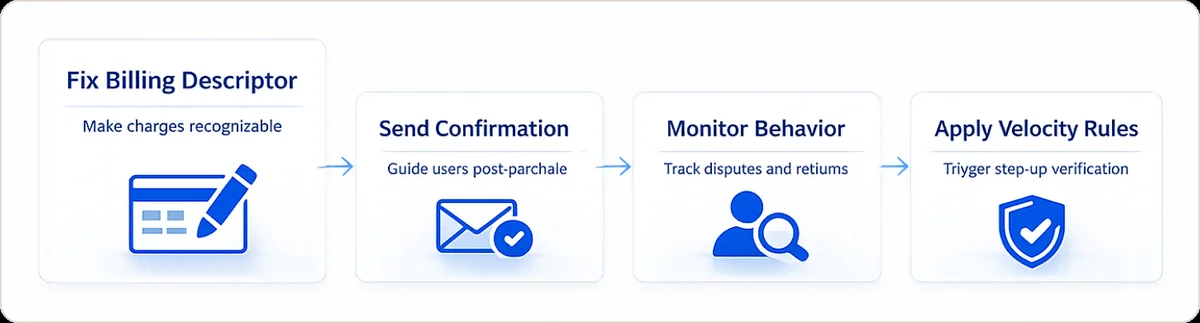
Post-purchase communication. Send a confirmation email within minutes of purchase, including the exact descriptor the customer will see on their statement, a link to their order, and a self-service path to raise a concern. A customer who resolves a question through your support channel does not go through their bank.
Return behavior monitoring. Log return requests and dispute history by account. A customer who has disputed three of their last eight orders is not experiencing bad luck. Flag those accounts for manual review on future high-value transactions.
Promotional velocity rules. Three or more new account signups from the same IP within 24 hours of a promotional launch is a concrete signal worth acting on. Route those accounts to step-up verification rather than blocking. Blocking loses you the legitimate customer. Step-up verification costs the fraudster time they will not spend.
Tracking how your chargeback ratio shifts in response to these interventions tells you which lever is producing the most impact.
Conclusion
Most fraud operations fail not because of bad tools but because of a misclassified problem. Third party fraud requires identity-level defenses: strong authentication, ATO monitoring, and real-time scoring. First party misuse requires intent-level defenses: behavioral biometrics, cluster analysis, CE3.0 evidence packaging, and post-purchase communication that stops disputes before they are filed. For that evidence-packaging piece specifically, it is worth reviewing the strongest alternatives to Chargeflow.
Applying third party tools to first party misuse produces false declines, alienated customers, and dispute ratios that climb regardless of what you spend. Applying friendly fraud tools to genuine ATO attacks leaves real victims unsupported. Checkout screening platforms are built for the third party column, which is why teams usually pair one with dispute-side measurement rather than swapping between them, a split laid out in Beast Insights vs Signifyd and across the Signifyd alternatives that cover the dispute side.
As Monica Eaton-Cardone of Chargebacks911 has explained, friendly fraud leads merchants to lose merchandise, transaction fees, fines, and account stability while fighting illegitimate claims
A merchant who can answer "is this bucket one, two, or three?" within ten minutes of a dispute alert is running a fundamentally different operation than one who cannot. That classification decision is where the revenue difference is made.
FAQ: First Party vs Third Party Fraud
Is friendly fraud the same as first party fraud?
In payments and chargebacks, the two terms are interchangeable. In lending, first party fraud refers to intentional misrepresentation on applications or deliberate default. The context determines which meaning applies.
What is the most significant difference between first and third party fraud?
The identity of the perpetrator. In third party fraud, an external criminal uses stolen credentials to make unauthorized purchases. In first party fraud, the legitimate account holder disputes genuine purchases they authorized and received.
Can first party fraud be accidental?
Yes. A cardholder may not recognize an unfamiliar billing descriptor, a household member may have made the purchase, or a subscription renewal may have been forgotten. These still produce chargebacks but are not intentional. Descriptor clarity and post-purchase communication resolve most accidental cases before they reach a dispute.
How does Visa Compelling Evidence 3.0 work?
Visa CE3.0 allows merchants to contest reason code 10.4 disputes by presenting evidence from two prior undisputed transactions on the same device or IP, made between 120 and 365 days before the dispute. If two of four data elements match, with at least one being IP address or device ID, the dispute is automatically resolved in the merchant's favor.
What is second party fraud in e-commerce?
Second party fraud occurs when a legitimate account holder willingly shares their credentials with a fraudster, often in exchange for payment. The account owner is complicit, making the activity nearly invisible to standard identity detection tools.
How common is first party misuse among e-commerce chargebacks?
The Visa and Datos Insights Consumer Attitudes Toward Chargebacks report (2024) indicates that first party misuse accounts for approximately 70 to 75 percent of all chargebacks, while genuine criminal 3rd party fraud represents only 20 to 25 percent.