Performance-Based Pricing for Chargeback Tools: A Buyer's Guide
Performance pricing bills you on disputes fought. Your costs come from disputes filed. Here are the four chargeback pricing models, their effective take rates, and how to compare cost per prevented dispute.
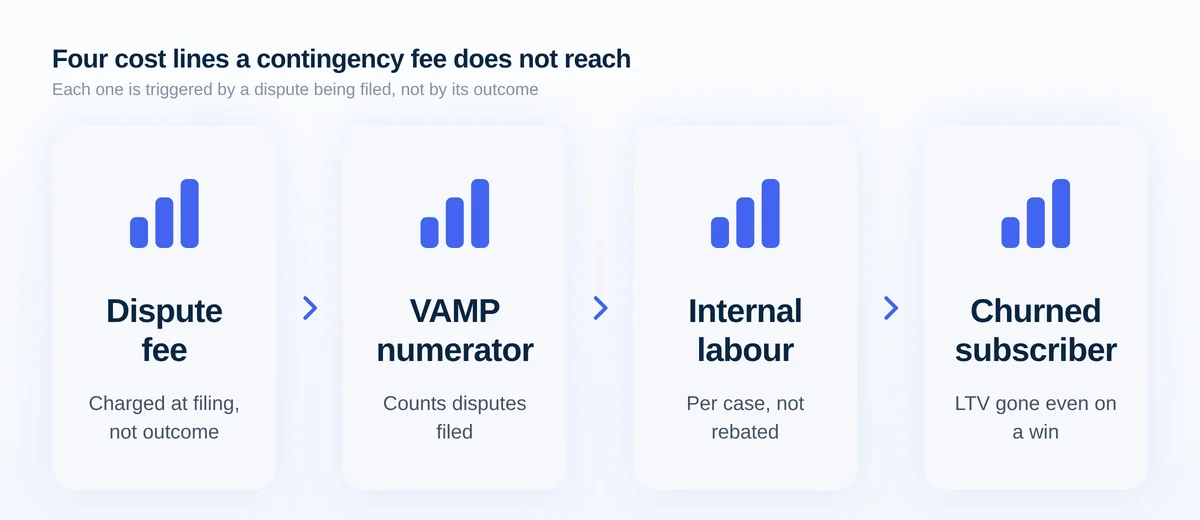
Performance pricing is the easiest thing in payments to say yes to. No recovery means no invoice. But a contingency-priced chargeback tool earns its fee on the disputes you fight. A subscription business bleeds on the disputes that get filed. The filing costs you three things: the dispute fee, the subscriber who is now gone, and the ratio that decides whether your acquirer keeps you. Those are three different cost lines, and one pricing model reaches none of them.
What does performance-based pricing actually mean for a chargeback tool?
Performance based pricing means the vendor bills only when a defined event fires. The vendor wins a dispute, deflects an alert, or approves an order. It feels risk free because the invoice tracks activity. The catch is which activity counts. Most performance models in this category bill on disputes fought, not on disputes prevented.
Filing sets your compliance exposure. The Visa Acquirer Monitoring Program (VAMP) ratio divides the count of fraud reports (TC40) plus disputes (TC15) by the count of settled card-not-present transactions. Visa's own VAMP fact sheet lists exactly two exclusions: disputes resolved through pre-dispute solutions, and TC40 fraud that qualified for Compelling Evidence 3.0. Representment wins are not on that list. A vendor paid on wins therefore cannot move your chargeback ratio.
Why paying per won dispute rewards fighting instead of preventing
Stripe states the rule plainly: won disputes still count toward your dispute rate. Prevention, not representment, keeps you out of monitoring programs. So model the vendor's revenue line. Under contingency it equals cases won multiplied by the fee rate multiplied by average dispute value. Each of those three inputs rises when your dispute count rises.
- A vendor on 25% of recovered revenue earns more in a month when your dispute count goes up, not down.
- Merchants contest about 54.2% of the cases they receive, so the fee base covers roughly half your dispute volume while the ratio counts the whole of it.
- Reported win rates run around 43.8% of the chargebacks represented, but net recovery lands near 10.7% once second-cycle escalations are counted.
- Fraud-coded disputes, the bulk of subscription 'I did not authorise this' claims, are won only about 17% of the time, so contingency revenue concentrates in non-fraud codes while the VAMP numerator is driven by fraud codes.
What are the four pricing models, and which vendors use each one?
Four structures dominate the category. The first takes a percentage of recovered revenue, typically 20% to 25%. The second charges per alert, at $15 to $29 per prevention event. The third charges per win with a cap. The fourth is flat pricing by subscription tier or payment volume, at $50 to $2,500 per month. Enterprise tiers run higher. Most vendors sell two or three of these at once, on separate invoices. Published rates also vary more than the category admits: Chargeback Gurus lists $40.00 per alert received on its own partner FAQ while quoting representment per proposal, a split the Chargeback Gurus alternatives comparison lines up against vendors that publish both.
| Vendor | Pricing model | Published rate | What it leaves on your P&L |
|---|---|---|---|
| Chargeflow | Percentage of recovered revenue | 25% per recovered chargeback, $29 per deflected chargeback, $0.20 per scanned transaction | Success fee is calculated on the disputed amount only and does not cover the processor's chargeback fee |
| Disputifier | Per win with a cap | 20% of recovered revenue capped at $250 per won case, $0.05 per order for prevention | The cap helps high-ticket plans and does little for small-ticket subscription disputes |
| Stripe Smart Disputes | Percentage of the disputed amount per win | 30% of the disputed amount per dispute won, nothing charged on losses | The $15 dispute received fee still applies and is not returned outside Mexico |
| Chargeback.io | Per alert | $29 per Ethoca alert, $15 per Visa RDR alert, $15 per CDRN alert, no monthly minimum | The refunded order value, plus duplicate alerts where Ethoca and CDRN see the same order |
| Signifyd | Percentage of order total on approved orders | A percent of GMV on approved orders, nothing charged on declines | A clean month still carries a bill, because the fee tracks orders rather than disputes |
| Chargebacks911 | Not published | No representment, alert or minimum pricing on the public site as of 20 July 2026; third-party reporting puts enterprise tiers around $1,000 to $3,000 per month | Unknown until quoted, so model it as a flat fee plus a negotiated success fee |
| ChargeMate | Flat per case or per win | $10 per case or 20% on wins, with no monthly minimum and no contract | Per-case billing charges you whether the case is won or lost |
Rates as published by each vendor and by third-party pricing audits during 2026. Prevention and representment are separately priced product lines at each vendor above that sells both.
The table has no column for disputes prevented. Prevention and representment are different jobs. They bill on different units and run on different clocks. Deflection catches the case after the cardholder calls the issuer and before anyone files a chargeback. Representment fights a chargeback that has already landed and already counted. If you are shortlisting, our vendor alternatives page lists who sells which line. Our explainer on chargeback representment covers what the post-filing job can and cannot do.
How do you calculate the effective take rate of a percentage-of-recovered-revenue deal?
Divide the vendor's total annual fees by the total dollar value of disputes filed against you, not by the amount recovered. Vendors quote the headline percentage against the cases they chose to fight and won. Your profit and loss statement (P&L) lives on the full filing count. That denominator is much larger, and it produces a very different number.
- Count the disputes filed in the period and their total dollar value, including the ones nobody fought.
- Apply a realistic recovery rate. Merchants represent about 43.8% of cases and net roughly 10.7% of disputed value after second-cycle escalations.
- Multiply recovered dollars by the fee rate, then check the base. Stripe's Smart Disputes charges 30% of the disputed amount, not the recovered amount.
- Add the lines the percentage does not cover: platform or minimum fee, alert fees, per-order or per-scanned-transaction fees, the processor's dispute fee of $15 to $25 and up, and 20 to 45 minutes of internal time per case.
- Divide that total by disputes filed to get cost per dispute touched, then by disputes actually prevented to get the number that maps to your ratio.
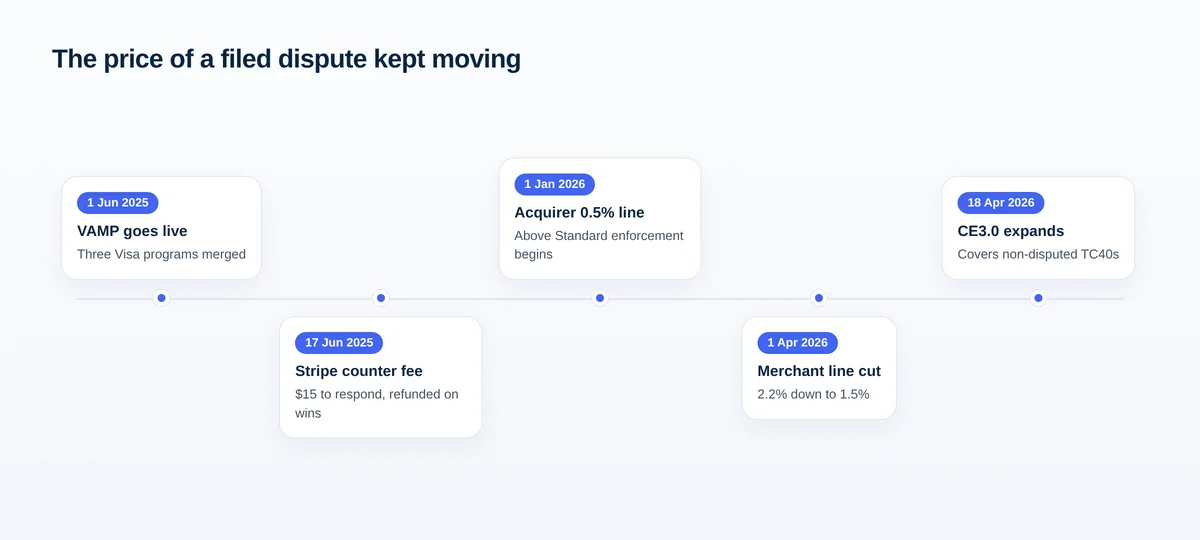
Run it on the standard illustrative scenario. Recovering $10,000 across 30 won cases averaging $333 costs $2,500 at an uncapped 25%. The same recovery costs $2,000 at 20% capped at $250. The two models cross over as average order value climbs toward $2,000. Now add the rest of the invoice. A published worked example of stacked contingency billing starts with a store: 20,000 quarterly orders, 120 disputes, $10,000 recovered, and 40 deflections. That store pays $3,800 for prevention, $1,160 for alerts, and $2,500 in success fees. The bill totals $7,460 against $10,000 recovered. Only $2,500 of it is charged against recovery. Now layer the processor on top. At Stripe's published $15 dispute received fee, those 120 filings carry $1,800 that no percentage of recovery reaches. Stripe charges a further $15 for each dispute countered, and returns it only on a win.

How do per-alert fees behave when Verifi and Ethoca volume spikes?
Per-alert pricing runs linear with no cap. A spike in Verifi Rapid Dispute Resolution (RDR), Cardholder Dispute Resolution Network (CDRN), or Ethoca volume converts straight into an invoice. Published reseller rates run $29 per Ethoca alert and $15 per Visa RDR or CDRN alert. RDR is a rules engine, not a queue. Once you configure your scenarios, it auto-refunds and auto-bills without a human gate.
- Duplicates. Ethoca and CDRN both see Visa disputes and overlap on roughly 15% to 20% of the same orders, so one order can generate two billable alerts. Providers differ on whether the duplicate is waived.
- Alerts on orders that were not going to dispute. Stripe's own data puts about 80% of early fraud warnings converting into a fraud dispute if you do nothing, which means roughly one in five you pay to resolve was not headed for a filing.
- Low-value orders. A $19 alert plus a full refund on a $28 order is not a win against a $20 chargeback fee, it is a loss with extra steps.
- The refunded principal. The alert fee buys you the right to spend the order value, and for a subscription business it also ends the recurring relationship.
- The fee that survives the deflection. With Ethoca and CDRN the processor typically sees no chargeback, but with RDR the processor sees a resolved dispute and may still bill a chargeback fee, even though RDR cases are excluded from the Visa dispute ratio.
- The TC40 that stays behind. RDR removes the TC15 dispute from the VAMP numerator, but a fraud report filed on the same transaction still counts.
The defence against a spike is a dollar floor and a duplicate-matching rule, not a bigger budget. Stripe publishes an explicit break-even. Refund pre-dispute warnings on charges at or below your dispute fee. Above about 135% of that fee, the refund stops being worthwhile. Auto-refunding on receipt is the failure mode. You refund transactions that were never going to dispute. Per LexisNexis, anti-fraud measures are themselves a churn lever, and more than half of US merchants now report it. Our guide to chargeback alerts walks through the three shapes of dead alert spend in more detail.
What does a chargeback actually cost a subscription business beyond the dispute fee?
A chargeback costs far more than the disputed amount. Javelin research puts the all-in merchant cost of a single chargeback near $128. That total splits into $46 in third-party fees and $82 in internal labour. For a subscription book, a published worked stack on a $29 charge reaches $289 immediately. It reaches $521 once you count the churned subscriber's remaining value.
- The refund itself, $29, plus a $15 chargeback fee and around $5 of service already delivered.
- A $40 alert fee if the case was flagged, and roughly $200 of staff time at four hours against a $50 hourly rate.
- $232 of destroyed lifetime value across an average eight remaining months, which a representment win does not bring back.
- An $8 VAMP assessment per fraudulent or disputed transaction while you sit in the Excessive tier, charged on the count of filings.
- Mastercard's Issuer Recovery Assessment of $5 per chargeback above the first 300, plus ECM fines that start at $1,000 in month two.
The mix makes this a subscription problem, not a generic ecommerce one. Subscription merchants run chargeback rates of 1% to 2%, double standard ecommerce. Recurring billing accounts for about 27.1% of disputes. Friendly fraud is 70% to 79% of the total, against 40% to 60% elsewhere. Subscription disputes are also the smallest-ticket vertical in Mastercard's data, at an average $69. A 25% success fee on a won case is worth about $17 to the vendor. That filing already cost you the fee, the ratio, and the subscriber. The merchant Excessive VAMP threshold moved from 2.2% to 1.5% on 1 April 2026. Tolerance for filed disputes narrowed, and contingency pricing kept measuring wins.
What is your cost per prevented dispute, and when does flat pricing beat performance pricing?
Cost per prevented dispute is total spend on the dispute programme, including refunded principal, divided by the number of disputes that stayed off your count. It is the one denominator that normalises across all four models. You can reduce a contingency vendor, a per-alert reseller, and a flat subscription each to dollars per filing avoided.
- Numerator, per-alert model: alert fees, plus the refunded order value on each resolved alert, plus any duplicate fees the provider did not waive.
- Numerator, contingency model: success fees, plus platform and per-order fees, plus the processor's dispute received and countered fees on the cases fought.
- Numerator, flat model: the monthly subscription, plus the same processor dispute fees, plus internal handling time.
- Denominator in each case: disputes that did not get filed, measured against your own pre-programme baseline rather than against alert volume.
- Sanity-check the denominator with realistic operating benchmarks. Alert match rates of 30% to 50% and dispute reductions of 20% to 40% are the range to model, not the ceiling.
The break-even between flat and success-fee pricing is arithmetic. Divide the monthly subscription by (average dispute value x win rate x success fee percentage). At $500 a month, a $120 average dispute, a 55% win rate, and a 20% fee, the break-even lands near 38 disputes a month. Below that, contingency is cheaper. Above it, flat pricing pulls ahead, and the gap widens with scale. At double the volume, the success-fee bill doubles and the subscription does not. A higher win rate can also net you less money. A 70% win rate on a 30% success fee can leave you with less than a 55% win rate on a flat subscription.
What should you ask a vendor before signing a contingency contract?
Two percentages are not comparable until you know four things: the base, the cap, and whether declined cases cost anything. The fourth is what happens to the fee if a case is later reversed. Public pricing pages rarely list that last one. Put it in writing as your first question.
- What exactly is the fee base: recovered amount, disputed amount, or order value? Stripe's Smart Disputes bills 30% of the disputed amount, which is a different number from 30% of what lands back.
- Is there a cap per case, and at what average dispute value does your capped model cross over against an uncapped competitor?
- What counts as a 'win', and is the fee refunded if the case is reversed in a second cycle or lost at pre-arbitration?
- Who pays the processor's dispute fee, and does the success fee sit inside it or on top of it?
- On alerts: are duplicate Ethoca and CDRN charges on the same order waived, and do you credit an alert we refunded that still became a chargeback?
- Which reason codes do you decline to fight, specifically the recurring-billing codes 13.2 and 13.7 that concentrate in subscription books?
- Do you support Compelling Evidence 3.0, and who controls the single submission attempt, given that incomplete responses are declined and cannot be retried?
- What are the minimum term, the termination notice, and the export path for dispute evidence, alert history and case outcomes if we leave?
Expect some vendors to answer none of that in writing until you are deep in a sales process, because they publish no rate at all and size the quote to your monthly dispute volume. That is common among the done-for-you providers, and our roundup of Chargeback360 alternatives sets the quote-only options side by side with the ones that publish a per-alert and per-recovery rate you can model first.
Ask one more question that rarely comes up: which of your cost lines does this contract actually reduce? If the answer is only 'recovered revenue', you are buying a revenue product and calling it a compliance product. Three levers move an acquirer ratio letter: fewer disputes filed, more disputes resolved before filing, or more settled transactions. Representment appears on none of those three lists.
Frequently Asked Questions
Is a flat-fee or pay-per-alert chargeback model more cost-effective?
It depends on alert volume and how steady it is. Per-alert pricing tends to win while your monthly count stays low, because a quiet month costs nothing. Flat pricing tends to win once volume is high or spiky, since per-alert cost is linear at $15 to $29 per alert with no cap and a surge bills at list rate.
What percentage do chargeback companies take of recovered revenue?
Published contingency rates cluster at 20% to 25% of recovered revenue. Chargeflow lists 25% per recovered chargeback, Disputifier lists 20% capped at $250 per won case, and Stripe's own Smart Disputes charges 30% of the disputed amount per win. Broader market surveys put the category range at 15% to 40%.
Does winning a chargeback remove it from your chargeback ratio?
No. Visa's VAMP ratio counts a dispute when it is filed, and the fact sheet excludes only disputes resolved through pre-dispute solutions and TC40 fraud that qualified for Compelling Evidence 3.0. Mastercard counts a chargeback regardless of refund, liability shift or outcome. Winning recovers money, not ratio.
Is a chargeback management company worth it for a small business?
Often yes, but at small volume the pricing model matters more than the vendor. Below roughly 38 disputes a month, a 20% success fee on a $120 average dispute at a 55% win rate typically costs less than a $500 monthly subscription. Above that crossover, flat pricing usually pulls ahead.
Can I switch chargeback pricing models or vendors later as my volume grows?
Yes, and it is a contract question rather than a technical one. Before signing, check the minimum term, the termination notice period, any monthly minimum you are committed to, and whether you can export dispute evidence, alert history and case outcomes in a usable format. Portability is what keeps the switch cheap.
What are the hidden costs to look for when comparing chargeback vendors?
The headline rate is one of about six cost lines. The others are the platform or minimum fee, alert and deflection fees billed separately from representment, per-order or per-scanned-transaction fees, the processor's dispute fee of $15 to $25 and up, and 20 to 45 minutes of internal handling time per case.