Chargeback Representment Win Rates: A Data-Driven Playbook
What makes a chargeback representment program profitable? This guide covers win rate definitions, CE 3.0 evidence, triage, and VAMP compliance.
Most Merchants Are Winning Cases and Still Losing Money
Here is the uncomfortable truth most vendor blogs will not say directly: a 60% representment win rate can still be a losing program. If your team is spending $55 in labor to contest a $40 transaction and winning it, you have lost $15. Your win rate looks good. Your P&L does not agree.
I have worked through enough dispute data to see this pattern repeatedly. Teams optimize the metric they track, and most teams track the wrong one. The industry benchmark of 45% for contested disputes sounds useful until you realize two different operations can both post 45% while one generates positive net recovery and the other bleeds money on every case it fights.
This guide is built around one principle: chargeback representment is a data system, not a one-off argument. What follows is the measurement framework, the evidence playbook, the triage model, and the compliance context you need to make it work.
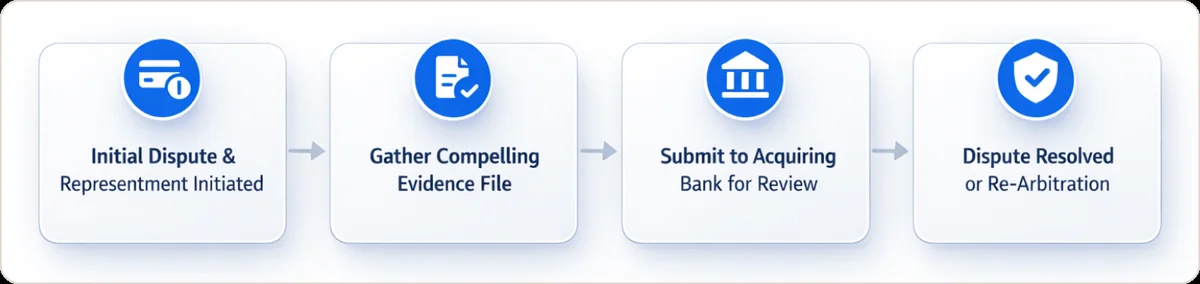
What Is Chargeback Representment, and How Does the Process Work?
Chargeback representment is a merchant's legal right to contest a dispute by re-presenting the transaction to the issuing bank with documented evidence. When a cardholder disputes a charge, the issuer reverses the funds immediately. The representment process is the merchant's one formal opportunity to reverse that reversal.
The distinction between first presentment (the original authorization) and re-presentment (the merchant's challenge) matters because they operate under different rules. First presentment is a payment event. Chargeback representment is a legal filing governed by card network timelines. Missing a response deadline is an automatic loss regardless of evidence quality.
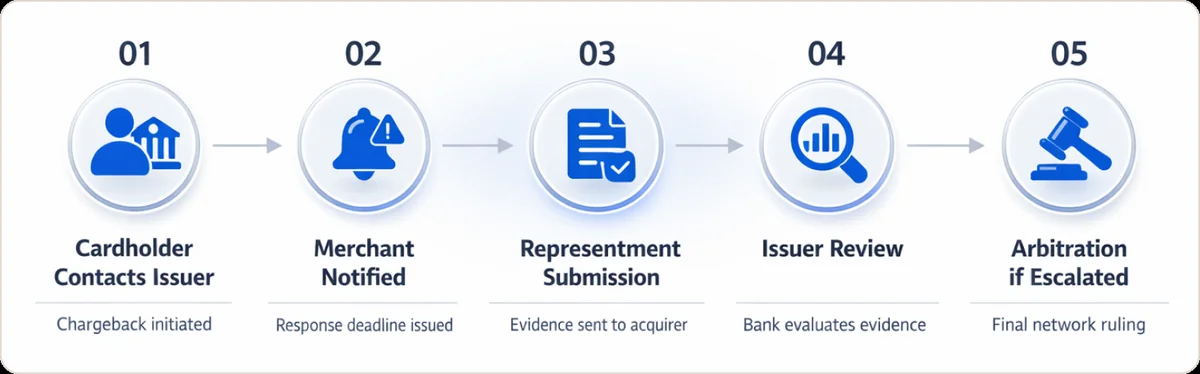
The process runs in five steps:
- Cardholder contacts issuer. If the claim is deemed valid, a chargeback is initiated and funds are pulled from the merchant account.
- Merchant is notified. The acquirer issues a response deadline. Miss it and the case closes as a loss.
- Representment submission. The merchant submits a rebuttal letter with supporting evidence. The acquirer forwards the package to the issuer.
- Issuer review. The bank analyst reviews the evidence against the specific reason code. Visa's standard review period is approximately 30 days.
- Pre-arbitration or arbitration if escalated. Formal arbitration fees run $400 to $500 per case, and the card network's ruling is final.
Many disputes can be intercepted before they reach the chargeback representment stage. Real-time alert tools like Verifi and Ethoca notify merchants when a dispute is filed, opening a window to resolve the issue before a formal chargeback is recorded. If you are not running a pre-dispute alert system alongside your representment workflow, you are solving only half the problem.
Why Win Rate Misleads More Teams Than It Helps
Win rate measures the percentage of contested disputes where the merchant received a favorable ruling. It is technically accurate and operationally dangerous if used alone.
Kount explicitly states there is no official win rate calculation endorsed by the card networks. Two vendors quoting "65% win rate" may be using completely different denominators, including or excluding pre-arbitration wins, unfought cases, or withdrawn disputes. Kount publishes its own denominator, which is a useful habit to demand of any vendor you shortlist, and Beast Insights vs Kount sets out where that measurement discipline stops and where the alert side of the same program is still unmeasured. If that measurement gap is what you are shopping on, the roundup of Kount alternatives compares the dispute stacks on what they can prove rather than on headline win rates.
The four definitions every team needs: Win Rate (wins divided by total contested), Win Rate+ (adds pre-arbitration wins to the numerator), Net Recovery Rate (net dollars recovered divided by total dollars lost), and Net Dollar Recovery (revenue recovered minus all labor, fees, and arbitration costs).
Net Dollar Recovery is the only number that tells you whether representment is actually making money. A team posting 70% win rate on $40 cases with $55 average labor cost is running a money-losing operation. A team posting 40% win rate on $300 cases with tight triage and $20 labor cost is generating a real return.
As Justt's analysis of win rates as a KPI argues, a high win rate is actively misleading if you are only contesting the easiest cases. The program looks healthy. The financials say otherwise.
Industry Benchmarks: What a Good Representment Win Rate Looks Like
The 45% industry average masks extreme variation by vertical. Knowing where your sector lands is the starting point for any honest performance review.
| Industry Vertical | Avg. Chargeback Rate | Win Rate (Contested) | Net Recovery Rate |
|---|---|---|---|
| Travel and Hospitality | 4.68% | 30.47% | ~12% |
| Digital Goods / Gaming | 1.85% | 41.43% | ~22% |
| Apparel / Fashion | 0.18–0.95% | 35.81% | ~15% |
| Consumer Electronics | 0.31–1.00% | 16.59% | ~5% |
| Subscriptions / SaaS | 0.54–1.85% | ~35% | ~14% |
Source: Midigator / LexisNexis dispute benchmark data, 2024.
Consumer electronics sit at the bottom for a structural reason. High-resale-value goods attract professional criminal fraud, and in true fraud cases where the cardholder genuinely did not authorize the purchase, merchants win fewer than 9% of the time. The only reliable win condition is a signed delivery receipt where the cardholder personally accepted the item.
Digital goods achieve the highest net recovery because server-side usage logs, IP matches, and download timestamps are already collected passively at every transaction. The failure point for most digital merchants is not evidence quality, it is retrievability. The logs exist but are not stored in a format that can be pulled quickly for a representment submission.
Travel faces the opposite problem. High transaction values combined with fragmented booking systems mean travel merchants often cannot produce the real-time fulfillment data issuers expect.
What Evidence Actually Wins a Chargeback Representment Case?
A generic evidence list is not a strategy. In the chargeback representment process, evidence must match the specific reason code being disputed. The issuer analyst is checking whether your submission directly contradicts the specific claim filed, not looking for reasons to rule in your favor.
Unauthorized and fraud claims (Visa 10.4, Mastercard 4853) are the highest-volume dispute category. Visa's Compelling Evidence 3.0 framework changes the outcome math here. To qualify, a merchant needs two prior undisputed transactions from the same cardholder dated 120 to 365 days before the disputed charge, with at least two matching data elements from: User or Account ID, IP address, shipping address, or Device ID/fingerprint. One match must be either an IP address or a Device ID.
When CE 3.0 criteria are met, Visa automatically reverses the chargeback through a rules-based process. These wins are also excluded from VAMP ratio calculations, which have direct compliance implications covered below.
Item not received (INR) claims require a signed delivery confirmation with the recipient's name, carrier tracking showing delivery to the verified billing address, and, for digital goods, server logs showing the download IP, timestamp, and session duration.
Not as described disputes have one evidence requirement most merchants get wrong: submit the product description as it existed at the time of purchase, not the current version. Merchants who update product pages after a dispute and then submit the updated copy hand the issuer evidence that undermines their own case.
Recurring subscription cancellation disputes require the enrollment agreement showing the cardholder accepted recurring terms, confirmation that no cancellation request was received before the disputed billing date, and customer service interaction logs.
The rebuttal letter structure matters as much as the attachments. Open with ARN, case number, and reason code in bold. Follow with one sentence that directly contradicts the claim. List each attachment with a single line explaining what it proves. Close with the accepted policy and a formal reversal request. Per Visa's Dispute Management Guidelines (June 2024), illegible or untranslated documents are treated as absent.
For a breakdown of what each Visa and Mastercard reason code requires, the chargeback reason codes guide maps every major code to its documentation requirements.
How to Build a Measurement System That Actually Improves Over Time
Most teams track win rate. High-performing teams track loss reasons. That is the difference between knowing you are losing and knowing why.
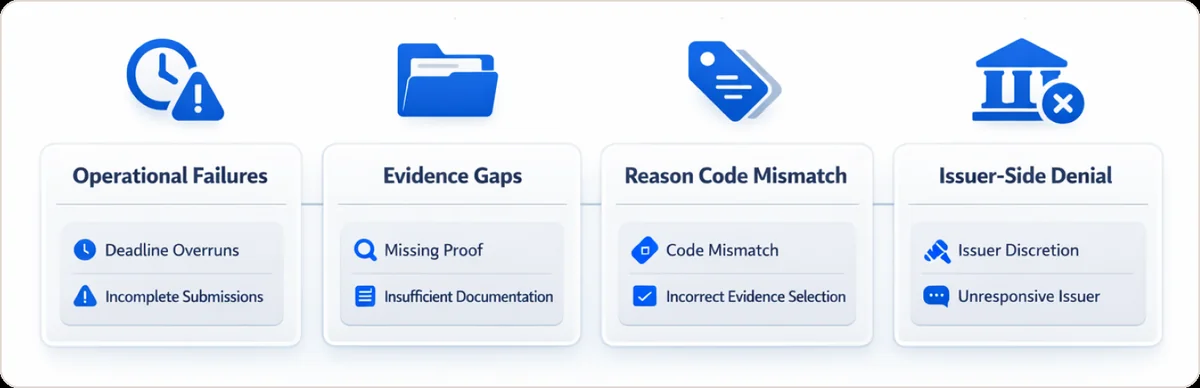
A practical loss reason taxonomy breaks into four categories.
Operational failures cover missed deadlines, incomplete submissions, and illegible documents, all fixable within 30 days.
Evidence gaps occur when the right documentation was never collected at the transaction moment, requiring upstream fixes to checkout or fulfillment workflows.
Reason code mismatches happen when submitted evidence addresses the wrong dispute type.
Issuer-side denials are cases where evidence was strong, but the issuer ruled against the merchant anyway. Track these separately as pre-arbitration candidates.
Your dashboard should capture dispute ID, reason code, transaction and dispute dates, network deadline, internal submission date, outcome (Won, Lost, Pre-Arb Won, Pre-Arb Lost, Did Not Fight), loss reason, and net dollar recovery per case.
One reality most teams discover too late: acquirers do not surface granular outcome data by default. Building this tracking layer requires direct coordination with your processor. Run a monthly root-cause review, trace the highest-frequency loss reason to a process or evidence gap, fix it, and measure the next cohort. Over two to three cycles, the program self-corrects into a structurally higher win rate.
When to Fight, When to Accept: The Triage Decision in Numbers
Not every dispute is worth contesting. Running chargeback representment without a triage filter burns analyst time on cases that cannot be won or are not worth winning financially.
The decision formula: (Transaction Value x Estimated Win Probability) minus (Labor Cost plus Fees). If the result is negative, do not fight.
A $40 transaction with 30% win probability and $55 total cost produces $12 expected recovery minus $55 in cost, negative $43 net. Accept it. Apply that analyst time to a $300 case with 60% win probability: $180 expected recovery minus $55 cost, positive $125 net. Some managed providers now run that filter for you and file only what their model expects to win, which is the pitch behind Chargeback360; the roundup of Chargeback360 alternatives compares that approach against vendors that show you the triage and the outcomes afterwards.
The inputs that drive this calculation: transaction value (below $50 to $75 rarely clears the cost threshold), evidence quality (usage logs, signed delivery, or 3DS auth records versus no proof at all), reason code type (CE 3.0-eligible friendly fraud is the highest-probability category), cardholder history (repeat disputers are low-probability contests), and deadline proximity (fewer than three days remaining changes the risk equation).
Transactions with completed 3DS2 authentication shift dispute liability to the issuer, so many of those cases do not need representment at all, reducing the overall volume your team manages.
How Visa VAMP and Mastercard ECP Change Your Representment Strategy
Chargeback representment strategy cannot ignore card network monitoring programs. Penalty costs from program enrollment can quickly exceed what representment wins are recovering.
Visa VAMP measures a count-based ratio: fraud reports (TC40) plus disputes (TC15) divided by settled transactions (TC05). The key implication for representment is direct. Disputes resolved through Visa CE 3.0 are excluded from VAMP calculations entirely. CE 3.0 adoption is therefore a dual-benefit decision: it wins more cases and simultaneously reduces monitoring program exposure. If your VAMP ratio is approaching the threshold, prioritizing every CE 3.0-eligible case in your queue is the highest-ROI move available to your team.
Mastercard ECP triggers when the chargeback-to-transaction ratio exceeds defined thresholds. According to PayPal Braintree's ECP documentation, the fine schedule escalates materially by tier. A merchant who enters at the standard tier and allows the ratio to climb will see per-dispute fees increase to a level where the monitoring program's financial impact outpaces the disputes themselves.
What representment directly affects the dispute count in both ratios. Each win reverses a dispute and reduces that count. What it cannot affect is the fraud report (TC40) count, driven by pre-authorization fraud prevention and 3DS2 authentication. Dispute management and fraud prevention solve adjacent problems and both are required for ratio health. The card scheme compliance guide covers the full VAMP and ECP penalty structure.
Representment vs. Related Terms: Quick Clarifications
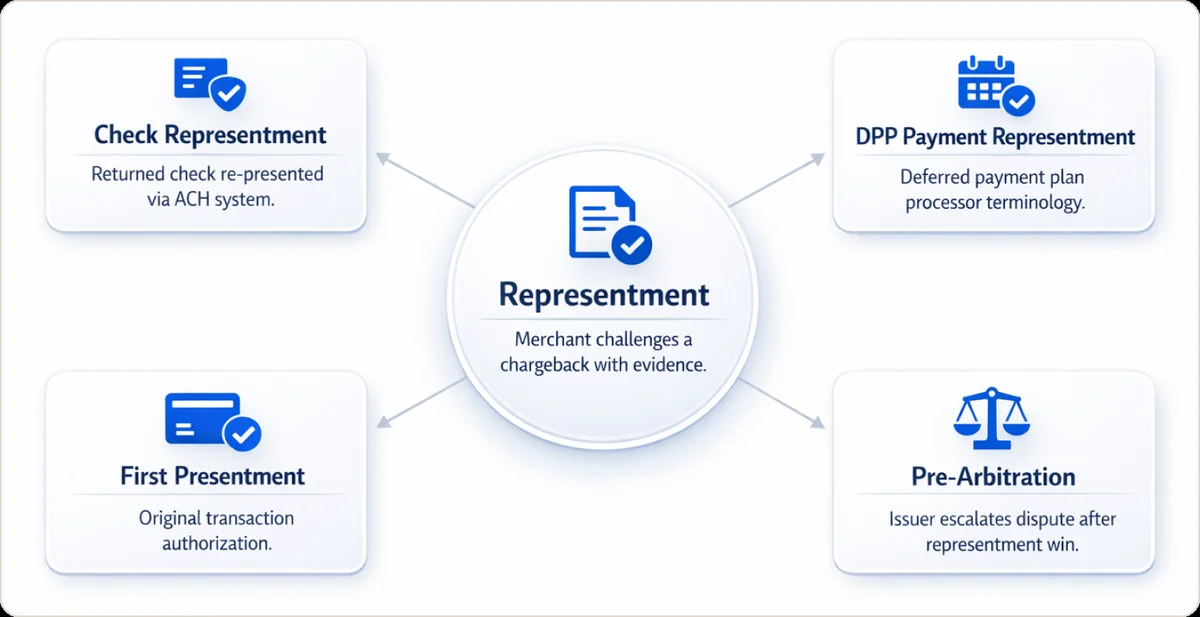
Check representment refers to re-presenting a returned check through the ACH system. It is a separate process for checking payments under different federal rules, not a card network concept.
DPP payment representment is a deferred payment plan term used in specific processor contexts. It is not a universal card network standard.
First presentment is the original transaction authorization, the record that representment defends.
Pre-arbitration is the escalation stage after a merchant wins representment and the cardholder continues to contest, not an alternative name for representment itself.
Conclusion: Build the System Before You Fight the Cases
The merchants who consistently outperform the 45% benchmark treat chargeback representment as a closed-loop analytics system, not a reactive filing process.
That system needs four things: upstream data capture at every transaction touchpoint, a triage filter that routes only financially viable cases into the workflow, evidence built around reason codes rather than generic documentation, and a loss reason taxonomy that drives monthly improvement cycles.
Win rate is a useful signal. Net dollar recovery tells you whether the program is generating real value. And no representment strategy is complete without accounting for how dispute counts feed into Visa VAMP and Mastercard ECP thresholds, because monitoring program penalties can erase everything representment wins back.
Fix the measurement system first. Build the evidence strategy second. Ask the automation question third. Get those in order, and the win rate takes care of itself.
Manual vs Automated Representment: When Should You Scale It?
Handle disputes by hand and each case runs roughly 30 to 60 minutes of labor, about $12.50 to $25 per dispute before the disputed amount. Manual win rates sit near 20 to 40 percent versus 50 to 70 percent or more with automation. Once you cross about 50 disputes a month, manual handling stops scaling. If you are still deciding which cases even qualify to fight, start with chargeback reason codes and the chargeback vs refund distinction before you invest in tooling. When you do compare automated and managed representment vendors, see how Beast Insights stacks up against Chargeback Gurus, Justt, and the alerts-plus-representment portal ChargebackHelp.
- Keep it manual when volume is low or a case needs deep, in-depth investigation, since analyst review still adds value there.
- Automate as volume climbs: analyst-only services hit bottlenecks and either turn away requests or compromise quality to keep up.
- Labor is about 32 percent of net chargeback expense, so cutting per-case handling time is where automation pays back fastest.
- Use a human-in-the-loop model: let the system draft a per-dispute rebuttal and assemble evidence, then review or auto-accept its fight-or-accept recommendation.
- Anchor the decision in your own numbers. Beast breaks recovery, declines and disputes down by decline code, issuer, BIN, gateway/MID, acquirer, card brand and billing cycle so you scale effort where the leak actually is.
FAQ
What is the representment definition in payments?
Representment is the process by which a merchant contests a chargeback by submitting evidence to their acquirer, who re-presents the disputed transaction to the issuing bank under card network rules.
What is a good chargeback representment win rate?
The industry average is 45% for contested cases. A well-run program with disciplined triage and reason-code-matched evidence should target 55% to 65%, with net dollar recovery being the more meaningful performance measure.
How long does the chargeback representment process take?
Typically 30 to 45 days from submission to issuer ruling. Merchant response windows are generally 30 days from dispute notification.
What is compelling evidence in chargeback representment?
Documentation that directly contradicts the specific reason code disputed. For Visa 10.4, this means IP matches, device fingerprints, and CE 3.0 transaction history. For item not received, it means carrier tracking showing delivery to the billing address.
What is the difference between representment and pre-arbitration?
Representment is the first formal challenge to a dispute. Pre-arbitration is the escalation when the cardholder continues to contest after the merchant wins. Arbitration fees are $400 to $500 per case and the ruling is final.
Does winning representment affect Visa VAMP ratios?
Yes. Each win reverses the dispute and reduces the VAMP count. CE 3.0 wins are excluded from VAMP calculations entirely, making them the highest-priority cases to fight.
When should a merchant not fight a chargeback?
When transaction value falls below the break-even cost of labor and fees, when evidence does not match the reason code, or when the case involves confirmed true fraud with no cardholder data link.
At what dispute volume should I automate chargeback representment?
Around 50 disputes per month is the common tipping point where manual handling stops scaling. Below that, manual review still works, especially for cases needing in-depth investigation. Above it, analyst-only workflows hit bottlenecks and teams either turn away cases or compromise quality to keep processing volume. If you are shortlisting a platform that covers alerts and representment together, the best ChargebackHelp alternatives compare the main full-lifecycle options.
How much does handling a chargeback manually actually cost?
A manual case runs roughly 30 to 60 minutes of labor, about $12.50 to $25 per dispute at $25 per hour, before the disputed amount itself. Labor makes up around 32 percent of net chargeback expense, which is why cutting per-case handling time is where automation pays back first.