Verifi vs Ethoca Alerts: Which Rails Do You Actually Need?
Verifi is Visa-owned and Ethoca is Mastercard-owned, but both rails carry Visa disputes. Here is the coverage, cost and double-billing math behind the choice.
Search "Verifi vs Ethoca" and page one hands you a feature table between two vendors. That framing is wrong. It is also why the answers you get back are vague. Verifi is Visa's dispute-prevention arm. Ethoca is Mastercard's. So this is a decision about which network rails your card mix needs, not a bake-off between suppliers you pick one of. Get the framing right and three practical questions fall out. Where do the rails overlap? Where does that overlap bill you twice? At what ticket size does an alert stop being cheaper than the chargeback it prevents? If you are still mapping the category itself, start with our primer on chargeback alerts.
Verifi vs Ethoca: are they competitors, or two network-owned rails you may need both of?
Verifi and Ethoca are not competing vendors. Visa owns Verifi. Mastercard owns Ethoca. Both carry disputes from the other network's cards, because each bank decides its own participation. So the question is not which one wins. The question is which rails your card mix needs, and where they bill you twice.
Visa completed its acquisition of Verifi on 12 September 2019. Ethoca's site now brands itself as an Ethoca by Mastercard property. Ownership is not coverage. CDRN is Verifi's Cardholder Dispute Resolution Network, the rail that sends merchants manual dispute alerts. Verifi's own seller page says CDRN resolves Visa and non-Visa transaction disputes across Mastercard, Discover and American Express. Ethoca advertises dispute data from all card brands. Each network negotiates reach issuer by issuer. That is why the tidy brand split falls apart in your actual alert feed.
That matters commercially. Every reseller sells access to the same two networks. Coverage is therefore not a vendor differentiator, and a feature table cannot tell you what to buy. Your own Visa-versus-Mastercard dispute split can tell you. Pull that split from processor data and set it against the price of each rail.
| Product | Owned by | What it carries in practice | Merchant action | Note |
|---|---|---|---|---|
| Verifi RDR | Visa | Visa disputes only, roughly 95% of Visa transactions | None, auto-credit fires on preset rules | Issuer participation is opt-out, so reach is broad but not assured for a given BIN. |
| Verifi CDRN | Visa | Visa plus some Mastercard, Amex and Discover | Manual, about 72 hours | Verifi calls CDRN card-brand agnostic, which is exactly where it collides with Ethoca. |
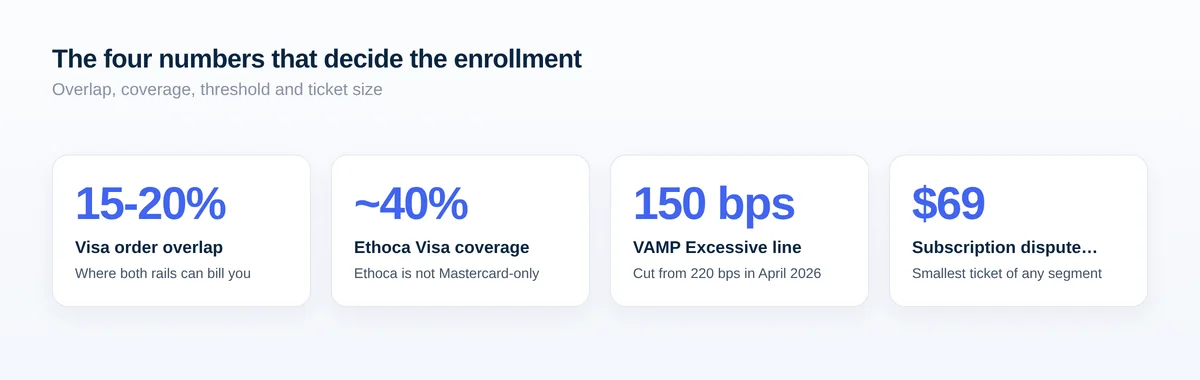
| Ethoca Alerts | Mastercard | About 95% of Mastercard disputes and about 40% of Visa disputes | Manual, objective within 24 hours | That 40% Visa share is the overlap surface with the Verifi rails. |
| Order Insight | Visa | Visa pre-dispute data sharing, not an alert | None once integrated | No per-transaction licence fee, so it is a coverage decision rather than a cost one. |
| Consumer Clarity | Mastercard | Mastercard pre-dispute data sharing, not an alert | None once integrated | Prevents the dispute without paying the customer back, unlike an alert. |
Coverage percentages are vendor-published estimates; neither network publishes issuer participation lists, so treat them as directional.
What does each product actually do across RDR, CDRN, Order Insight, Ethoca Alerts and Consumer Clarity?
Five products sit under two owners, and only three of them are alerts. Verifi runs three products. RDR (Rapid Dispute Resolution) auto-refunds Visa disputes by rule. CDRN is a manual alert that gives you about 72 hours to act. Order Insight shares transaction data before a dispute is filed. Mastercard runs two products. Ethoca Alerts is a manual alert targeting action within 24 hours. Consumer Clarity is its data-sharing mirror of Order Insight.
- Verifi RDR: a rules-based decision engine that credits the cardholder in real time through the Visa network, with no human review step. Rules are bounded to ten scenarios built from seven attributes, and enrollment is keyed to BIN and CAID rather than a descriptor.
- Verifi CDRN: the manual counterpart. Issuer-submitted pre-disputes are paused and posted in Verifi | One for 72 hours so a person can decide. CDRN never reaches the acquirer; RDR routes through to it.
- Order Insight: not an alert at all. It shares enhanced merchant, transaction and order data with the issuer so the cardholder recognises the charge, and it carries no per-transaction licensing fee.
- Ethoca Alerts: a merchant, acquirer and issuer data-sharing network covering both confirmed fraud and customer disputes, with an objective of refunding or stopping settlement inside 24 hours and recording the outcome as Stopped.
- Ethoca Consumer Clarity: the Mastercard-side purchase-information service, surfacing merchant name, logo, digital receipt, subscription details and support links inside the issuer's app. It prevents a dispute without a refund.
RDR carries a cost beyond the fee, and a feature table hides it. Once RDR resolves a transaction, Visa blocks any further dispute response. You concede the case before anyone reads your evidence, and some of those cases were winnable. RDR also cannot resolve partially disputed or already-refunded transactions. That is a live constraint for subscription merchants who pro-rate cancellations. If you win a meaningful share of cases on evidence, check how chargeback representment actually performs for you before switching RDR on broadly.
Which issuers, card brands and regions does each rail actually reach, and why do descriptor rules make you miss alerts?
Individual banks decide coverage, one bank at a time, rather than card brands deciding it. Neither network publishes a participation list. A 2024 vendor comparison put Ethoca at over 5,000 participating issuers against roughly 1,000 in Verifi's CDRN issuer network, which is mostly US-based. Read that as a CDRN figure, not a Verifi-wide one: Verifi states RDR is available to all global Visa issuers, so the gap is narrower than the raw counts suggest. Ethoca is stronger across Europe, Asia and Canada, and CDRN is weighted to the US. Descriptor matching then decides whether the alerts you bought ever reach you.
The alert-mix data shows how cross-brand both rails are. Ethoca volume runs about 60% Mastercard, 39% Visa and about 1% Amex plus Discover. Verifi CDRN runs about 75% Visa, 24% Mastercard and under 1% Amex plus Discover. A large national bank can participate for one brand's disputes and not the other's. Visa coverage and Mastercard coverage at the same issuer are separate switches.
Matching keys differ between the two rails. That difference is where money leaks. Ethoca matches alerts to a merchant using the billing descriptor, on a starts-with or exact basis. Ethoca asks merchants to notify it as soon as they open any new descriptor. Verifi requires an exact-match descriptor or a match to a registered customer service number. Issuers truncate descriptors aggressively, so distinguishing text sitting after the truncation point does not match. The failure produces no error. The invoices keep arriving.
- Ethoca and CDRN enroll on the billing descriptor, so every variation, soft and hard, static and dynamic, has to be registered.
- RDR enrolls on Visa BIN plus CAID, so a new MID means a new CAID and no RDR coverage until you re-enroll.
- RDR issuer participation is opt-out: Visa auto-activates issuers with a VROL organization, but issuers and processors can opt out, so a given BIN is not assured.
- CDRN is restricted to US transactions and covers roughly 95% of US-based Visa volume; its Amex and Discover reach is effectively a single reason code.
- Amex and Discover disputes largely do not alert through either network, so plan to fight or absorb those.
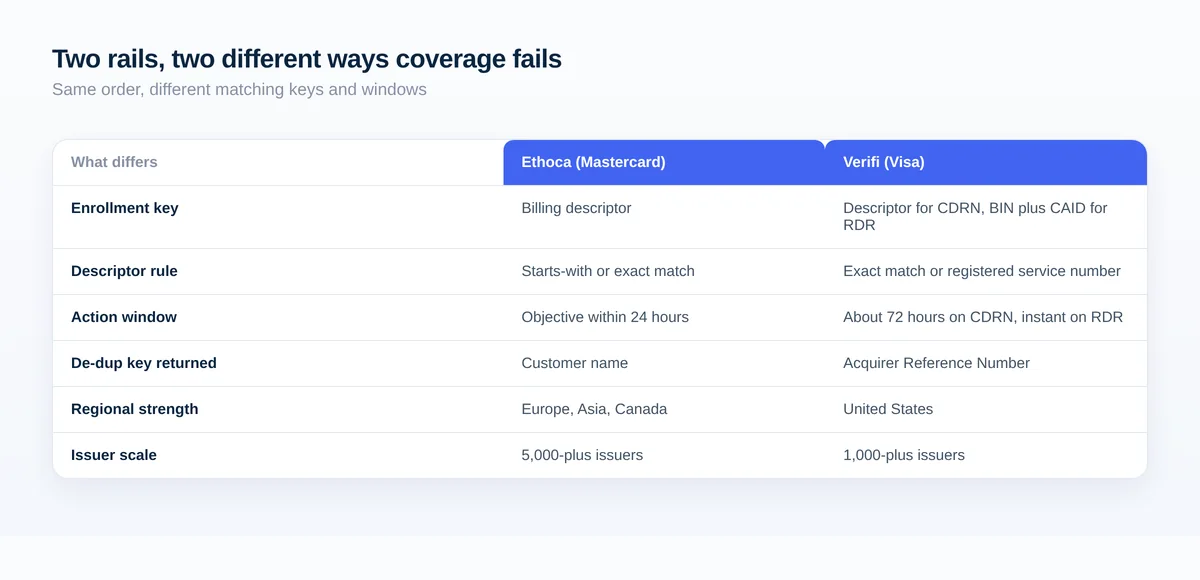
Can Ethoca and Verifi both fire on one Visa dispute, and where does that bill you twice?
Yes. Ethoca and Verifi CDRN both see Visa disputes, so one order can generate two billable alerts. Chargeback.io states plainly that Ethoca Alerts may overlap with CDRN and result in duplicate charges, and that some resellers reimburse those duplicates. Neither network publishes an overlap rate, so size it from your own alert feed rather than a vendor figure. Visa's own RDR documentation warns processors about this. Other mitigation services crediting off fraud records must first check whether RDR already resolved the transaction.
That warning is the network itself acknowledging the problem. Visa tells acquirers to check for prior RDR resolution before crediting off a confirmed fraud record. The purpose is to avoid duplicate refunding and reconciliation problems. A processor's own documentation puts it more plainly. The same transaction can generate an alert from both Ethoca and Verifi, because some issuing banks feed both networks.
- You accept the Ethoca alert, the chargeback flows anyway, Verifi raises its own alert on the same transaction, and both alerts are billable.
- You refund on the Ethoca alert and Verifi still triggers, which typically happens when the two alerts land within 24 hours of each other.
- Cross-network alerts are commonly not treated as duplicates at all: same-network duplicates sharing an ID or ARN get auto-resolved and waived, while a CDRN and an Ethoca alert on one transaction are both counted.
- Refunding the second alert without a de-duplication check credits the customer twice, and Visa's double-credit protection carves RDR out, so the network rule does not cover you there.
- Recovery is time-boxed. Visa has a dedicated Compliance condition, Rapid Dispute Resolution: Credit Issued, with a pre-Compliance attempt due within 29 calendar days and the filing within 60 calendar days of the dispute processing date.
- Inside the Visa estate there is no equivalent risk: Verifi states a merchant cannot receive both a CDRN case and an RDR notification for the same transaction, so the exposure is Ethoca against Verifi, not RDR against CDRN.
Some vendor pages argue this cannot happen. They reason that a single transaction runs on one card network, so only that network's company can flag it. That is brand-level reasoning applied to a bank-level system. It sits badly against Ethoca's own brand-agnostic positioning, Verifi's card-brand-agnostic description of CDRN, and Visa's duplicate-refund warning. How you enroll changes the exposure too. Routed through Stripe, Ethoca Alerts is scoped to Mastercard transactions only. That scoping removes the Visa double-fire that a direct descriptor-based enrollment can create.
What does each alert really cost per resolved dispute, and at what chargeback value does it stop paying?
Published fees run about $15 per Visa RDR or CDRN alert and $24 to $29 per Ethoca alert. Some resellers quote $40. The fee is the small line. An alert resolves through a full refund. So the real unit cost is the fee plus the refunded principal plus any duplicate fee your contract does not waive.
| Scenario | Alert fee | Refunded principal | Total to deflect | Note |
|---|---|---|---|---|
| $28 subscription rebill | $19 | $28 | $47 | Against a $15 to $20 dispute fee this is a net loss, which is why a minimum-value floor matters. |
| $69 subscription dispute (segment median) | $29 | $69 | $98 | Subscription is the smallest average ticket of any segment, so this band is where the math gets tight. |
| $120 median deflected order | $19 | $120 | $139 | Worth it only where the avoided chargeback genuinely costs more than $139 all in. |
| Doubled Visa dispute, Ethoca plus CDRN | $44 in fees | Order value | Order value plus $44 | Two fees on one case unless the reseller waives the duplicate. |
| RDR case with acquirer fee | $15 to $19 plus acquirer processing fee | Full order value | Order value plus both fees | Verifi confirms acquirers may add their own processing fee on RDR-resolved pre-disputes. |
Prices are reseller-specific rather than network-fixed; Verifi does not publish standardised pricing at all.
Price the avoided cost honestly too. Stripe publishes an explicit break-even for pre-dispute refunding. Stripe puts it this way: it is likely not worthwhile to refund a fraud warning on charges more than 35% higher than your dispute fee. On a $15 US dispute fee, that rule puts the ceiling near $20. Stripe also puts the conversion rate on unactioned fraud warnings at 80%, so about a fifth of alert spend buys nothing. Against that, merchants report about $46 in third-party fees and $82 in internal costs per chargeback. Merchants over the VAMP (Visa Acquirer Monitoring Program) line pay $8 per disputed or fraudulent transaction. Our breakdown of chargeback vs refund economics works the same trade in more detail.
Use a simple rule for the cases you could contest. Fight rather than refund whenever your recovery rate exceeds the dispute fee divided by the order value. Measure recovery as recovered dollars over disputed dollars, not wins over cases fought. On a $200 order at a 40% recovery rate, fighting costs about $140. Refunding costs $200. Deflecting on a $19 alert costs $219.
Do alerts and RDR refunds still count toward your dispute ratio and VAMP in 2026?
Partly. Visa's fact sheet says the VAMP ratio excludes disputes resolved through pre-dispute solutions. It excludes TC40 fraud records, the fraud reports issuers file against a transaction, only when they qualify for Compelling Evidence 3.0. So an RDR or Ethoca refund strips out the TC15, the dispute record itself. The fraud report stays in the numerator it was bought to protect.
The VAMP ratio is count-based. It divides TC40 fraud reports plus TC15 disputes by settled TC05 transactions, the records of completed sales, on card-not-present volume. Since 1 April 2025, TC40 fraud alerts resolved through RDR and CDRN count toward the ratio. Non-fraud TC15 disputes resolved via RDR stay excluded. And per Visa's own VAMP fact sheet, the merchant Excessive threshold fell to 150 bps on 1 April 2026, down from 220 bps. A bp, or basis point, is one hundredth of a percent. That threshold carries a 1,500 monthly event floor and $8 per disputed or fraudulent transaction. Visa flags acquirer portfolios at 50 bps and 70 bps. That is why your acquirer polices your alert coverage long before Visa does. We keep the current numbers in VAMP thresholds. We cover the arithmetic behind the denominator in chargeback ratio.
- A transaction appearing in both the TC40 and TC15 reports is counted twice in the VAMP count, so one fraud-coded dispute can hit the ratio on both legs.
- Issuers file TC40s on low-value claims they do not bother to charge back, and those still count, so a merchant with a clean chargeback record can breach on fraud reports alone.
- Refunding does not retroactively clean the file: monitoring programs do not consider refunds when identifying disputes, and issuers must report suspected fraud on any captured payment even if it is later refunded.
- The exclusion is timing-fragile. VAMP evaluates each month in isolation, so a late-month alert resolved next month buys nothing on the ratio.
- Compelling Evidence 3.0 is the sanctioned route to remove an already-reported TC40, which is why Order Insight protects the ratio in a way RDR cannot.
- On the Mastercard side the math is cleaner: ECM counts chargebacks that actually post (100 to 299 chargebacks with a 1.5% to 2.99% ratio, HECM at 300-plus and 3%), so a timely Ethoca refund typically keeps the case out of the numerator.
- Mastercard's SMMP counts refunds and chargebacks together above a combined 5% over a rolling 30-day window for newer merchants, so refunding hard to stay clean can feed a different metric.
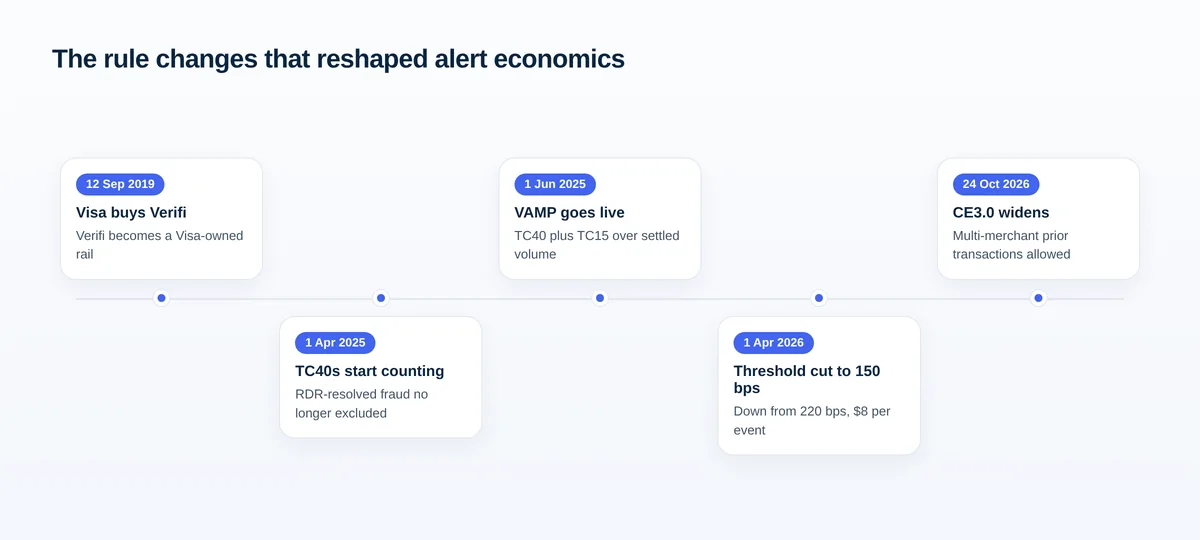
Should a subscription merchant run one network, both, or neither, and how do you set the rules?
Start from your own dispute split by card brand rather than a vendor table. A Visa-heavy book justifies Order Insight plus RDR first. A balanced book justifies adding Ethoca. Running Ethoca and CDRN together across the same Visa volume is the configuration that buys duplicates. Add CDRN only where RDR cannot enroll.
Subscription merchants feel this hardest. They run chargeback rates of about 1% to 2%, against 0.5% to 0.7% for traditional ecommerce. Recurring-billing disputes account for 27.1% of their chargebacks. Their average dispute value is the smallest of any segment at $69. That combination puts them near the 1.5% line by default. It also sits in the exact ticket band where fee plus refunded principal rivals the cost of the chargeback avoided. Volume gating helps. Under about $100K a month, free tools plus RDR once the ratio passes 0.5% is a reasonable floor. If the disputes alerts would actually have caught run under three a month, look at the billing descriptor before you buy a program.
Set the threshold where the alert stops paying
You scope RDR rules by transaction amount, dispute category and dispute condition code. You get up to ten rule scenarios per BIN (bank identification number) and CAID (card acceptor ID, your merchant account number at the acquirer). Verifi's own worked example is a low-value cap: accept liability on disputes of $25 or less. Verifi also documents the opposite pattern, an amount ceiling set above typical daily processing so everything auto-resolves. That catch-all is the setting that most reliably makes alert spend net-negative. Watch the other edge too. A case that falls outside your rules comes back declined with status code 957, and the issuer files it as a chargeback. So a threshold set too low converts to a full chargeback with a fee rather than a free pass.
For the manual rails, the workable structure is a value threshold plus reason-code routing. Auto-refund the alerts below the line. Hold everything above it for a person inside the window. Refund when the dispute would succeed anyway, or when the goods are still yours: unshipped orders, cancelled subscriptions and forgotten rebills. Decline when you have delivery confirmation and the value justifies representment. Carve out the cases that qualify for CE3.0. That standard today needs two prior non-fraud transactions on the same credential more than 120 days before the dispute. Those are exactly the subscription rebills a blanket RDR rule would auto-refund. Also decline an alert on an order you already credited. Paying a fee to refund money you have already refunded is the most common expensive mistake.
Prove the spend against outcomes, not a deflection count
Vendor-reported deflection rates are the wrong denominator. Sort last quarter's alerts into outcome piles instead. Count the ones you deflected that would have become a chargeback. Count the ones you deflected that would have evaporated. Count the ones you refunded where the chargeback filed anyway. Count the ones you paid for but missed the window on. Then divide total program cost by the disputes that actually stayed off the count. Total program cost means fees plus refunded principal plus unwaived duplicates. Expect friction in the data. Deflection is not certain even when you pay and refund, and one processor cites a success rate of about 90%. About 5% to 10% of Ethoca alerts each month are invalid, including already-refunded, already-disputed and duplicates of a prior alert. Measure your own catch rate as well. Count how many of last quarter's chargebacks arrived with an alert ahead of them, because resellers share the same underlying network access.
- Pull your last 90 days of disputes split by card brand and issuing bank, and size each rail against that split rather than a vendor table.
- Register every billing descriptor variation, soft and hard, static and dynamic, with Ethoca and CDRN, and re-register the moment a new MID or PSP goes live.
- Confirm RDR enrollment carries the right BIN and CAID for each MID, since a new CAID means no RDR coverage until re-enrolled.
- Get the duplicate definition in writing: whether a CDRN and an Ethoca alert on the same dispute bill once or twice, and whether the second fee is waived.
- Build a de-duplication check on order ID or ARN that runs before the refund fires, not after, and use the VROL Financial ID tag on RDR-resolved items.
- Set an RDR amount cap and reason-code scope that reflects your break-even, and avoid the catch-all ceiling that auto-refunds everything.
- Turn on Order Insight and Consumer Clarity first, since they deflect without a refund and Order Insight has no per-transaction licence fee.
- Report alert cost as fee plus refunded principal per dispute that stayed off the count, and review it monthly against your VAMP and ECM position.
Frequently Asked Questions
Which is better, Ethoca or Verifi?
Neither is better, because they are not substitutes. Verifi is Visa's prevention arm and Ethoca is Mastercard's, so the right rail depends on your card mix and issuing-bank footprint. A 2024 vendor comparison put Ethoca above 5,000 participating issuers, with more strength in Europe, Asia and Canada, against roughly 1,000 in Verifi's CDRN network, weighted to the US. That count describes CDRN specifically; Verifi states RDR is available to all global Visa issuers.
Can Ethoca and Verifi both flag the same transaction?
Yes, they can. Ethoca carries roughly 40% of Visa disputes and Verifi CDRN is described by Verifi itself as card-brand agnostic, so a single Visa order can produce two alerts. Chargeback.io states that Ethoca Alerts may overlap with CDRN and produce duplicate charges, with some resellers reimbursing them. No network publishes an overlap rate, and cross-network alerts are commonly billed as two separate events.
Do I need both Ethoca and Verifi alerts?
Only if your dispute volume is genuinely split across both brands. A one-sided card mix usually justifies the matching network alone. The common layering is Ethoca plus RDR first, with CDRN added only where RDR will not enroll, since running Ethoca and CDRN together across the same Visa volume is what creates duplicate billing.
Do chargeback alerts and RDR refunds still count toward my dispute ratio?
Partly. Visa excludes disputes resolved through pre-dispute solutions from the VAMP ratio, but excludes TC40 fraud records only when they qualify for Compelling Evidence 3.0. Since 1 April 2025, fraud-coded disputes resolved via RDR or CDRN still count. On Mastercard, ECM counts posted chargebacks, so a timely alert refund keeps the case out.
How much does an Ethoca or Verifi alert cost per alert?
Published rates run about $15 per Visa RDR or CDRN alert and $24 to $29 per Ethoca alert, with some resellers quoting $40 and Verifi publishing no standard pricing at all. The fee is the smaller number: an alert resolves through a full refund, so budget the fee plus the refunded order value plus any acquirer processing fee.
What's the difference between Verifi RDR, CDRN, and Ethoca Alerts?
RDR auto-credits Visa disputes in real time against rules you preset, with no review step and no representment afterwards. CDRN is Verifi's manual alert covering Visa and non-Visa disputes with about 72 hours to act. Ethoca Alerts is Mastercard's issuer data-sharing network, targeting a refund or stopped settlement within 24 hours.