How to Improve Rebill Approval Rates Across Multiple Processors
Generic advice treats approval as one number and one checklist. For a subscription merchant running several processors, approval is a matrix: processor, MID, issuer BIN, card status and attempt number. How to measure it like-for-like, route the recoverable segment, and prove the lift with a holdout.
Ask most vendors how to improve rebill approval rates. You get the same three-line checklist: enable 3D Secure (3DS), run an account updater, retry smarter. 3DS is the card authentication step at checkout. That checklist is not wrong so much as it is unaddressed to anyone. It assumes you have one processor, one merchant ID (MID), one traffic mix and one problem. A subscription business running several processors has none of those things. The checklist quietly answers a question you have not diagnosed yet.
The real problem sits upstream of every tactic on that list. Your top-line approval rate is a blended average across processors, MIDs, issuers, card states and attempt numbers. A blended average is precisely the object that hides which of those is failing. You also cannot route your way out of a gap you have not measured like-for-like, because two processors have never seen identically distributed traffic. This piece builds the measurement layer first. It then applies routing, retries and credential repair to the segments that can actually move. It closes with a holdout design that tells you whether any of it worked.
What counts as a good rebill approval rate, and why your blended number is lying to you
A good rebill approval rate is only meaningful once you name the segment. Current 2026 benchmarks put domestic recurring card traffic at 85 to 90 percent typical and 92 to 95 percent when well optimized. Cross-border recurring runs 72 to 80 percent typical. A single blended figure sits somewhere in between and describes no real population.
Those bands come from a 2026 authorization-rate benchmark grid that also puts cross-border traffic with local acquiring at 82 to 88 percent typical. Independent 2026 benchmark work lands in the same neighbourhood. It puts general card-not-present authorization at 85 to 92 percent and well-optimized merchants at 90 to 95 percent. It puts North American domestic online cards at 92 to 95 percent, and international traffic 5 to 15 percentage points below domestic. That last figure is the important one. A 5 to 15 point mix effect is larger than almost any processor difference you will ever detect.
Before any of that is comparable, settle the denominator. Authorization rate conventionally means approvals divided by attempted transactions. A processor that carries your retry tail therefore posts a mechanically lower rate than one handling only first attempts. Payment success rate and authorization rate are different numbers on the same traffic. One processor's worked example shows the gap: 93,000 approvals produced a 93 percent payment success rate against 100,000 valid API (application programming interface) requests. The same 93,000 approvals produced a 94.9 percent authorization rate against the 98,000 attempts that reached the network. Authentication failures and risk-engine blocks fall out of that second denominator.
Then there is the retry artifact. A single purchase that failed twice and then succeeded scores 33.3 percent on a raw rate. The same purchase scores 100 percent on a deduplicated rate that groups attempts and scores the final outcome. Any rebill programme that retries at all systematically depresses its own raw number. Three legitimate denominators circulate: first-attempt, raw and deduplicated. Comparing a processor reporting one against a processor reporting another is not a comparison at all.
How to break the top-line rate into a matrix and find the segment dragging the average
Break the rate into a matrix and read cells, not the aggregate. The dimensions that carry signal are processor and acquirer, MID, issuer BIN (bank identification number, the leading digits that identify the issuer) and card country. The rest are card status (token versus raw PAN, the primary account number, and fresh versus stale credential), decline category, and attempt number. A blended 87 percent can be 93 percent on domestic traffic and 71 percent on one cross-border corridor. Those are two problems with two different fixes.
That example is not a thought experiment. It is how segmentation usually resolves. A 92 percent aggregate can sit on top of an 85 percent rate for one acquirer on EU-issued cards. An 85 percent headline can conceal issuer segments declining at 40 percent alongside others approving at 95 percent. Aggregates also move late. They shift only once the underlying cause has been building for weeks, which is why a stable top line is not evidence of health. If you want the diagnostic walkthrough for a rate that has already moved, we cover it in approval rate drop analysis.
The columns worth pivoting on
- Processor and acquirer: the same cards, customers and products can swing five points on the acquirer alone, and per-BIN acceptance can vary by 10 to 25 percentage points across acquirers.
- MID: the MID is a risk-monitoring unit, not just a reporting label. Visa can evaluate VAMP performance at aggregated or sponsored merchant level, so one bad MID inside a multi-MID setup is separately surfaceable.
- Issuer BIN and card country: bucket by issuer BIN rather than billing geography, because 'EU traffic' on one processor is not the same population as 'EU traffic' on another.
- Card status: credit outperforms debit, which outperforms prepaid, largely because debit and prepaid hit insufficient funds more often. Token versus PAN belongs in the same column.
- Decline category: Visa's four categories decide whether a reattempt is permitted at all, and mixing them into one decline rate makes two processors look different when only their traffic mix differs.
- Attempt number: report attempt 1 separately from attempt N, or 'approval rate' silently means first-pass approval in one paragraph and eventual recovery in the next.
One caution applies to how much any of this can tell you. Issuers categorise most declines generically, and do-not-honor is the most common category. They discuss the specific reason only with their own cardholder. Segmentation by processor, BIN and attempt is therefore the inference channel available to you. It is not a nice-to-have reporting flourish.

How to compare processors like-for-like when traffic was never randomly split
You cannot compare raw side-by-side percentages, because processors never see identically distributed traffic. Once smart routing is on, traffic stops being randomly distributed and naive comparison becomes self-fulfilling. The routing engine sends the easy volume to whichever processor it already believes is winning. You have to construct comparability deliberately, either by stratification or by a randomised split.
Stratification is the cheaper option. Compare providers only within matched BIN ranges in the same market. Treat a gap of three points or more inside a matched cell as evidence that static routing is leaking revenue. Match geographies and customer cohorts on both sides rather than comparing whole populations. Normalise the underlying data yourself, because each processor delivers transaction records in its own format and on its own schedule. Each processor also applies its own settlement logic and its own decline-code vocabulary.
Confounders that will fool a raw comparison
- Traffic mix: cross-border runs 5 to 15 points below domestic, so a processor carrying the heavier cross-border share looks worse while performing identically.
- Input method: wallet and tokenised traffic carries structurally higher approval because it is device-authenticated, so wallet share alone moves a blended rate.
- Customer tenure: long-standing customers with established transaction history authorize at higher rates, so a processor carrying newer cohorts is penalised for its cohort, not its quality.
- Retry configuration: whichever processor handles your retry tail absorbs the failed attempts into its own denominator.
- Signalling differences: the CIT/MIT interaction type in analytics is what the processor actually sent to the network, which can differ from what you set via API because the processor rewrote it.
- MID age: issuer authorization engines hold no history on a new merchant record, and elevated security and do-not-honor declines are typical for the first 90 to 120 days.
Even after all that, most inter-processor gaps merchants chase are too small to detect. Moving a 70 percent baseline to 80 percent needs 330 payments per variant. Detecting 70 to 71 percent needs 33,000 payments per variant. If your monthly rebill volume in a given segment is four figures, a one-point difference between processors is not a finding. It is noise. Our note on intelligent payment routing covers how to hold that line when a routing engine is already reordering your traffic.
Which rebill declines are recoverable, which are hard stops, and how much is card lifecycle
Soft declines dominate the recoverable pool. They run 70 to 90 percent of all declines in subscription businesses, and 40 to 70 percent of those are recoverable through targeted retries. Hard declines are a separate population: the card, account or recurring authorization is no longer valid. Retrying does not change that. Sizing those two buckets separately is the first useful cut.
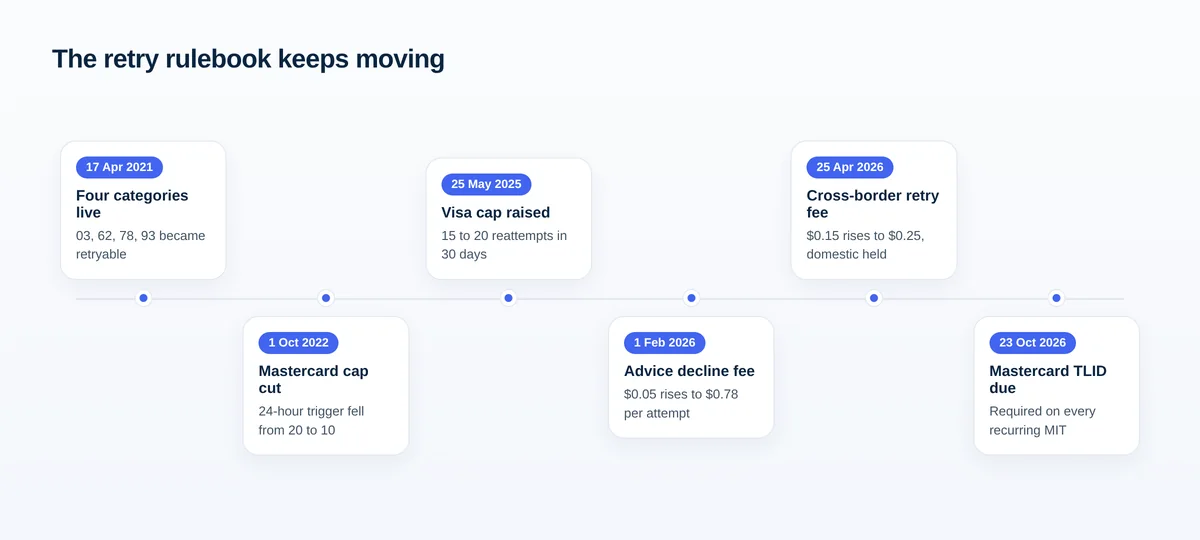
Visa's four decline categories are the taxonomy to normalise against. If you run retry orchestration across processors, you have to derive the category yourself. You do that by mapping each processor's raw acquirer response code onto it. Category 1 is a zero-reattempt list for the same payment credential: 04, 07, 12, 14, 15, 41, 43, 46 and 57. It also covers the subscription-specific stop-payment and revocation instructions R0, R1 and R3. Categories 2, 3 and 4 permit reattempts up to 20 in 30 days under the 18 April 2026 Visa Core Rules. That is up from the 15-in-30-days figure many vendor docs still publish.
| Decline segment | Example codes | Reattempt permitted? | Lever that actually applies | Note |
|---|---|---|---|---|
| Visa Category 1 (hard stop) | 04, 07, 12, 14, 15, 41, 43, 46, 57, R0, R1, R3 | No reattempt for the same credential | Account updater, or a new credential from the customer | A reattempt is fee-bearing on the first try, and issuers must return the same code consistently. |
| Visa Category 2 (cannot approve now) | 51, 03, 19, 59, 61, 62, 65, 78, 91, 96, 83 | Up to 20 in 30 days | Timed retries keyed to the advice code | Code 83 joined Category 2 effective 25 July 2026, so it moved from stop to retry-eligible. |
| Visa Category 3 (data quality) | 54, 55, 82, 6P, N7 | Up to 20 in 30 days | Revalidate the credential first, then retry | Exceeding the cap here can draw both excessive-retry and data-quality fees. |
| Visa Category 4 (generic) | 05 do-not-honor and other generic responses | Up to 20 in 30 days | Segmentation, routing, tokens, correct MIT flags | Code 05 carries no retry signal at all, which is why blended reporting hides what is recoverable. |
| Mastercard MAC 03 / MAC 21 | Do not try again / payment cancellation | No reattempt | Ask the customer for a fresh mandate or method | MAC 03 covers account closed, suspected fraud and cancelled recurring agreement. |
| Mastercard MAC 24 to 30 | Timed-retry advice on insufficient funds | Retry after the stated wait | Honour the issuer's window instead of a fixed cadence | Windows run from 1 hour to 10 days, supplied per transaction by the issuer. |
Codes and caps reflect the current Visa Core Rules edition and current Mastercard advice-code documentation. Derive categories from raw acquirer responses per processor rather than trusting a normalised label.
Lifecycle failure versus an issuer risk decision
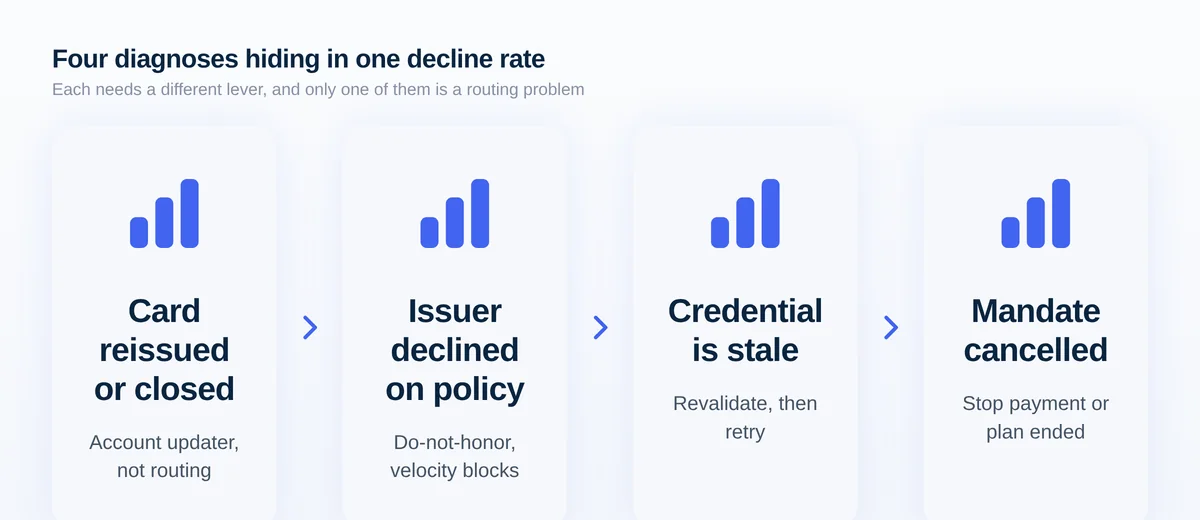
These are different diagnoses with different remedies. Most checklists list account updater and retries side by side as if they were interchangeable. One dataset covers 1,168,245 failed business-to-consumer subscription payments from April 2025 to March 2026. In it, the top ten decline codes accounted for 88 percent of failures. Insufficient funds led at 31.7 percent, and do-not-honor followed at 11.3 percent. Hard lifecycle codes were a small minority: stolen card 1.7 percent, pickup card 1.3 percent and lost card 1.3 percent. Expired card did not even reach the top twelve.
That does not make lifecycle irrelevant. It makes lifecycle a bounded segment you should size rather than assume. Visa reports that 30 percent of card accounts in an issuer's account updater portfolio change account number or expiration date, or close, every year. The authoritative way to size your own lifecycle share is the account updater response itself. It returns four distinct outcomes: account number updates, expiration date updates, closed-account advices and contact-cardholder advices. Measure update hit rate against total queries. Do not glance at approval before and after.
Two of those four outcomes are not recoveries at all. Cardholder-reported loss or theft and cardholder revocation of your billing mandate are cancellations. Leaving them inside your recoverable-decline denominator inflates your apparent opportunity. Recovery also differs sharply by reason. In the same 2025 to 2026 subscription dataset, insufficient funds recovered at 37.9 percent while transaction-not-allowed recovered at 5.2 percent. A blended retry success rate destroys the signal you were trying to read.
When routing a rebill to a different processor or MID actually lifts approval
Routing lifts approval when two conditions hold. The decline was a soft, situational refusal, and the second provider holds a genuinely different issuer relationship. Insufficient funds, bank timeouts and issuer velocity checks are worth cascading. Hard declines are not worth cascading. No acquirer approves a closed account or a revoked mandate, so re-routing that attempt relocates the decline rather than recovering the payment.
The upside is real but bounded. One processor reports that cascading recovers 8 percent of the transactions its primary acquirer declined. The same processor notes that two strong acquirers on the same traffic differ by up to 5 percentage points in acceptance. Another orchestration vendor puts combined smart routing plus cascade recovery at an additional 8 to 15 percent of declined volume. Both figures are vendor-reported on their own books, which is exactly why the holdout section below exists.
Four ways a reroute quietly fails
- It violates the reattempt rules. Visa prohibits manipulating data elements from the original request when reattempting, naming acquiring identifier, acquirer and merchant country, MCC, POS condition code, POS entry mode and ECI, so a reroute is not a free retry lever.
- It hides the fee rather than avoiding it. Visa's counter is scoped on acquirer, acquiring identifier, card acceptor ID and token or PAN, and Mastercard's is scoped to a single PAN on the same MID, so splitting retries across MIDs resets the counter without changing the issuer's decision.
- It converts a decline into a dispute. Cascading a transaction the issuer already flagged as do-not-retry risks an unauthorized attempt, and repeatedly retrying fraud-flagged transactions across acquirers is a documented path to a dispute ratio that draws network monitoring attention.
- It breaks the consent chain. The network transaction ID is returned to the processor that handled the original cardholder-initiated transaction, and it frequently does not transfer on migration, so the second processor sends merchant-initiated rebills without the linkage issuers use to validate consent.
One more structural asymmetry matters. Processors usually provision network tokens under a token requestor ID that belongs to the processor rather than the merchant. The token asset and the approval lift attached to it therefore do not travel when you re-route. The same applies to account updater, which the acquirer mediates. A second processor needs its own enrollment and file cadence. Without that, routing volume to it simply moves stale-credential declines to a new MID.
Routing earns its keep through per-issuer specialisation rather than a global processor preference. Only one issuer in three manages to be strong at both approving legitimate traffic and controlling fraud. A processor can therefore lose on the aggregate and win decisively inside a specific segment. That is the argument for a matrix-shaped routing table instead of a winner-takes-all switch. It is also why you should read MID health and approval rates per MID rather than rolled up.
How retry timing and attempt caps should change by issuer, BIN and decline code
Drive retry cadence from the decline code and the issuer's own advice code, not from a fixed dunning calendar. Mastercard supplies explicit wait windows per transaction through Merchant Advice Codes 24 to 30. Those codes encode retry after 1 hour, 24 hours, 2, 4, 6, 8 or 10 days. Honouring that instruction turns retry timing from a heuristic into a per-transaction directive.
The scheme ceilings differ, and that difference is the trap for a multi-processor merchant. Current Visa rules permit up to 20 reattempts in 30 days for Categories 2, 3 and 4. Mastercard runs a tighter dual cap of 10 retries in 24 hours and 35 in 30 days. A same-day retry storm across three processors on one card breaches Mastercard long before it approaches Visa's monthly counter.
The fee side changed materially in 2026, and it now dominates the arithmetic on marginal retries. The Mastercard card-not-present advice decline fee was $0.05, in effect until 31 January 2026. It rose to $0.78 effective 1 February 2026 on TD's published Canadian schedule, a fifteenfold increase. Visa's cross-border excessive-retry fee moved from $0.15 to $0.25 per attempt effective 25 April 2026, while the domestic fee held at $0.10. Mastercard's excessive-authorization fee has climbed from $0.10 in 2022 to $0.50 in January 2025. Penalties accrue whether or not the retried transaction eventually succeeds. Aggressive retrying therefore carries a margin cost on recovered revenue, not only a compliance cost.
Some declines also cost money on the first attempt. Mastercard applies a per-decline card-not-present fee of $0.03 on reason codes 79 lifecycle, 82 policy, 83 security and 51 insufficient funds. Code 51 makes up the largest single slice of rebill failures.
Where practitioners actually set the cap
- One processor recommends a maximum of eight retries on charges that permit them, warning that additional attempts can read as fraud to issuers and increase declines on otherwise legitimate charges.
- Its billing product defaults to 8 tries within 2 weeks, configurable across 1 week to 2 months, with custom non-adaptive schedules capped at three retries.
- A second processor bounds its rescue window at 1 to 48 days and recommends one calendar month for cards, keeping attempts inside the network's 30-day counting window.
- A 2026 orchestration guide puts the practical range at three to five attempts spread over 10 to 14 days.
- Recovery decays fast by attempt: roughly 20 to 40 percent on the first retry, a further 15 to 25 percent of the remaining pool on the second, another 10 to 15 percent on the third, then it flattens while penalty risk keeps rising.
- Retry behaviour is scored at merchant-account level, not per attempt, so repeated failed attempts on hard declines raise your fraud score and lower how issuers score your future traffic.
Vendor documentation on these caps is genuinely inconsistent. Several widely used processor docs still publish the superseded 15-in-30-days Visa figure. At least one 2026 guide states a cap that matches neither the current rulebook nor the prior value. Reconcile against the rulebook, then against your acquirer's fee schedule. The fee can bite before the rule does: one published schedule assesses an excessive retry fee from the 16th attempt even though the rules permit 20. We go deeper on cadence design in payment retry strategies.
Do network tokens, account updater, MIT flags and a cleaner descriptor really move recurring approval?
Three of those four levers move recurring approval, and one mostly does not. Network tokens, account updater and correct stored-credential flagging each address a distinct failure mode. Their published lifts vary widely by portfolio. The fourth lever works as a dispute lever rather than an authorization lever. Its documented mechanism is statement recognition preventing a chargeback, not issuer approval.
Treat token uplift as a range to be measured, not a constant to be imported. Visa's own tokenization page carries three different figures from three different data windows. It reports 4.6 percent lift globally on tokenized card-not-present traffic versus PAN across FY22. It reports four percent from an October to December 2022 measurement, and more than three percent from January to March 2022. Vendor figures spread wider still, from 3 percent to double-digit percentage points. The Visa-versus-Mastercard gap of 4.6 versus 2.1 percent reflects measurement methodology and data period, not a real difference in how tokenization works.
Tokens are also not uniformly better. At least one processor selects token or PAN per transaction, based on whether the issuer supports the token and whether predicted success is higher. Another keeps a PAN vault specifically so the choice stays per-transaction. The durable structural argument for network tokens is that automatic credential refresh is inherent to them. Proprietary gateway tokens cannot deliver lifecycle updates without extra integration. Coverage is also uneven by law. Visa's stored-credential tokenization mandates land region by region. They already apply across parts of CEMEA (Central Europe, Middle East and Africa) and LAC (Latin America and the Caribbean). A further LAC wave has been in force since 25 July 2026.
Account updater is a different instrument, not a competing one
Account updater targets the lifecycle bucket specifically. It covers account renewals and replacements, upgrades and downgrades, portfolio acquisitions and mergers, lost or stolen card replacement, and account closures. Its coverage has legitimate holes. The major regions mandate issuer enrollment at BIN level. That mandate carves out commercial card BINs, prepaid BINs, ATM-only BINs and single-use virtual account BINs. That is why hit rates differ by card-portfolio segment rather than by processor quality.
It also has structural latency worth designing around. Issuers must submit account number and expiration changes within two business days of activation. They may submit an update only if an authorization using the new data would be approved. Merchants must update billing files within five days of receiving updates and submit inquiries a few days before billing. Real-time updater has narrower preconditions still. It fires only on a refusal, and only on non-zero merchant-initiated stored-credential traffic with no card verification code (CVC) present. Rebill traffic mis-flagged as cardholder-initiated silently loses that repair path. We lay out the trade-offs between the two instruments in network tokenization versus account updater.
Stored-credential signalling sits upstream of both. Visa requires every stored-credential transaction to carry point-of-sale (POS) entry mode code 10 plus the appropriate recurring, installment or unscheduled indicator. Visa also requires an approved authorization or account verification before you may store a credential at all. Visa frames framework compliance as a precondition for real-time account updater participation. Missing or wrong indicators are a per-MID integration defect. They surface as an approval-rate gap rather than as an error, which makes them a common hidden cause of a 'processor B is worse' reading. Merchant category code (MCC) alignment belongs in the same bucket. Your MCC determines which issuer risk model scores every rebill.
Two dated items deserve a place on your roadmap. Merchants have had to store the Mastercard Transaction Link Identifier since 2 June 2026. They must send it on every economically related recurring transaction from 23 October 2026. Issuers may decline merchant-initiated transactions that lack it, and no provider can synthesize one for legacy credentials. Separately, generic advice to 'enable 3DS' does not apply to the rebill leg at all. Merchant-initiated transactions preauthorized for the same amount fall outside strong customer authentication. So 3DS belongs at registration, not at renewal.
How to run a routing change as an experiment and prove the lift was not seasonality
Run a concurrent randomised split, not a before-and-after. Sequential comparison runs provider A for a quarter, then provider B for a quarter. That design absorbs seasonality and traffic-mix drift into the result. Splitting live traffic in real time, commonly 50/50, puts both arms under identical conditions. That is the only reason you can attribute the difference you measure to the change you made.
Subscription churn itself is strongly seasonal. One illustrative pattern shows 12 percent in January against 7 percent in July and 4 percent in December for the same product. The population you rebill in any given month is therefore not stable. Authorization rates are also most volatile in the first six weeks after any major payments change. Pull at least one year, ideally two, of prior-processor history before you judge a migration.
A defensible test design
- Stratify the randomisation. Split 50/50 within value tiers, matched BINs and matched geographies rather than one global coin flip that lets high-value accounts land unevenly.
- Fix sample size in advance and do not peek. Checking early inflates false positives, and extending a run to chase significance is equally invalid.
- Size the test honestly. At a 50/50 split, roughly 80,000 sessions is enough power to detect a 100 basis point change at 5 percent significance, so scope the segment accordingly.
- Exclude ineligible traffic before enrollment. Dilution, treatment-arm traffic that never receives the treatment, pushes the measured effect toward zero and lengthens time to significance.
- Run long enough to catch late recoveries. One published design runs 30 days and reports at day 37, deliberately waiting so payments that failed in-window but succeeded on later retry are counted.
- Freeze everything else. Hold pricing, layout, dunning copy and group sizes constant for the duration, or the lift cannot be attributed.
- Bake in lagging guardrails. Approval moves in real time while disputes and refunds surface weeks later, so guardrail metrics belong in the test design from the start.
- Apply a significance bar and report it. Treat results as significant when the probability of observing them by chance is below 5 percent, and show non-significant differences as non-results rather than wins.
Some things resist a clean split, and you are better off knowing which. You cannot apply card credential updates selectively. Account updater therefore runs on 100 percent of card-not-present volume in both arms. You have to estimate its lift separately rather than randomise it. You can measure retry recovery exactly: count transactions declined on first attempt and then approved on retry. That needs no statistical estimation. When you add a challenger processor, the incumbent holds the stored credentials and the network transaction IDs. That biases early results toward the incumbent for reasons unrelated to authorization quality.
Two subtler points follow. Subscribers tend to stay in the same arm across days, so a temporal variance component persists. The confidence interval does not shrink at the rate people expect, and running longer buys less precision than you assume. A blended experiment result can also mislead as badly as a blended approval rate. One published 50/50 network-token test ran across two processors simultaneously. It moved processor A from 63.2 to 66.3 percent with statistical significance, while processor B moved 69.6 to 69.8 percent with none. Reported as one number, the real effect would have disappeared.
Finally, watch for rule changes that confound a window. Visa's merchant excessive threshold for its Acquirer Monitoring Program (VAMP) ratio dropped from 2.2 percent to 1.5 percent on 1 April 2026. Visa has enforced the acquirer above-standard threshold of 0.5 percent since 1 January 2026. A pre-and-post routing comparison spanning those dates measures the rulebook as much as your routing table.
The 30-day implementation checklist
- Pick one approval-rate definition (first-attempt, raw or deduplicated), document the grouping key for retried attempts, and rebuild both processors' numbers from raw transaction data.
- Map every processor's raw acquirer response code onto Visa's four categories and Mastercard's advice codes, so 'retryable' means the same thing on both rails.
- Build the matrix view: approval by processor, MID, issuer BIN, card country, token versus PAN, decline category and attempt number, with attempt 1 reported separately from attempt N.
- Size the lifecycle bucket from account updater outcomes (number updates, expiry updates, closed-account advices, contact-cardholder advices) rather than inferring it from decline codes.
- Move recoverable declines off a fixed dunning calendar and onto issuer-supplied advice codes, capping attempts well below the scheme ceilings and reconciling against your acquirer's fee schedule.
- Audit stored-credential signalling per MID: POS entry mode, recurring or unscheduled indicator, CIT/MIT interaction type as actually sent, network transaction ID linkage and MCC alignment.
- Route by segment rather than by global processor preference, and exclude hard declines and revoked mandates from any cascade.
- Launch the routing change as a stratified concurrent split with a fixed sample size, lagging dispute guardrails and a stated significance bar.
Frequently Asked Questions
What is a good rebill approval rate for a subscription business?
There is no single good number, only good numbers per segment. Current 2026 benchmarks put domestic recurring card traffic at roughly 85 to 90 percent typical and 92 to 95 percent when well optimized, with cross-border recurring at 72 to 80 percent typical. Compare each segment to its own band, not to a blended average.
Why are recurring payments declined more often than one-time purchases?
Recurring payments carry stale credentials and no live cardholder. Cards change constantly, with roughly 30 percent of accounts in an issuer's updater portfolio changing number or expiry, or closing, each year. Merchant-initiated attempts also lack fresh authentication signals, so issuers lean more heavily on risk scoring and funding checks.
Which credit card decline codes can you retry and which are hard declines?
Visa's Category 1 codes are hard stops for the same credential: 04, 07, 12, 14, 15, 41, 43, 46, 57, R0, R1 and R3. Categories 2, 3 and 4 permit reattempts up to 20 in 30 days. On Mastercard, advice codes 03 and 21 are do-not-retry, while 24 to 30 supply an explicit wait window.
How many times should you retry a failed subscription payment, and how long should you wait?
Most practitioners cap well below the scheme ceilings, at three to five attempts over 10 to 14 days, or up to eight within two weeks. Timing should follow the issuer's advice code where one is supplied. Recovery decays sharply after the third attempt while fee and issuer-friction risk keeps climbing.
How do you compare two payment processors' approval rates fairly?
Compare inside matched cells or use a concurrent randomised split, because processors never see identically distributed traffic. Match BIN ranges, market and customer cohort, normalise decline codes and denominators yourself, and treat a three-point gap inside a matched cell as signal. Raw side-by-side percentages on unmatched traffic are not comparable.
Will routing declined rebills to a different processor or MID recover the payment?
Sometimes, on soft declines. Cascading insufficient-funds, timeout and velocity declines to a provider with a different issuer relationship recovers a measurable share, reported by one processor at around 8 percent of declined volume. Hard declines and revoked mandates typically just move, adding fee and dispute exposure rather than revenue.