Interchange Fees for Subscription Businesses: The Real Cost
Every guide explains interchange from the card network's side. This one starts on your side of the ledger: what a recurring charge actually costs, how to compute your effective rate per MID, and how to stop one blended percentage from mispricing every cohort.
An interchange fee is the amount your acquiring bank pays the cardholder's issuing bank on every card transaction. The card network publishes the rate. You never pay interchange directly. You pay a bundled merchant discount instead. That is why a subscription business tends to carry a different effective rate on each merchant ID (MID) it runs.
What is an interchange fee?
Interchange is a bank to bank transfer fee. On every card payment the acquirer pays the issuer, and the card network sets the rate. Visa's own US interchange schedule states it plainly. Merchants do not pay interchange. Merchants pay a merchant discount to their financial institution. That discount bundles interchange with other processing services.
The published rate and the paid rate are different numbers. The schedule currently in effect is the 18 April 2026 edition. Both networks repost their schedules twice a year, in April and October. A processing percentage hard coded into a margin model therefore has two scheduled chances to go stale every year, even if nothing about your business changes.
- Card type: consumer debit, consumer credit, or commercial.
- Rewards tier: a basic card and a spend qualified premium card do not price the same.
- The merchant category code assigned to the MID, not to the transaction.
- Card present versus card not present acceptance.
- Domestic versus cross border issuance.
- Transaction size and the processing details submitted with the authorization.
Who actually pays interchange, and who keeps it?
The merchant pays the acquirer. The acquirer pays the issuer. The card network sets the rate and keeps none of it. Mastercard confirms this in its own filings. Acquirers pay interchange, issuers collect it, and the network earns no revenue from it. Interchange still makes up a significant part of your acceptance cost.
You never write the cheque yourself. The acquirer pays you the purchase amount net of the merchant discount. Interchange comes out upstream, before money reaches your bank account. The industry total is large. US merchants paid $187.20 billion in card processing fees in 2024, or $1.57 per $100 of card payments accepted. Credit cards alone accounted for $148.52 billion of that.
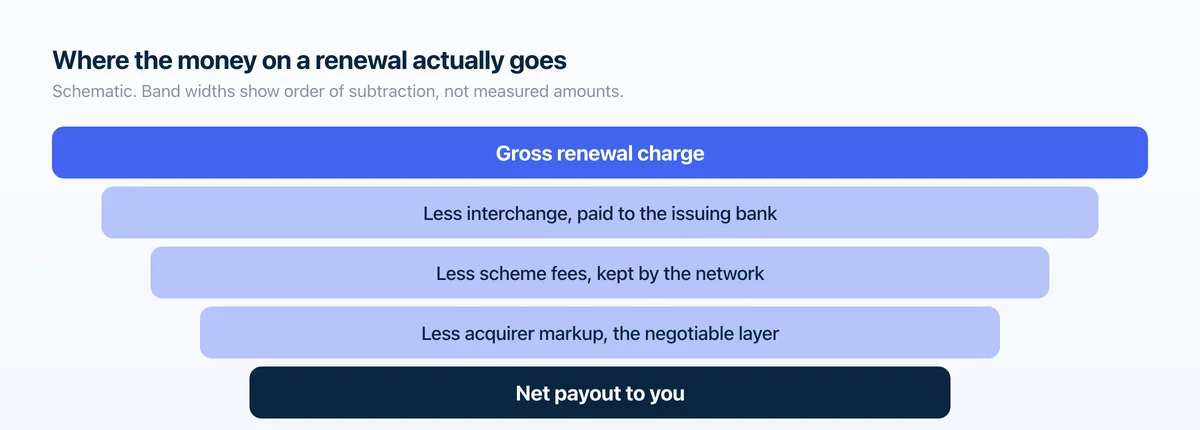
What is the difference between interchange, scheme fees and your processor's markup?
Every card transaction pays three separate parties. Interchange goes to the issuing bank. Scheme or assessment fees go to the card network. The markup goes to your acquirer. Only the markup is negotiable. A blended rate collapses all three into one number, and you cannot decompose it after the fact.
| Fee layer | Set by | Kept by | What it means on a subscription P&L |
|---|---|---|---|
| Interchange | Card network | Issuing bank | The largest slice, typically 75% to 85% of total processing expense, and not negotiable at any volume. |
| Scheme / assessment fees | Card network | Card network | Small but real: about 0.14% plus $0.0195 per Visa credit transaction, 0.1275% plus $0.0195 for Mastercard under $1,000. |
| Acquirer markup | Your acquirer | Acquirer / processor | The only layer negotiation touches, and the only one a blended rate can quietly widen. |
Under blended pricing all three arrive as one percentage, so when your cost moves you cannot tell which layer moved.
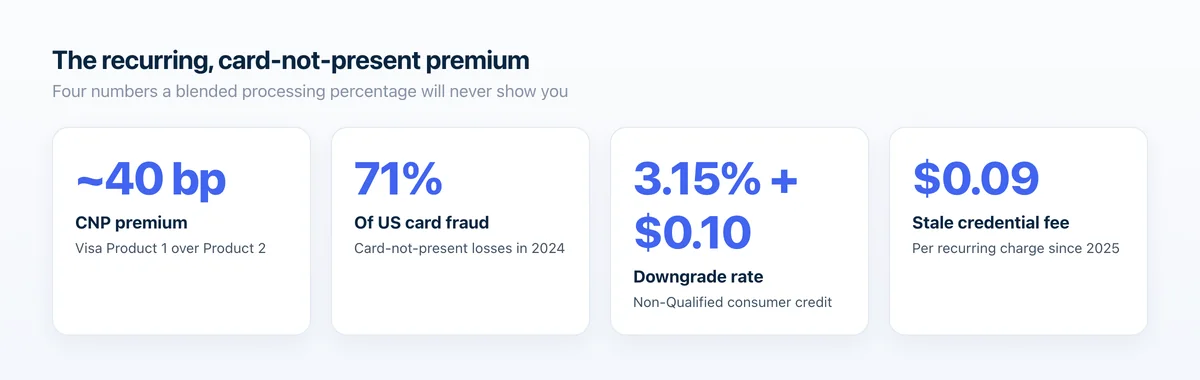
Recurring billing also attracts network fees that sit outside all three layers. On 1 April 2025, Mastercard tripled its Credential Continuity Program fee from $0.03 to $0.09. The fee applies to every non swiped recurring transaction you submit with outdated stored credentials. On 1 April 2026, Visa doubled its Digital Commerce Service Fee on card not present transactions to 0.015% domestic and 0.035% cross border. You cannot negotiate either fee. Both hit every billing attempt.
Why are card-not-present and recurring transactions charged more?
The networks price fraud risk into the rate. Card not present transactions carry higher interchange than card present ones. Recurring charges sit in their own categories with their own qualification rules. A subscription business pays that premium on one hundred percent of its volume, on every cycle, forever.
The spread is measurable. Visa's current US consumer credit schedule prices the card not present Product 1 program at 1.89% to 2.05% + $0.10. Card present Product 2 runs 1.51% to 1.65% + $0.10. That is a 38 to 40 basis point premium per transaction. Mastercard prices the same gap through its Merit programs, at close to 30 basis points per card tier. The fraud data supports the pricing. Card not present fraud made up 71% of US card fraud losses in 2024, an estimated $10 billion. Federal Reserve research finds the gap is still widening.
Recurring billing adds its own fee surface on top. Visa charges $1 per declined transaction when you re-authorize a recurring charge after three prior declines on the same transaction. Its excessive retry fee on declined cross border attempts rises from $0.15 to $0.25 on 25 April 2026. Dunning strategy is a fee line, not only a recovery lever.
What do interchange rates look like for a subscription business?
Expect 1.53% + $0.05 on a Visa consumer credit renewal. Premium rewards cards cost materially more. A downgrade doubles the rate. Visa publishes dedicated Recurring categories with tiered rates. The cheap tiers that generic explainers quote sit behind volume thresholds a normal subscription business will never reach.
| Visa category | Rate | What it means for you |
|---|---|---|
| Recurring Tier 1 | 1.33% + $0.05 | The lowest printed recurring rate on the schedule. Tier qualification is volume gated, not something you negotiate. |
| Recurring Tier 2 | 1.43% + $0.05 | Middle tier, same card products, still threshold gated. |
| Recurring (base) and Tier 3 | 1.53% + $0.05 | Where a normal subscription business actually sits on most consumer cards. |
| Recurring, spend qualified Infinite or Signature Preferred | 2.30% + $0.05 | Identical charge, about 77 bp more, purely because of the card in the subscriber's wallet. |
| Small Merchant Recurring 1 and 2 | 1.43% + $0.05 | A separate program, capped at $280,000 of gross Visa consumer credit sales over 12 months. |
| Commercial Card Not Present | 2.70% + $0.10 | Subscribers expensing on corporate cards cost over a full point more than a basic consumer card. |
| Non-Qualified Consumer Credit | 3.15% + $0.10 | The downgrade bucket, flat across every card product. Roughly double the base recurring rate. |
Rates effective April 18, 2026. Debit prices on a separate axis entirely: 1.65% + $0.15 on exempt small-issuer cards versus 0.05% + $0.21 on regulated big-bank cards.
Generic guides omit the tier thresholds. Visa's Recurring Telecommunications and Cable Threshold I requires a minimum of 54.0 million transactions and $11.40 billion in volume over 12 months. It also requires a dispute financials ratio no higher than 0.100%. It requires PCI compliance too, meaning you meet the card industry's data security standards. Dispute performance is an interchange qualification input, not only a risk metric.
Interchange++ vs blended pricing: which one lets you see the real number?
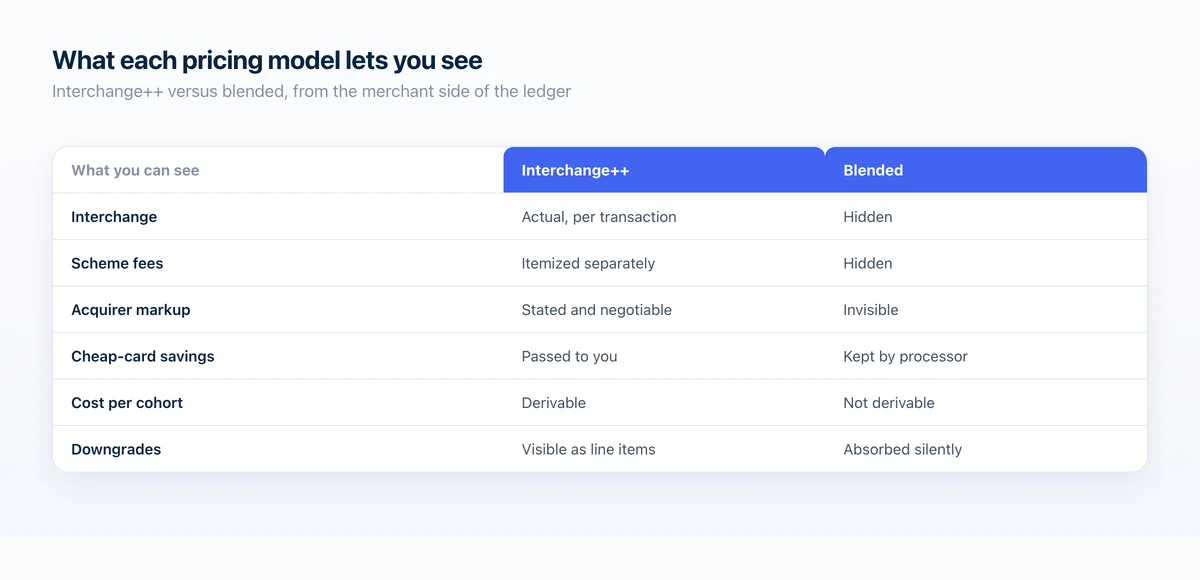
Interchange++ (IC++) lets you see the real number, and blended pricing does not. Under IC++ your acquirer bills interchange, scheme fees and markup as three separate lines. You can then attribute cost to card, channel and cohort. Under blended pricing you get one averaged rate. The variance still exists. It just lands inside the flat price.
- Cheap-card savings. When a charge lands on regulated debit at 0.05% + $0.21, the spread against your flat rate stays with the processor, not with you.
- Downgrades. A batch that settles late or loses its recurring indicator jumps to the Non-Qualified rate and your invoice looks identical.
- Card mix drift. A cohort acquired through a premium-rewards-heavy channel structurally costs more to bill, and the flat rate flattens that away.
- Per-MID divergence. Two MIDs at the same processor can sit on different programs and different data quality, and blended pricing reports them as the same cost.
- Rate schedule moves. April and October releases change your underlying cost while your quoted rate stays put.
In the EU and UK, unblending is a legal default, not a favor you ask for. The Interchange Fee Regulation (IFR) sets those rules. IFR Article 9 requires acquirers to offer individually specified merchant service charges per card category and brand. Article 12 gives you a per transaction right to see interchange separately from the merchant service charge. Blended pricing is lawful there only if you request it in writing. In the US it is a commercial conversation. The common volume convention runs blended under $5M to $10M a year, then IC+ (interchange passed through, with scheme fees folded into the markup) from $10M to $50M, then IC++ above that. If you are running a multi-acquirer strategy, unblended pricing is what makes the acquirers comparable at all.
How do you work out your effective interchange rate per MID?
Take one MID's statement, sum every fee line on it, divide by the card sales volume that processor reported, and multiply by one hundred. That is your effective rate. Run it for three consecutive months per MID, because some fees, billback among them, do not hit every statement.
- Pull three consecutive monthly statements for each MID separately. Never combine MIDs; the whole point is that they differ.
- Sum every fee line in the numerator: interchange, assessments, gateway, PCI, downgrade, chargeback and monthly minimums. Not just the headline discount rate.
- Use the processor's reported card sales for the denominator, not accounting revenue, not cash sales, not net bank deposits.
- Sum fees and sum volume across the three months, then divide the totals. Averaging three monthly percentages gives a wrong answer.
- Compare against the benchmark. Roughly 2% to 4% all-in is normal, and above 4% is a signal to investigate that MID's pricing structure.
The gap between quoted and effective is often larger than teams expect. One worked example puts $5,907.03 of fees on $98,511.45 of volume, a 5.99% effective rate on a MID nobody thought was expensive. A cleaner statement shows $310 on $10,000, or 3.10%. Once you have the per-MID number, put it in your profitability analysis in place of the single company-wide percentage.
- Pull three consecutive monthly statements for every MID, not just the busiest one.
- Sum all fee lines: interchange, assessments, gateway, PCI, downgrade, chargeback and monthly minimums.
- Divide by card sales volume as reported by the processor, not by accounting revenue.
- Sum across months before dividing, since averaging monthly percentages distorts the result.
- Flag any MID whose effective rate sits above 4% for a pricing conversation.
- Find the Non-Qualified, EIRF and Standard lines and quantify what downgraded volume costs per cycle.
- Re-run the exercise after every April and October network release.
- Push the per-MID rate back into the margin model instead of one blended figure.
How does interchange show up in subscription margin, cohort by cohort?
Two cohorts with identical revenue can carry different margins, because you bill them on different cards, through different MIDs, in different geographies. Card mix, issuer mix, geography and downgrade behavior all move the effective rate. A single blended processing percentage assigns the same cost to all of them.
- Rewards saturation. 92% of US general purpose credit card spending in 2023 and 2024 was on rewards cards, and premium tiers price highest. A channel that skews premium bills more every month.
- Issuer size on debit. Fed 2024 data shows covered issuers averaged $0.22 per signature debit transaction (0.45% of value) against $0.61 (1.41%) for exempt issuers. You cannot see or choose which bank issued the card.
- Commercial cards. Visa's Commercial Card Not Present rate is 2.70% + $0.10, so a cohort that expenses the subscription on corporate plastic runs 100+ bp above a consumer-debit-heavy cohort.
- Geography. An EEA domestic consumer card is capped at 0.20% debit and 0.30% credit, while a UK to EEA card not present charge falls under interregional caps of roughly 1.15% debit and 1.50% credit, about five times the domestic level.
- Ticket size and cycle. Fixed per-item components (the $0.05 to $0.25 tails, Base II at $0.0027, authorization misuse at $0.15) are a much larger share of a $9 monthly plan than a $99 annual one.
The Federal Reserve publishes the debit gap directly in its Regulation II average interchange data. That data is the cleanest proof that identical transactions cost different amounts for reasons no merchant controls. On the parts you do control, the acquiring footprint matters most. Read cross-border versus local acquiring for the geography decision. Read running multiple payment gateways for why per-MID cost divergence appears in the first place.
Can you reduce interchange fees, and what is genuinely outside your control?
You cannot reduce interchange itself. The network sets the rate, and it applies alike to merchants within a given category. Negotiation only ever moves the acquirer markup. You can change which category your transactions qualify for, what markup sits on top, and where you acquire volume.
- Qualification hygiene. Settle within three days, pass one valid electronic authorization, keep authorization and settlement MCC matching, and keep AVS data on file. Miss any of these and the batch downgrades.
- Stored credential compliance. Flag renewals correctly as merchant-initiated transactions and carry the Network Transaction ID from the initial cardholder-initiated charge forward, or you pay both surcharges and higher declines.
- Tokenization and authentication. Visa's card not present incentives shave 0.05% for EMV token, 0.10% for the Digital Commerce Authentication Program, and 0.15% for both together.
- Account updater hygiene. Stale credentials trigger Mastercard's $0.09 per transaction CCP fee on every recurring attempt until fixed.
- Commercial card data. Visa is retiring Level 2 and Level 3 in favor of the Commercial Enhanced Data Program, which carries a 0.05% participation fee and starts everyone as Non-Verified. See what Level 3 data is before assuming the old lever still works.
- Markup and pricing model. The only negotiable layer, and the reason IC++ matters once volume grows.
- Debit routing. Since July 2023 issuers must enable at least two unaffiliated networks on card not present debit, so online debit can route to the cheaper one.
- The posted rate. Networks set it, publish it twice a year, and apply it uniformly by category.
- Which card the subscriber holds. A spend-qualified Infinite card and a basic consumer card price 77 bp apart on the identical recurring charge.
- Which bank issued the debit card. Regulation II caps covered issuers at 21 cents plus 5 basis points plus a 1 cent fraud adjustment; exempt small issuers are uncapped.
- Regulatory direction. A North Dakota court vacated Regulation II on 6 August 2025 in Corner Post v. Federal Reserve but stayed its own ruling pending appeal, so the 21 cent cap still applies today.
- Pending rate relief. Do not model it as in effect.
Frequently Asked Questions
What is the difference between interchange fee and scheme fee?
Interchange goes to the bank that issued your customer's card. The scheme fee, also called an assessment, goes to the card network itself. Visa credit assessments run about 0.14% of volume plus $0.0195 per transaction, and Mastercard about 0.1275% plus $0.0195 under $1,000. Both are pass-through costs; only your acquirer's markup is negotiable.
Who pays interchange fees to whom?
The acquiring bank pays interchange to the card-issuing bank on every card payment, at a rate the network publishes. Merchants never pay interchange directly. Visa's own schedule says merchants pay a merchant discount to their acquirer, which bundles interchange with markup and other services, and the acquirer settles your funds net of it.
Can you negotiate interchange fees?
No. Interchange rates are set by Visa and Mastercard and apply alike to merchants within a given category, so negotiation only moves your acquirer's markup. What you can change is which rate you qualify for: tokenization, authentication, correct recurring flagging, matching MCCs and settling inside three days all move the category.
How to avoid interchange fees?
You cannot avoid interchange while accepting cards. It attaches to every transaction and flows to the issuer. What you can do is stop paying more than the category requires, route card-not-present debit to the cheaper of two enabled networks, and, on Visa, surcharge credit up to the lesser of 3% or your merchant discount rate.
Why are interchange fees so high?
Because rewards funding sits inside the rate. Interchange reimburses the issuing bank, and 92% of US general purpose credit card spending in 2023 and 2024 went on rewards cards, whose categories price highest. Card-not-present acceptance then adds a fraud premium of roughly 30 to 40 basis points on every recurring charge.
What does interchange mean in credit card processing?
In processing, interchange is the wholesale cost component of accepting a card: the portion of your fee that leaves your acquirer and reaches the issuer. It is typically 75% to 85% of total processing expense, which is why assessments and markup look small beside it, and why your effective rate tracks it closely.