

On this page
Key takeaways
- Level 3 data is full line-item transaction detail submitted with a commercial card payment to qualify for lower interchange rates.
- Merchants typically save 50 to 100 basis points per eligible transaction versus standard commercial rates.
- Visa retired Level 2 in April 2026. Product 3 under CEDP is now the only path to reduced interchange on Visa commercial cards.
- Submitting inaccurate Level 3 data can cost 75 basis points more than sending no data at all.
Who this helpsB2B and B2G merchants processing corporate, purchasing, or government cards who want to reduce interchange fees, finance and AR teams managing commercial card reconciliation, and payment operations teams navigating Visa CEDP Product 3 compliance and Verified Merchant status requirements.
What Does Level 3 Data Mean in Credit Card Processing?
Level 3 data is the most granular tier of transaction information a merchant can send when processing a commercial card payment. It functions as a digital invoice attached to the payment itself, giving the card network full visibility into what was purchased, at what quantity, and at what price per unit.
In B2B payments, Visa and Mastercard define three processing levels. Each requires progressively more transaction detail and unlocks progressively lower interchange rates in return for reduced fraud and dispute risk. More verifiable invoice-level data means lower risk for the issuing bank, which translates to lower fees for the merchant.
How Do Level 1, Level 2, and Level 3 Data Compare?
| Data Element | Level 1 | Level 2 | Level 3 |
|---|---|---|---|
| Merchant name and MCC | Yes | Yes | Yes |
| Transaction date and amount | Yes | Yes | Yes |
| Customer reference or PO number | No | Yes | Yes |
| Sales tax amount | No | Yes | Yes |
| Ship-to and ship-from ZIP code | No | No | Yes |
| Line-item product description | No | No | Yes |
| SKU or commodity code | No | No | Yes |
| Quantity and unit of measure | No | No | Yes |
| Unit price and extended price | No | No | Yes |
| Freight and duty amounts | No | No | Yes |
| Discount per line item | No | No | Yes |
| Typical interchange range* | 2.50-2.95% | 2.05-2.50% | 1.75-1.95% |
| Cards typically eligible | Consumer | SMB commercial | Corporate, purchasing, B2G |
*Representative ranges from Visa and Mastercard U.S. published rate schedules. Actual rates vary by card type, MCC, issuer, and transaction size. Verify against the current Visa U.S. Interchange Reimbursement Fees and the Mastercard U.S. Interchange Programs and Rates.
Level 2, referred to by Mastercard as Data Rate II, added summary purchasing data for SMB commercial cards. Level 3, called Data Rate III by Mastercard and Product 3 by Visa under the current CEDP framework, is the full invoice-level tier.
Critical 2026 update. Visa retired its Level 2 commercial card program in April 2026. If your gateway is still submitting Level 2 data on Visa corporate or purchasing cards, you are no longer receiving any rate benefit. Product 3 is now the only path to reduced interchange on Visa commercial transactions.
Why Does Level 3 Data Matter for Your Business?
Merchants processing B2B or B2G commercial card volume have three concrete reasons to care: interchange savings, reconciliation efficiency, and fraud and audit trail quality.
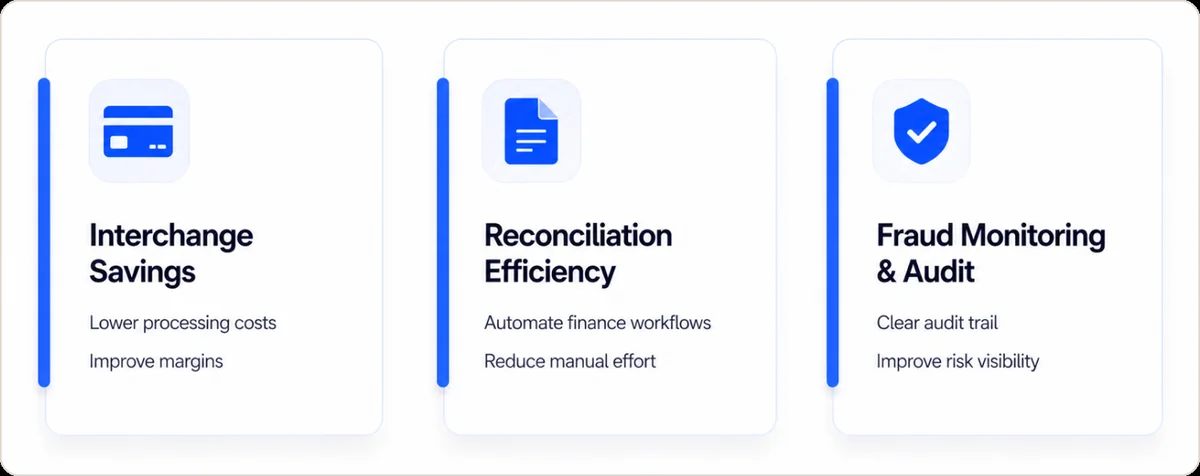
Interchange savings are the most immediate driver. Commercial card transactions qualifying at Level 3 rates cost 50 to 100 basis points less than the same transaction at a standard commercial rate. For a business with $5 million in annual commercial card volume, that differential is $25,000 to $50,000 per year. According to Visa's Commercial Enhanced Data Services documentation, the network's stated goal is to make better transaction data available to issuers so they can price risk accurately and return savings to merchants through lower interchange.
Reconciliation efficiency matters equally to AR teams. When payment data includes line-item detail, matching invoices to payments and payments to GL entries can be largely automated. A case study published by REPAY documents this at K&K Interiors. The company was manually processing roughly 250 commercial cards per day, sometimes taking up to eight hours of daily work. Their operations leader put it plainly: "Our process couldn't keep up." After implementing integrated Level 3 processing, K&K reported saving almost $40,000 annually in processing costs and labor.
Fraud monitoring and audit trails complete the case. The U.S. General Services Administration, through its GSA SmartPay program training materials, notes that enhanced line-item data shows the exact products or services purchased rather than only a transaction total, which directly improves fraud monitoring and supports post-transaction tax recovery in government and fleet card contexts. Federal agencies and large enterprise buyers often require Level 3 data from suppliers as a condition of procurement contracts because of the audit trail.
Understanding why transactions get declined before enhanced data enters the picture is also worth reviewing
Which Cards Qualify for Level 3 Credit Card Processing?
Level 3 processing applies to commercial, corporate, purchasing, and government cards used in B2B or B2G transactions. Consumer cards do not qualify regardless of data submitted.
For Visa, eligible card types include Visa Corporate, Visa Purchasing, Visa Business, and U.S. government cards issued under programs such as GSA SmartPay. Consumer Visa cards and most small-business owners personal cards do not qualify.
For Mastercard, eligible card types under the Data Rate III program include Mastercard Corporate, Mastercard Purchasing, and qualifying Business cards. Mastercard publishes its U.S. interchange rate schedule semiannually with the Data Rate III tier explicitly listed.
MCC exclusions also apply to both networks. Petroleum, supermarkets, and several service-industry categories carry restrictions that block enhanced data rates regardless of card type. Verify your MCC eligibility directly against current Visa and Mastercard published interchange tables, as exclusion lists are updated each rate cycle.
Level 3 does apply to e-commerce, virtual terminal, and card-not-present transactions. The transaction channel is not a disqualifier. What disqualifies a transaction is an ineligible card type, a missing required field, or a data quality failure. If you are evaluating a multiple payment gateway setup, Level 3 pass-through capability varies significantly between gateways and is worth confirming before committing to a configuration.
What Fields Are Required for Level 3 Data?
Required fields differ between Visa and Mastercard. Both networks now validate field accuracy, not just field presence.
| Required Field | Visa Product 3 (CEDP) | Mastercard Data Rate III |
|---|---|---|
| Customer code or PO number | Yes | Yes |
| Ship-to ZIP code | Yes | Yes |
| Ship-from ZIP code | Yes | No |
| Destination country code | Yes | No |
| Freight amount | Yes | Yes |
| Duty amount | Yes | Yes |
| Order date | Yes | No |
| Commodity code per line item | Yes | Yes |
| Product description per line item | Yes | Yes |
| Quantity per line item | Yes | Yes |
| Unit of measure per line item | Yes | Yes |
| Unit price per line item | Yes | Yes |
| Extended price per line item | Yes | Yes |
| Discount per line item | Yes | Yes |
| Tax amount per line item | Yes | No |
| Tax indicator per line item | Yes | No |
| Tax amount at transaction level | No | Yes |
| Net/gross indicator | Yes | No |
Current as of April 2026; CEDP rolled out in phases (live April 2025, full replacement by April 2026), and TLID enforcement is ongoing with fees from January 2027. Access primary docs via Visa's partner portals or Mastercard's developer resources for the latest file specs. (Source)
Visa's CEDP runs an AI-based audit at the time of transaction. Generic descriptions such as "Product" or "Item 1," placeholder tax values that do not reconcile with extended price math, and auto-generated field content are flagged and rejected.
Mastercard's TLID system similarly validates field accuracy against transaction logic. Both networks have moved from checking data presence to checking data integrity. Submitting all required fields with inaccurate values is a compliance failure with direct rate consequences.
What Changed With Visa CEDP and Why It Affects Your Costs Now
The Visa Commercial Enhanced Data Program (CEDP) is the most consequential structural change to commercial card interchange qualification in years. The April 2026 changes directly determine whether your business pays preferred or penalty rates on Visa commercial transactions.
Visa consolidated its legacy Level 2 and Level 3 programs into a single enhanced-data tier called Product 3 and introduced a Verified Merchant status system. Merchants with a consistent record of clean, mathematically accurate submissions receive Verified status and the preferred Product 3 rate. Merchants whose data fails quality checks are classified as Unverified.
An Unverified merchant pays interchange approximately 75 basis points higher than a merchant submitting no enhanced data at all. For a business processing $10 million annually in Visa commercial card volume, that gap represents $65,000 to $90,000 per year. Visa designed the penalty specifically to eliminate the practice of submitting placeholder data to game legacy qualification logic.
If your gateway or ERP integration was populating fields with generic values or tax figures that do not match your actual line-item math, your Verified status is at risk. Audit submitted data quality before each April and October rate cycle.
As NMI noted in their Level III Advantage documentation covering the 2025 transition, the change is "from data presence to data integrity," meaning submitted data must accurately reflect what was actually sold. Our card scheme compliance guide covers the broader network rule framework governing these types of changes.
How Much Can Level 3 Processing Actually Save?
Savings depend on three variables: total commercial card volume, the percentage of eligible card types, and whether your gateway consistently qualifies transactions. All three matter equally.
The table below uses a consistent 0.75% rate differential, which reflects a realistic spread between standard commercial and Level 3 rates for most mid-market merchants:
| Annual Commercial Volume | Eligible Card Mix | Eligible Volume | Rate Differential | Estimated Annual Savings |
|---|---|---|---|---|
| $2M | 60% | $1.2M | 0.75% | $9,000 |
| $10M | 65% | $6.5M | 0.75% | $48,750 |
| $25M | 70% | $17.5M | 0.75% | $131,250 |
The eligible card mix is the most underestimated variable. Many businesses assume most of their B2B volume runs on corporate or purchasing cards, when a meaningful share actually runs on consumer rewards cards issued to business owners. Those cards qualify at Level 1 rates regardless of data submitted.
A Forrester Total Economic Impact™ study commissioned by Visa found that commercial credit card acceptance programs delivered 132% ROI, with lower processing costs, faster cash flow via reduced DSO (e.g., 30-45 to 15-18 days), improved collections (20%), and process efficiencies—benefits scaling to six figures annually for firms adopting 50%+ card payments on $5M+ revenue.
The only accurate way to estimate your savings is to pull your merchant statement, sort by card type, and calculate what percentage of volume sits on genuinely eligible cards. If your approval rates are also under pressure, our approval rate drop analysis guide helps identify where processing costs are leaking across your full payment operation.
Why Are Transactions Downgrading Instead of Qualifying?
Transaction downgrading, where a commercial card payment qualifies at a higher rate than it should, is one of the most common and costly problems in B2B payment operations. Four causes account for the majority of cases.
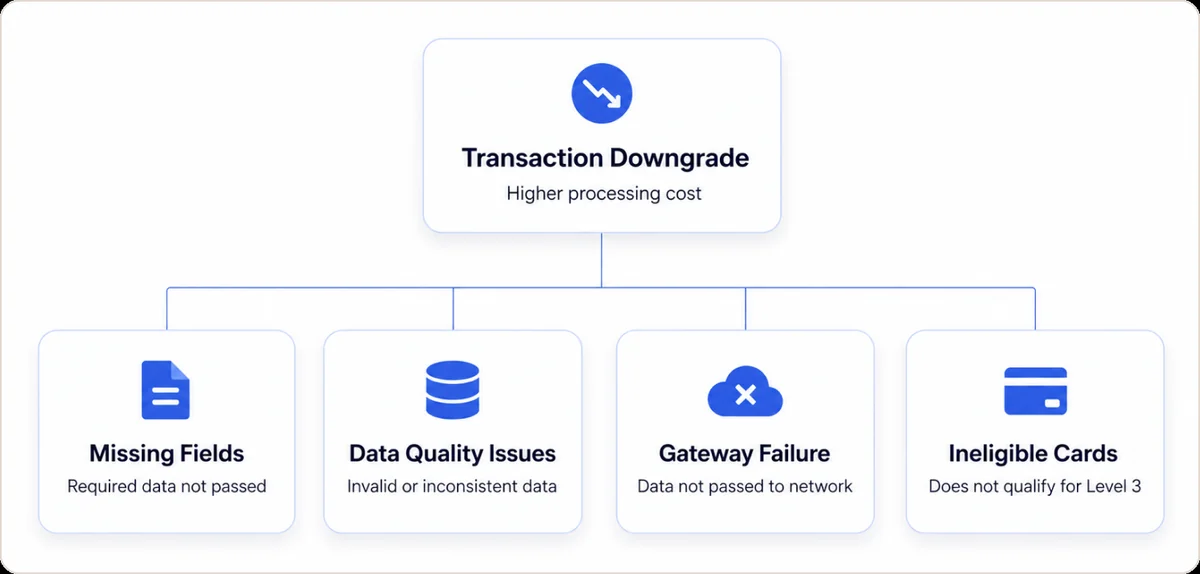
Missing required fields. A gateway that does not pass all required line-item fields causes the transaction to fall back to a standard commercial rate. This is most often a gateway configuration issue, not a problem with the merchant's underlying data.
Data quality failures. Under CEDP's AI audit layer, fields that are present but contain generic or mathematically inconsistent data trigger the same downgrade as missing fields, plus the added risk of Unverified classification.
Gateway pass-through failure. Many gateways market Level 3 support, but only pass data to the processor, not all the way to the card network in the required format. There is a meaningful difference between a gateway that accepts Level 3 fields and one that submits them to the network correctly. Ask your processor for end-to-end pass-through documentation, not just an API field list.
Ineligible card type. Consumer cards, non-U.S. issued corporate cards, and many sole proprietor business cards will not qualify at Level 3 rates, regardless of data submitted. If a large share of your volume runs on these card types, the fix is upstream in how you collect payment.
To diagnose your specific pattern, pull your merchant statement and look for transactions listed under "standard commercial" or "commercial data rate I." Those are your downgraded transactions. Our payment routing optimization guide covers how gateway configuration decisions affect qualification outcomes across card types.
How Do You Know If Your Processor Actually Supports Level 3?
There is a meaningful difference between a processor that supports Level 3 fields in its API and one that reliably qualifies transactions at Level 3 rates in practice. Ask these five questions.
Does your gateway auto-detect eligible commercial cards and trigger Level 3 data capture automatically? Manual field entry creates inconsistency and makes CEDP Verified status difficult to maintain at scale.
Does your gateway pre-validate field completeness and math consistency before submission? A gateway that confirms unit price multiplied by quantity equals extended price before sending to the network prevents CEDP quality failures before they affect your status.
Does your processor pass data all the way to the card network, or does it stop at the acquiring bank? Ask for end-to-end pass-through documentation, not just gateway-level field acceptance.
Can your processor show you transaction-level qualification rate reports? A processor confident in their Level 3 performance will show what percentage of eligible transactions are qualifying versus downgrading. Processors who cannot provide this create a visibility problem that compounds every billing cycle.
Does their ERP or AR integration map to current Visa and Mastercard field specifications? General ERP integrations frequently fail to map commodity codes, network-specific tax logic, or net/gross indicators correctly. Verify it was built against current network specifications, not a generic field template.
Our gateway compliance monitoring service tracks qualification rates, downgrade patterns, and CEDP compliance status if you need ongoing visibility without building that reporting internally.
The Real Problem With Level 3 Data in 2026 Is Accuracy, Not Collection
When I work through payment cost analyses with B2B merchants, the conversation has shifted. The question used to be whether a business was submitting enhanced data at all. Now the question is whether the data is accurate enough to maintain Verified status under CEDP, because the penalty for getting that wrong now exceeds the cost of submitting nothing.
For finance leaders: if your business processes more than $1 million annually in commercial card volume and you are not monitoring your qualification rate and CEDP Verified status, you are almost certainly overpaying.
For operations and IT leaders: a gateway that auto-maps ERP data to current Visa and Mastercard field specifications, pre-validates submissions before they reach the network, and provides qualification reporting is table stakes for competitive interchange rates in 2026, not a premium feature.
Frequently Asked Questions
What is the difference between Level 2 and Level 3 data?
Level 2 data covers summary purchasing information: sales tax total, customer code, and PO number. Level 3 data adds complete line-item detail for every product in the transaction. As of April 2026, Visa retired Level 2 and now requires Level 3 (Product 3) for any reduced interchange on Visa commercial cards.
What cards qualify for Level 3 credit card processing?
Visa Corporate, Visa Purchasing, Mastercard Corporate, Mastercard Purchasing, and U.S. government cards qualify. Consumer cards, small business owner personal cards, and most sole proprietor business cards do not qualify regardless of data submitted.
Does Level 3 apply to online and card-not-present transactions?
Yes. Level 3 applies to e-commerce, virtual terminal, and card-not-present transactions. Card type eligibility and field completeness are the qualifying factors. The transaction channel is not a disqualifier.
What is Visa CEDP?
The Visa Commercial Enhanced Data Program (CEDP) replaced Visa's legacy Level 2 and Level 3 programs with a single tier called Product 3 in April 2026. CEDP uses AI-based data validation to assign Verified or Unverified status, with Verified merchants receiving preferred rates at the time of each transaction.
What happens if my Level 3 data fails Visa CEDP validation?
Merchants classified as Unverified under CEDP pay interchange approximately 75 basis points higher than merchants submitting no enhanced data. Maintaining Verified status requires accurate, complete, and mathematically consistent line-item data submissions.
What is Mastercard Data Rate III?
Mastercard Data Rate III is Mastercard's published terminology for its Level 3 commercial card interchange tier. It appears in Mastercard's semiannual U.S. rate schedule and requires line-item product data, freight amounts, ship-to ZIP code, and transaction-level tax data.
Why are my Level 3 transactions still downgrading?
The most common causes are missing required fields, gateway pass-through failure, data quality failures flagged by CEDP validation, and ineligible card types. Review your merchant statement for transactions qualifying at standard commercial rates to identify the pattern.
Does Level 2 data still qualify for reduced interchange?
Not on Visa. Visa retired Level 2 in April 2026 and Level 2 submission on Visa commercial cards no longer produces a rate benefit. Mastercard Data Rate II remains in Mastercard's schedule, but Level 3 compliance should be the baseline target across all networks.
Does Level 3 data help reduce chargebacks on commercial cards?
Line-item detail gives issuers a clearer record of what the customer bought. That record helps merchants win representments, the evidence a merchant files to fight a dispute. It also cuts the disputes customers file out of confusion. Beast Insights breaks disputes down by decline code, issuer, BIN (bank identification number, the first digits of a card), gateway/MID (merchant ID), acquirer, card brand and billing cycle. You then see which segment drives the losses.
How do I find out which Level 3 transactions are downgrading?
Pull your settlement data. Compare the interchange category returned against the category you submitted, transaction by transaction. The patterns cluster. Beast Insights groups the same volume by BIN, issuer, gateway/MID, acquirer and card brand. That view shows whether a single processor path or card range causes the downgrades.