BIN Codes Explained: What a Bank Identification Number Tells You
What a BIN code is, how to look one up, and what the issuing bank behind a credit card BIN tells you about routing, cost and risk.
What Is BIN Data?
BIN data is the Bank Identification Number, the first six to eight digits of every payment card that identify the issuing financial institution, card brand, and card type.
Every time someone enters a card number online, that BIN is analyzed instantly. It tells you who issued the card, what type it is, and where it came from, all before you process a single dollar.
Here's what those first 6-8 digits reveal:
- Issuing bank (Chase, Wells Fargo, Capital One)
- Card brand (Visa, Mastercard, Amex, Discover)
- Card type (credit, debit, prepaid, gift card)
- Card level (standard, platinum, business, corporate)
- Country of issuance
- Funding source (consumer vs. commercial)
The structure follows the ISO/IEC 7812 standard, which means payment processors worldwide use the same system to identify and route transactions.
Understanding Card Number Structure
| Position | Function | Example |
|---|---|---|
| Digits 1-6 (or 1-8) | Bank Identification Number | 414709 |
| Digits 7-15 | Account identifier | 123456789 |
| Digit 16 | Check digit (Luhn validation) | 4 |
The first digit indicates the card brand's Major Industry Identifier:
- 4 = Visa
- 5 = Mastercard
- 3 = American Express
- 6 = Discover
Under PCI DSS Requirement 3.3, you can display or store the BIN and last 4 digits without full PCI DSS compliance. The middle digits must be protected or masked.
BIN Code, BIN Number, IIN: What to Call It
A BIN code and a BIN number are the same thing: the leading digits of a payment card that identify the bank which issued it. You will also see it written as the bank identification code, and on a credit card it is often just called the credit card BIN.
The one term that is genuinely different is IIN. The card networks renamed the field Issuer Identification Number, and the ISO/IEC 7812 standard uses IIN rather than BIN. In practice the payments industry kept saying BIN, so gateway documentation, fraud tools and acquirer reports mix the two freely. If a spec says IIN and your processor says BIN, they mean the same digits.
Six digits or eight?
It used to be six. The networks moved to eight-digit assignment to avoid running out of ranges, so both lengths are live today. A lookup that assumes six digits will misattribute cards inside an eight-digit range, which is the single most common cause of a BIN table quietly going stale.
How Does BIN Lookup Work in Real-Time Payment Processing?
BIN lookup queries a database to retrieve card information based on the first 6-8 digits.
When a customer initiates payment, the system performs this workflow in under 50 milliseconds:
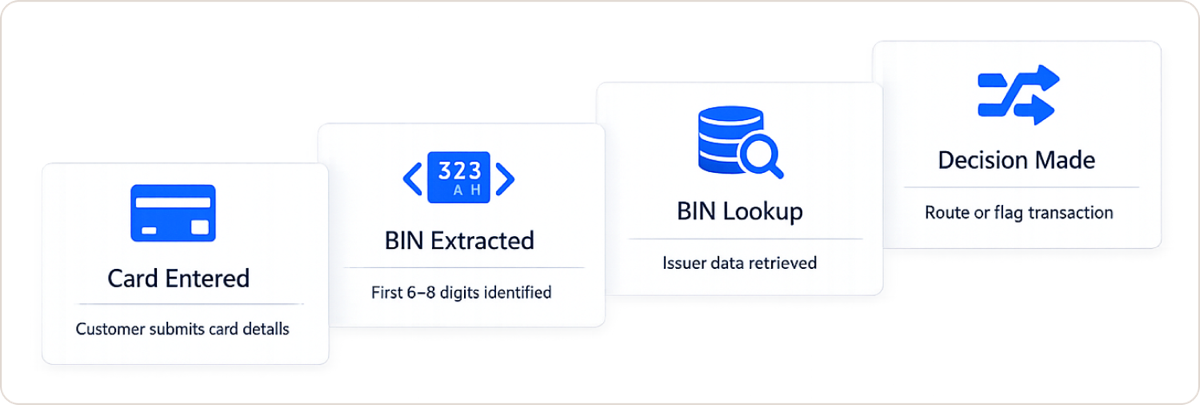
- Customer enters card number
- Payment system extracts BIN number (first 6-8 digits)
- System queries BIN database and retrieves issuer details
- Transaction routes to appropriate processor or triggers fraud review
Industry reports show BIN-based rules typically cut fraud-related chargebacks by 50-70% within 60 days across eCommerce.
The key: They didn't just block countries. They specifically targeted prepaid cards from those regions, which caught fraud while letting legitimate international customers through.
Three Ways to Look Up BIN Numbers
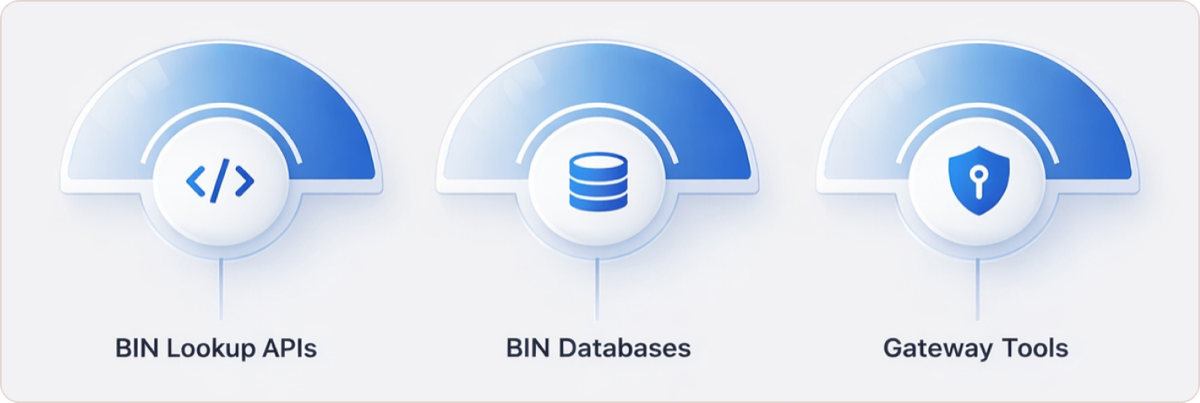
1. BIN Lookup APIs (Recommended for Production)
Real-time APIs return issuer data in under 50ms. Best options:
- BinList.net - Free, community-maintained, good for development
- Binbase - $49-299/month, 99.2% accuracy, includes fraud scoring
- Neustar BIN Intelligence - Enterprise pricing ($5K+/year), highest accuracy (99.8%), historical data
2. Downloadable BIN Databases
CSV or SQL files for offline lookup. Update monthly minimum. Best for high-volume batch processing where 50ms latency matters.
3. Payment Gateway Built-In Tools
Stripe, Braintree, and Adyen include BIN detection in their fraud tools. Convenient but less flexible than standalone APIs.
Practical implementation example:
Input: 4147 8900 0000 0000
BIN Extracted: 414789
API Response:{ "brand": "Visa", "type": "Credit", "level": "Platinum", "issuer": "JPMorgan Chase Bank", "country": "United States", "prepaid": false }
Why BIN Intelligence Is Your First Line of Fraud Defense
Fraudsters exploit specific BIN types because they're harder to trace. BIN intelligence in payment processing identifies these patterns before they cost you money.
High-Risk BIN Characteristics
Watch for these indicators:
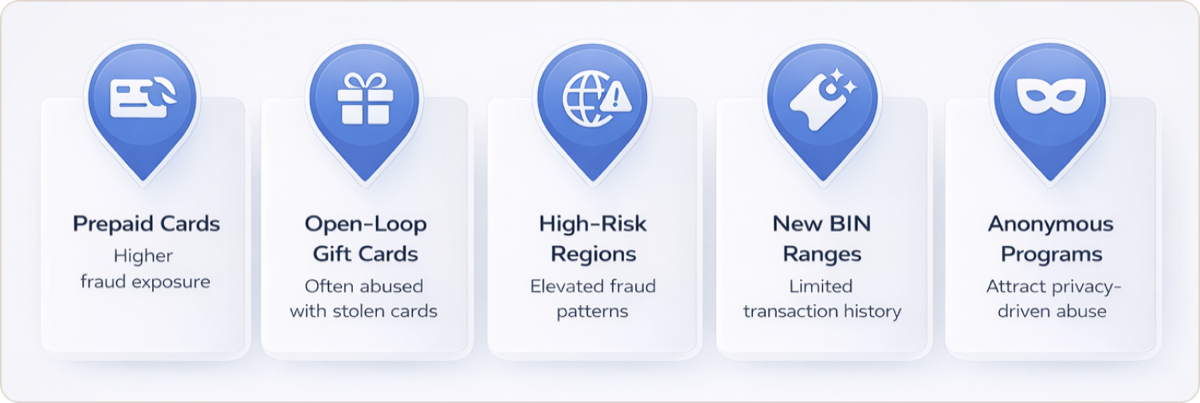
- Prepaid or reloadable cards - 5x higher fraud rate than traditional credit
- Gift cards with open-loop functionality - Frequently purchased with stolen cards
- Cards from high-risk jurisdictions - Specific countries show elevated fraud patterns
- Newly issued BIN ranges - Less transaction history makes fraud harder to detect
- Anonymous card programs - Privacy-focused services attract fraudulent users
Velocity Checks Enabled by BIN Data
- Multiple transactions from different BINs in 10 minutes
- Single BIN used across 5+ customer accounts
- BIN country doesn't match billing address country
- Unusual BIN for customer's purchase history
Case study: Digital goods marketplace
They were losing $12K monthly to fraud on software license sales. Implementation:
- Flagged all prepaid BINs from Eastern Europe for manual review
- Auto-declined gift card BINs on purchases over $100
- Required phone verification when BIN country didn't match IP country
Result: 62% reduction in fraud losses within 30 days. False positive rate: 2.3%.
According to the Federal Trade Commission's 2023 Consumer Sentinel Network Data Book, consumers reported 449,032 credit card fraud incidents, contributing to $10 billion in total fraud losses. The FTC's 2024 data put total reported fraud losses at $12.5 billion, with credit card fraud again the most common identity theft type, so the pressure on issuers to decline suspicious BINs keeps rising.
For high-risk transactions, combining BIN intelligence with 3D Secure authentication creates a powerful fraud prevention layer that verifies cardholder identity while maintaining conversion rates.
How BIN Routing Reduces Payment Processing Costs
Smart payment systems use BIN routing to direct transactions through the optimal processing path.
Domestic vs. International Routing
Cards issued in the US route through domestic processors for lower interchange rates. A $100 transaction on a US-issued Visa might cost 2.1% + $0.10 domestically but 3.2% + $0.10 if routed internationally.
Debit vs. Credit Routing
BIN data identifies whether a card is debit or credit. Debit transactions can route through PIN-based networks (Interlink, NYCE, Star) for rates as low as 0.5%, compared to 1.8-2.5% for credit.
Commercial Card Optimization
BINs identify corporate and purchasing cards, which trigger Level 2 and Level 3 data requirements. Submitting proper data prevents downgrades that cost 0.5-1.0% in additional fees.
According to Visa's 2024 Global Payment Trends Report, merchants using dynamic BIN-based routing saw authorization rate improvements of 3-7%, translating directly to revenue gains.
For a merchant processing $5M annually with a baseline 87% authorization rate:
- 5% improvement = 4.35% more approvals
- Additional revenue: $217,500
Learn more about optimizing payment routing strategies to reduce processing costs and improve authorization rates.
BIN Database Accuracy: Why Outdated Data Costs Money
In Q4 2023, a $50M e-commerce retailer lost $180K to fraud in six weeks. Root cause: Their free BIN database hadn't been updated in eight months.
New high-risk prepaid BINs weren't flagged. Fraudsters exploited the gap.
Why BIN Databases Change Constantly
- Banks launch new card products monthly
- Fintech companies receive dedicated BIN ranges
- Issuers expand into new markets
- Fraud patterns shift to newly issued BINs
Update Frequency Requirements
| System Type | Update Frequency | Risk Level |
|---|---|---|
| Critical fraud prevention | Weekly or real-time | High risk if outdated |
| Standard payment processing | Monthly | Moderate risk |
| Development/testing only | Quarterly | Low impact |
Commercial providers like Visa's Simplified BIN Table and Mastercard's BIN Range Table release weekly/monthly updates. Using stale data leads to 20-30% outdated BINs, operating blind on routing and fraud.
Comparing BIN Data Solutions
| Solution | Accuracy | Update Frequency | Cost | Best For |
|---|---|---|---|---|
| Free (BinList) | 70-85%* | Quarterly | $0 | Development only |
| Commercial APIs (Binbase) | 99%+ | Regular (up to 2-mo lag) | $50-500/mo | Production systems |
| Gateway built-in | 90-95% | Monthly | Included | Basic needs |
| Enterprise platforms | 99%+ | Real-time | $5K+/year | High-volume merchants |
*Source: Binbase accuracy testing
When transactions fail despite proper routing, implementing intelligent payment retry strategies based on BIN data and failure codes can recover 15-25% of initially declined transactions.
Regulatory Compliance: What You Can and Can't Do with BIN Data
BIN data isn't considered sensitive under PCI DSS, but payment networks impose strict usage rules.
PCI DSS Compliance
Per Requirement 3.3, you can display and store:
- First 6-8 digits (BIN)
- Last 4 digits
The middle account digits require full PCI compliance or tokenization.
Payment Network Rules
Visa and Mastercard prohibit:
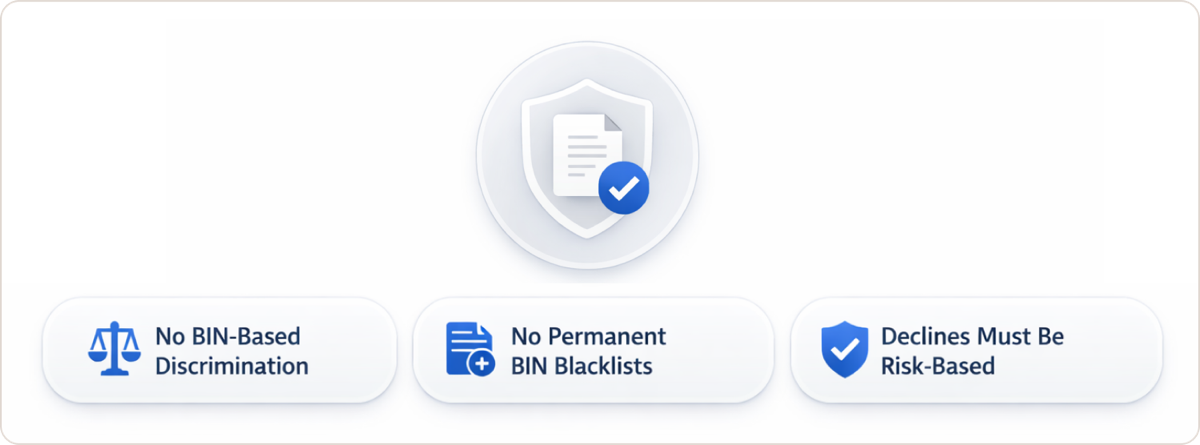
- Discriminating against cardholders based solely on BIN
- Building permanent BIN blacklists without documented fraud patterns
- Declining transactions without valid risk indicators
Understanding gateway compliance monitoring helps ensure your BIN data usage aligns with payment network requirements.
Real-World Implementation by Business Size
Small Businesses ($0-$500K Annual Card Volume)
Recommended approach:
- Use payment gateway's built-in BIN tools
- Set basic fraud rules: block gift cards over $200, flag international prepaid
- Review BIN patterns in chargebacks monthly
Expected impact: 20-30% fraud reduction, minimal false positives
Mid-Market ($500K-$10M Annual Volume)
Recommended approach:
- Implement commercial BIN lookup API ($50-300/month)
- Build BIN-based fraud scoring (prepaid = +25 points, country mismatch = +40 points)
- Use BIN routing to optimize processing (save 15-25 basis points)
- Quarterly BIN risk assessment
Expected ROI: At 0.5% fraud rate on $2M volume, that's $10K annual fraud. Investment: $3,600/year (API + implementation). Net savings: $6,400 minimum, plus $3,000-5,000 in reduced processing costs.
Enterprise ($10M+ Annual Volume)
Recommended approach:
- Deploy enterprise BIN intelligence (Neustar, Sift, Kount)
- Integrate BIN data with machine learning fraud models
- Optimize authorization by BIN segment (test retry logic per issuer)
- Real-time BIN database updates
- Dedicated fraud analyst reviewing BIN patterns
Expected impact: 40-60% fraud reduction, 3-7% authorization rate improvement
"Strategic use of BIN intelligence at the intersection of data science and payment security helps optimize authorization rates and fraud prevention." — Inspired by Aite-Novarica fraud research
Implementing BIN Intelligence: Your Next Steps
BIN data transforms payment processing from reactive to strategic. The difference between businesses that thrive and those that struggle with fraud comes down to how they use this intelligence.
Start here:
Review your last 90 days of chargebacks and identify BIN patterns. What percentage involves prepaid cards? Do certain card levels (platinum, business) have higher or lower fraud rates? Are international BINs over-represented in disputes?
Then choose your implementation tier based on volume and build specific rules, not blanket blocks.
Key decision points:
- Processing under $500K annually? Start with your gateway's built-in tools and basic fraud rules
- Processing $500K to $10M? Invest in commercial BIN APIs and dynamic routing
- Processing $10M+? Deploy enterprise BIN intelligence integrated with your fraud prevention stack
BIN intelligence works best when combined with other signals like device fingerprinting, velocity checks, and behavioral analytics. It's one component of a complete fraud prevention strategy.
For businesses serious about reducing fraud and optimizing payment performance, stopping disputes before they become chargebacks requires a multi-layered approach where BIN data serves as your first line of defense.
Frequently Asked Questions
What is a BIN code?
A BIN code is the first six to eight digits of a payment card. Those digits identify the bank that issued the card, the card brand and the card type, which is why they are read before a transaction is routed or screened.
What is a BIN number in banking?
A BIN (Bank Identification Number) is the first six to eight digits on a payment card that identify the issuing bank, card brand, and card type before processing a transaction.
Is a BIN code the same as an IIN?
Yes. IIN stands for Issuer Identification Number and is the current name in the ISO/IEC 7812 standard for the same leading digits. The payments industry largely kept using BIN, so the two terms appear interchangeably across gateway docs and acquirer reports.
What is a credit card BIN?
The credit card BIN is simply the BIN code on a credit card rather than a debit or prepaid card. The digits work the same way and identify the issuing bank, but the card type they return is what tells you the interchange band and the likely approval behaviour.
How do I find a bank identification code?
Take the first six to eight digits of the card number and pass them to a BIN lookup service or your gateway's built-in BIN detection. Never store or display the full card number to do this: the BIN alone is enough.
How much do BIN lookup APIs cost?
Free BIN lookup tools exist for testing, but production systems need commercial APIs ranging from $49-500 monthly for mid-market businesses or $5,000+ annually for enterprise solutions with 99%+ accuracy.
Can BIN data identify stolen cards?
No, BIN data identifies the card issuer and type, but cannot determine if a specific card is stolen. That requires verification services like 3D Secure or CVV checking.
Is BIN data the same as a routing number?
No, BIN identifies card issuers in card payments, while routing numbers identify banks in ACH and wire transfers. They serve completely different payment systems.
How do I look up a BIN number?
Use a BIN lookup API by entering the first 6-8 digits to retrieve issuer information, or access your payment gateway's built-in BIN detection tools.
Can BIN data prevent payment fraud?
BIN data supports fraud screening rather than preventing fraud on its own. It identifies higher-risk card types such as prepaid cards and flags a mismatch between the issuing country and the customer's stated location, both of which feed a wider risk decision.