Nutraceutical Payment Processing: How to Keep Your Merchant Account and Grow
Learn how supplement brands get approved, avoid shutdowns, and stay below Visa's 1.5% VAMP threshold with this 2026 nutraceutical payment processing playbook.
What Is Nutraceutical Payment Processing and Why Does It Differ from Standard Processing?
A nutraceutical merchant account gives your supplement business its own merchant identification number (MID), underwritten individually by an acquiring bank that has evaluated your product line, billing model, and chargeback history before approving you. That is the structural difference from a payment aggregator.
I have watched supplement brands generating solid, consistent revenue lose access to their entire payment infrastructure because Stripe's automated systems flagged a subscription product page on a Tuesday morning. No warning. Funds frozen. Fulfillment halted. That is not a hypothetical. It is the most common crisis I see in this space, and it happens specifically because aggregators like Stripe, Square, and PayPal pool all merchants under shared accounts and terminate categories that trigger their risk models, regardless of your individual history.
With a dedicated nutraceutical credit card processing account, your processor knows your product line, your subscription model, and your chargeback history before the account goes live. That prior underwriting is what creates stability during volume spikes, campaign launches, and growth periods. Without it, every spike is a potential freeze event.
Payment processing for nutraceutical businesses is not a checkout feature. It is infrastructure. The brands that treat it like infrastructure survive scaling. Those who treat it like a commodity find out otherwise.
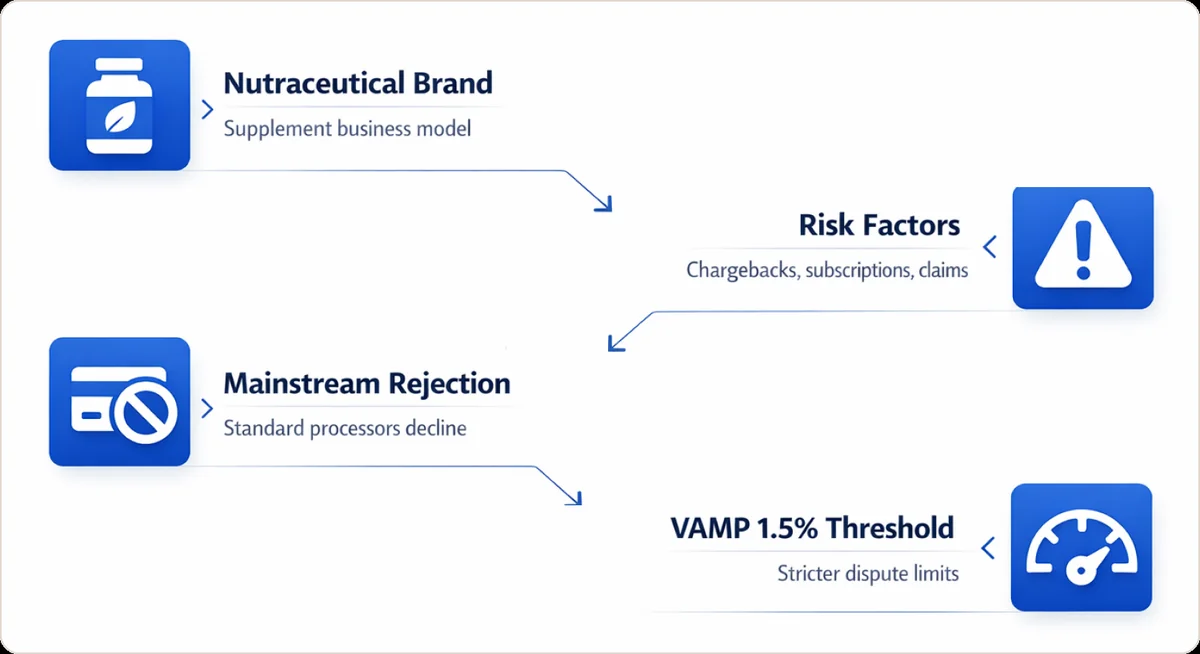
Why Are Nutraceutical Brands Classified as High-Risk?
Nutraceutical brands are classified as high-risk by acquiring banks and card networks because of three intersecting factors: structurally elevated chargeback rates from subscription billing, regulatory scrutiny over health claims, and product category risk that card networks apply industry-wide.
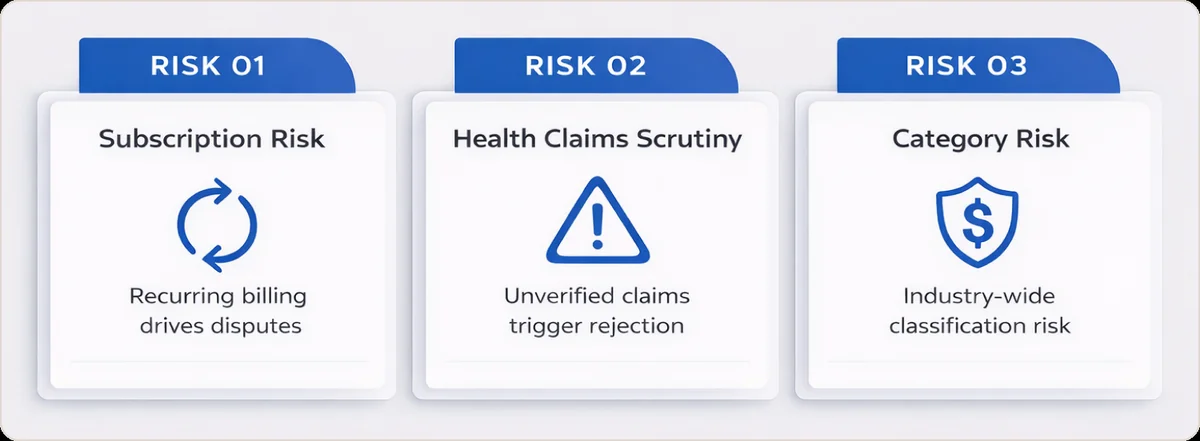
Subscription billing creates structural dispute exposure. Continuity programs, free-trial-to-paid models, and monthly supplement boxes generate disputes when customers cannot locate a cancellation option, forget they enrolled, or feel the product did not match its advertised claims. That friction translates directly into chargeback volume.
Health claims attract underwriter attention before approval. According to the FTC's Health Products Compliance Guidance, health-related claims must be truthful, not misleading, and supported by competent and reliable scientific evidence. Underwriters read your product pages. Phrases such as "clinically proven," "reverses aging," or "treats inflammation" are among the most commonly flagged terms in nutraceutical merchant account applications. A single unsubstantiated claim on a product detail page has caused more declined applications than weak financials.
The category carries inherited risk. Card networks apply blanket caution to nutraceuticals because the category has historically been associated with deceptive billing practices, inflated return rates, and aggressive continuity programs. Even brands with clean records inherit this classification.
What Do Underwriters Actually Require to Approve a Nutraceutical Merchant Account?
Underwriters approving a nutraceutical merchant account require a complete documentation package covering business identity, product legitimacy, financial history, and website compliance. Submitting an incomplete package is the most preventable reason applications fail.
Document packet requirements:
- Government-issued ID and business formation documents
- Three to six months of business bank statements
- Certificate of Analysis (COA) for each product SKU
- GMP certification or documentation from your manufacturing partner
- Processing history statements, if applicable
- Voided check for the settlement account
Website and policy requirements underwriters check:
- Clear contact information including phone, email, and physical address
- Explicit refund and return policy, ideally 30 days or better
- Shipping timelines and fulfillment disclosures
- Full subscription terms displayed before checkout completion, not buried in fine print
- The FDA-required disclaimer for structure/function claims: "This statement has not been evaluated by the Food and Drug Administration. This product is not intended to diagnose, treat, cure, or prevent any disease."
- No income claims, disease treatment language, or testimonials implying guaranteed outcomes
Before submitting any application, run a self-audit of every product page. Check every claim against the FDA's structure/function framework. Look for language that implies treatment or cure. Fix it before the underwriter does, because their fix is a decline.
What Metrics Determine Whether Your Nutraceutical Merchant Account Survives in 2026?
The metric that determines nutraceutical merchant account survival in 2026 is the VAMP ratio. Visa's Visa Acquirer Monitoring Program (VAMP) consolidates fraud and dispute tracking into a single ratio; effective April 1, 2026, the excessive merchant threshold for merchants in AP, Canada, EU, and U.S. regions drops from 2.2% to 1.5% (that is, from ≥220 bps to ≥150 bps) (Source).
For supplement brands running subscription billing with paid traffic, this threshold change is the most operationally significant payment network update in years.
How the VAMP ratio is calculated:
VAMP Ratio = (TC40 Fraud Reports + TC15 Disputes) divided by Total Card-Not-Present Settled Transactions
Only CNP transactions count in the denominator, which reflects the reality that supplement brands do the majority of their volume through ecommerce. TC40 data comes from your processor's monthly risk report or dispute management dashboard. TC15 dispute counts come from your chargeback management platform. If you do not have visibility into both numbers, you are managing your account blind.
For a deeper breakdown of how VAMP enforcement works, the guide on the Visa Acquirer Monitoring Program covers the program mechanics in full.
Risk thresholds and recommended actions:
| VAMP Ratio Range | Risk Level | Recommended Action |
|---|---|---|
| Under 0.8% | Healthy | Maintain hygiene, monitor monthly |
| 0.8% to 1.2% | Caution | Deploy chargeback alerts, audit cancellation UX |
| 1.2% to 1.5% | Elevated | Pause highest-risk offers, contact processor proactively |
| Over 1.5% | Enforcement risk | Emergency remediation, offer redesign, possible MID restructure |
One detail most brands miss: your acquiring bank may apply internal thresholds stricter than Visa's stated program threshold. Your account can be reviewed or restricted before you ever cross 1.5%. Proactive monitoring is not optional when you are in a category that acquirers are already watching.
How Does Subscription Billing Drive Dispute Risk in Nutraceutical Credit Card Processing?
Subscription billing is the highest dispute-generating model in payment processing for nutraceutical businesses. Friendly fraud, where a cardholder disputes a legitimate charge rather than requesting a cancellation, is the dominant dispute type in this category and it is almost always rooted in cancellation friction.
The FTC's updated Negative Option Rule, effective January 19, 2025, with key compliance sections (e.g., simple cancellation mechanisms) originally enforced from May 14, 2025 (later deferred to July 14, 2025), created explicit legal requirements for subscription enrollment disclosure and cancellation access. According to the FTC's guidance on negative option marketing, failure to provide a simple cancellation mechanism as easy as signing up is treated as an unfair or deceptive practice regardless of the terms of service (Source).
Non-compliant subscription UX does not just create regulatory exposure. It directly inflates your VAMP ratio. Every customer who cannot find the cancellation option and disputes the charge instead is a TC15 event counting against your threshold.
What the rule requires in practical terms:
- Clear and conspicuous disclosure of all subscription terms before enrollment
- Express informed consent, not pre-checked boxes or buried disclosures
- A cancellation mechanism as simple to use as the sign-up process
- Confirmation of enrollment and cancellation delivered to the customer
UX patterns that reduce dispute rates in practice:
- A pre-charge email sent five to seven days before each renewal
- A one-click cancellation link embedded in that email
- A billing descriptor that includes your brand name plus a phone number or URL
- A real-time cancellation confirmation sent immediately after cancellation
Involuntary churn from failed payments compounds this problem. If your retry logic is aggressive and customers receive unexpected charges after a declined card, disputes follow. Understanding involuntary churn and failed payment recovery as connected problems changes how you design your subscription stack.
Which Chargeback Reason Codes Should Nutraceutical Brands Track First?
Most supplement disputes cluster into a few codes. Recurring billing disputes, product not received, and fraud lead the list. Map each dispute to its chargeback reason code and you see which fix matters. Then track that mix against your VAMP ratio, the Visa Acquirer Monitoring Program score for dispute and fraud levels. The ratio shows whether the fix is working. Beast Insights breaks disputes down by reason code, issuer, BIN and MID. BIN means bank identification number, the first card digits that name the issuing bank. MID means merchant ID, the account that processes the charge.
- Recurring billing codes point at cancellation friction: fix the flow, the pre-charge email, and the billing descriptor.
- Product not received codes point at fulfillment timing: attach carrier tracking to the order ID and surface it in support.
- Fraud codes point at checkout controls: tighten 3DS rules, velocity limits, and card testing defenses on new offers.
- Read the mix per MID and per billing cycle, not blended, so one offer does not hide inside the account average.
How Do You Build a Dispute Defense System for Nutraceutical Merchant Account Processing?
A dispute defense system is a structured combination of alert integrations, evidence storage, and response workflows designed to prevent chargebacks from forming and win the ones that do.
The two alert networks that brands should integrate are Ethoca and Verifi. Ethoca, a Mastercard service, allows issuers to notify merchants of disputes before they become chargebacks, giving you a window to issue a refund and stop the escalation. Brands access Ethoca Alerts through their payment processor or gateway, not directly through Mastercard. Verifi's Rapid Dispute Resolution (RDR) allows merchants to define automated rules that resolve Visa disputes instantly without manual intervention. Supplement brands running Konnektive, Sticky.io or 29Next usually buy these alerts through a provider that already connects to those CRMs, so it is worth comparing the best Chargeback360 alternatives on coverage, pricing and whether they report which alerts actually prevented a chargeback.
Your proof library should contain:
- Subscription consent logs with IP address, timestamp, and the exact terms displayed at enrollment
- Delivery confirmation for physical shipments with carrier tracking linked to the order ID
- Customer support transcripts showing resolution was offered before a dispute was filed
- Refund timestamps showing the date and amount of any refund issued
- Billing descriptor documentation showing what appears on the cardholder's statement
The proof library is not administrative overhead. It is what determines whether you win a chargeback representment and, at scale, your win rate has a direct impact on your VAMP ratio trajectory.
Effective chargeback prevention starts before a dispute is filed. Brands that build alert integrations, clean consent logs, and refund workflows before they reach enforcement territory are the ones that stay below threshold. Brands that build those systems in response to a processor warning are already behind.
What Happens If Your Nutraceutical Merchant Account Is Terminated?
If your nutraceutical merchant account is terminated, the immediate consequence is loss of payment access. The downstream consequence is MATCH list placement, which can prevent you from obtaining a new merchant account for up to five years.
The MATCH list, maintained by Mastercard and shared across acquiring banks, is reported to processors when they terminate accounts for excessive chargebacks, fraud, or card network rule violations. According to Mastercard's MATCH system documentation, chargeback-related listing under Reason Code 04 requires chargeback rates to have exceeded network thresholds, which means your chargeback ratio management is directly connected to your MATCH list risk.
Prevention is the only real strategy. If your account is under review, contact your processor before they make the termination decision. Document your remediation steps in writing and send them to your risk contact. Do not open a new account under a related entity without disclosing the prior termination.
How Do You Scale a Nutraceutical Business Without Triggering Payment Account Freezes?
Scaling nutraceutical payment processing safely requires proactive processor communication, volume ramp governance, and redundancy built before you need it.
The most common freeze scenario is a DTC supplement brand running a successful paid campaign that drives five to ten times normal transaction volume over a weekend. The processor's automated risk systems flag the spike as potential fraud, freeze the account, and hold funds for review. That resolution process takes days or weeks. Fulfillment stops. Revenue evaporates.
A safer scaling protocol:
- Notify your processor in writing at least five business days before launching any campaign expected to materially increase volume
- Set internal monitoring alerts so you see volume spikes before your processor flags them
- Establish a second merchant account with a different acquiring bank before you reach high-volume thresholds, not after a freeze forces the issue
- Segment offers by MID where possible: subscription products on one MID, one-time purchases on another
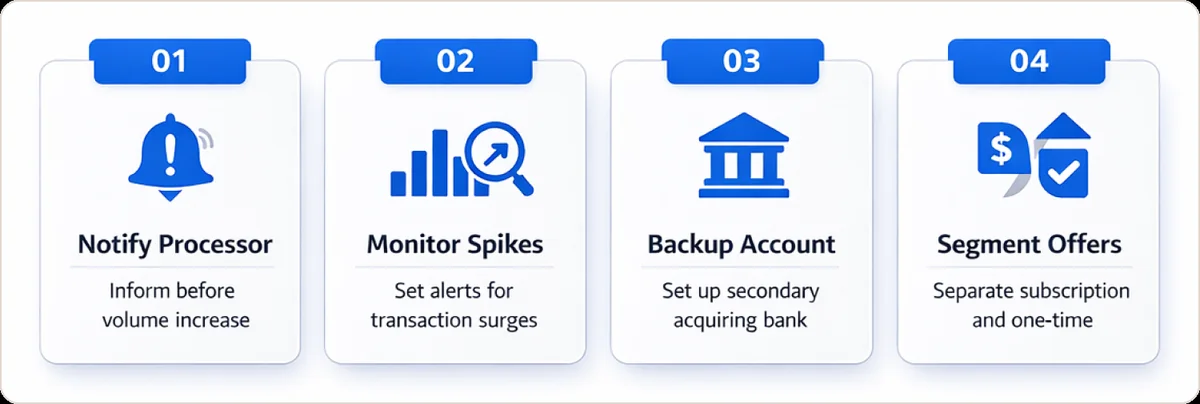
A multi-acquirer strategy is the structural answer to single-processor dependency. Brands that treat payment redundancy as a growth requirement do not lose weeks of revenue to freeze events. Monitoring your MID health and approval rates across processors gives you early warning when one account is trending toward a risk threshold before your processor acts on it.
Conclusion: What Actually Keeps a Nutraceutical Merchant Account Stable
Getting approved for nutraceutical payment processing is a one-time event. Keeping the account is ongoing operational discipline, and in 2026, that discipline has measurable thresholds attached to it.
The VAMP threshold is now 1.5%. The FTC subscription rule is enforced. The MATCH list consequence of termination is real and lasting. These are not risks to manage someday. They are the operating environment your supplement business exists in right now.
Your priority action sequence:
- Audit every product page for claims that fail the FDA structure/function framework and fix them before an underwriter flags them.
- Pull your TC40 and TC15 data from your processor and calculate your current VAMP ratio. Set an internal alert at 0.8%.
- Test your subscription cancellation flow against the FTC Negative Option Rule. If a customer cannot cancel in three clicks or fewer, that is your primary dispute risk.
- Build your proof library now: consent logs, delivery confirmation, support transcripts, and refund timestamps.
- Establish a second merchant account before your volume creates single-processor dependency.
If you are unsure where your dispute exposure sits or want to understand how your payment data connects to revenue and approval rate trends, talk to a payment strategy expert before your next campaign launch.
FAQ
What is a nutraceutical merchant account?
A nutraceutical merchant account is a dedicated payment processing account issued individually to supplement brands by acquiring banks that specialize in high-risk merchant categories. Unlike aggregated accounts, the bank has underwritten the specific business, products, and billing model before approval.
What is the current Visa VAMP threshold for nutraceutical merchants?
The Visa VAMP excessive merchant threshold is 1.5% as of April 1, 2026, reduced from the previous 2.2%. The ratio measures combined TC40 fraud reports and TC15 disputes against total card-not-present settled transactions in a calendar month.
What is a rolling reserve and how long do processors hold it?
A rolling reserve is a percentage of transaction volume, typically 5% to 10%, held by the acquiring bank as a risk buffer against future chargebacks. High-risk processors typically hold reserves for 90 to 180 days. The reserve percentage and release schedule are negotiable at the time of account approval.
Can supplement brands use Shopify Payments for nutraceutical credit card processing?
Shopify Payments prohibits nutraceutical and supplement products under its acceptable use policy. Supplement brands must integrate a third-party high-risk payment gateway with Shopify rather than using Shopify Payments natively.
What is the FTC rule for canceling supplement subscriptions?
The FTC Negative Option Rule, effective January 14, 2025, requires supplement brands to provide clear enrollment disclosure, express informed consent, and a cancellation mechanism as simple as the sign-up process. Key compliance sections were enforced from May 14, 2025.
What is the difference between a chargeback and a retrieval request?
A retrieval request is an issuing bank asking a merchant for documentation about a transaction before a dispute is filed. A chargeback is a formal dispute that reverses the transaction and counts against the merchant's chargeback ratio. Responding to retrieval requests promptly often prevents them from escalating to chargebacks.
Which chargeback reason codes are most common for supplement subscriptions?
Recurring billing disputes, product not received, and fraud codes dominate supplement subscription chargebacks. The code mix tells you where the leak sits. Cancellation friction, delivery timing, and card testing each show up under a different code. Beast Insights breaks disputes down by reason code, issuer, BIN, gateway/MID and billing cycle. BIN means bank identification number, the first card digits that name the issuing bank. MID means merchant ID, the account that processes the charge. Teams use that detail to fix the actual cause.
How often should a supplement brand check its VAMP ratio?
Check the ratio monthly at minimum. Check it weekly during paid campaigns and new offer launches. Dispute spikes surface before your acquirer flags them. Track the ratio per MID rather than blended, because one offer can pull the whole account up. MID means merchant ID, the account that processes the charge. Beast Insights shows approval rate and chargeback percentage per MID.