Dunning Management: How SaaS Companies Recover Failed Payments
Dunning management recovers failed subscription payments via smart retries. Learn how it works, which tools recover most, and compliance rules.
What Is Dunning Management, and Why Is It a Revenue Problem Right Now?
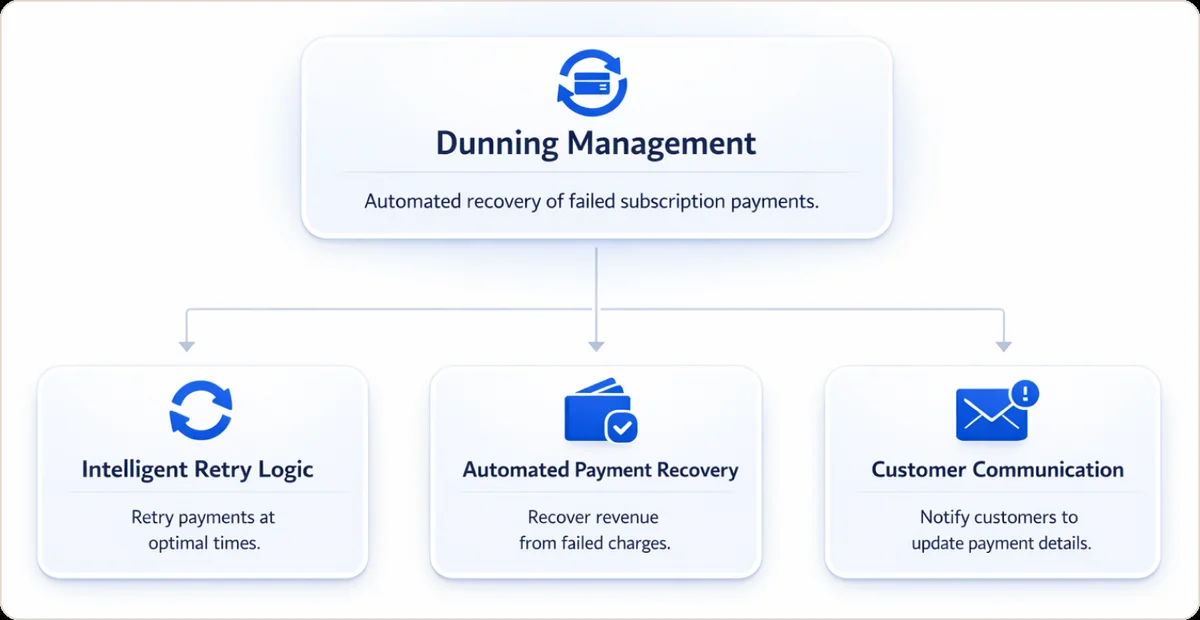
Most SaaS companies treat dunning as a billing afterthought. That is exactly why they bleed $400,000 a year without knowing it. Dunning management is the automated, systematic process used to recover failed recurring payments through retry logic and structured customer communication, thereby reducing involuntary churn before customers lose access to service.
The term comes from the 17th-century verb "dun," meaning to demand payment persistently. Historically, it was synonymous with aggressive debt collection. In the modern SaaS context, the goal is the opposite: recover revenue while actively preserving the customer relationship.
When a customer's credit card expires, a charge fails due to insufficient funds, or a network timeout interrupts a billing cycle, they have not decided to leave. A technical failure is pushing them out. A well-configured dunning system resolves that failure quietly, often before the customer ever knows there was a problem.
That distinction, between customers who chose to leave and customers who were lost to operational failure, is the entire strategic argument for investing in dunning. If you want to understand what that lost revenue looks like at the transaction level, our breakdown of credit card decline codes is a useful starting point before diving deeper into recovery systems.
What Is the Difference Between Traditional Dunning and Modern SaaS Dunning?
Traditional dunning collects debt from customers who refuse to pay. Modern SaaS dunning management recovers revenue from customers who intended to pay but encountered a technical barrier. The distinction reshapes every decision: your communication tone, your retry logic, your tooling, and your legal obligations.
Here is how the two approaches compare:
| Feature | Traditional Dunning | Modern SaaS Dunning |
|---|---|---|
| Primary Goal | Debt collection | Customer retention and churn mitigation |
| Automation | Manual, labor-intensive | Fully automated, ML-driven smart retries |
| Tone | Aggressive, threatening | Professional, empathetic, benefit-of-the-doubt |
| Customer View | Disposable after default | Long-term LTV asset |
| Tech Mechanism | Collection agencies / legal | Account Updaters + smart retry logic |
| Integration | Siloed accounting function | Billing, CRM, in-app, and UX stack |
The shift from reactive collection to proactive relationship management is what separates high-recovery SaaS companies from those silently losing 4-10% of annual revenue. See also: how involuntary churn compounds over time and why measuring it separately from voluntary churn changes your entire retention strategy.
What Is the Real Economic Cost of Payment Failure in SaaS?
Payment failures account for approximately 34% of involuntary customer churn in subscription businesses. For a $10M ARR SaaS company with a typical 7.9% transaction failure rate, that puts roughly $790,000 in annual revenue at risk. With median recovery rates of around 47.6%, more than $400,000 leaves the business each year due to preventable operational failures.
These figures draw from ProfitWell's B2B SaaS benchmarks and Chargebee's payment analytics datasets. According to the 2024 SaaS Benchmarks Report by High Alpha (building on OpenView), Sales & Marketing efficiency remains challenged as companies scale, with median spend at 34-40% of ARR. When you lose a customer to a failed payment, you've invested heavily in acquisition only to forfeit that revenue
The math compounds at the LTV level. A company charging $50 per month can lift expected customer lifetime value from $1,200 to $1,800 by reducing monthly churn from 3% to 2% through better dunning alone. That is a 50% LTV improvement without acquiring a single new customer, launching a new feature, or changing your pricing.
For a full-picture view of how payment data drives lifetime value decisions, our guide on increasing customer lifetime value through payment data walks through the modeling in detail.
"Involuntary churn is the silent monster eating your MRR. Most SaaS companies don't even know how much they're losing until they start measuring it separately from voluntary churn." — Patrick Campbell, Founder of ProfitWell (now Paddle). Source: ProfitWell Recur Research Library
How Does the Dunning Process Actually Work? (4 Stages)
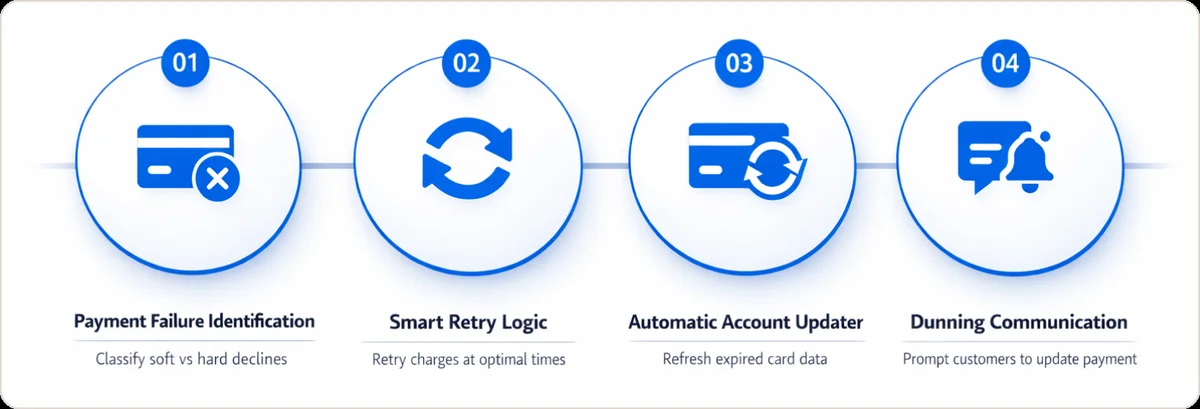
Stage 1: How Are Payment Failures Identified and Classified?
A well-configured dunning system categorizes each failure immediately upon receiving a decline code from the payment processor. Soft declines such as insufficient funds or network timeouts, are temporary and recoverable through retries. Hard declines, including those due to stolen cards or closed accounts, are permanent and must never be retried.
Retrying a hard decline increases your merchant risk profile with payment processors, which can trigger monitoring programs and account restrictions. Approximately 26-30% of all failures are insufficient-funds soft declines that resolve within 2-5 business days once a customer's payroll cycle completes. Knowing the difference changes your retry schedule entirely.
For a complete reference of what each decline code means and which are recoverable, see our credit card decline codes guide.
Stage 2: What Is Smart Retry Logic, and How Much Does It Recover?
Smart retry logic uses machine learning to determine the optimal moment to retry a failed charge rather than attempting at fixed 24-hour intervals. It analyzes historical payment data, the specific decline reason, the customer's time zone, and payroll cycle patterns to identify the highest-probability window for a successful charge.
According to Stripe's payment recovery documentation, dynamic retry schedules recover approximately 7.8% more purchases compared to static approaches. The most effective cadence attempts across Day 1, Day 4, Day 7, and Day 10, deliberately avoiding weekends and late-night windows.
Stage 3: What Is an Automatic Account Updater, and Why Is It Underused?
An Automatic Account Updater (AAU) is a card-network service provided by Visa and Mastercard that automatically pushes updated card numbers and expiration dates to your billing system when a card is reissued. It runs before any payment attempt fails, making it the highest-ROI element of any dunning system because it prevents failure entirely rather than recovering from it.
AAU recovers up to 20% more invoices before a failure event triggers. Despite this, many mid-market SaaS companies never enable it because it sits quietly within payment gateway settings, with no obvious prompt to activate it. Braintree, Stripe, and most enterprise gateways support it natively. Enabling it takes under an hour and requires no ongoing management.
For implementation specifics and network participation requirements, see our card account updater guide.
Stage 4: What Does an Effective Dunning Communication Sequence Look Like?
A dunning communication sequence is a structured series of messages sent across multiple channels after a payment failure, designed to prompt the customer to update their payment details. The sequence escalates in urgency over time, opening with low-friction in-app prompts and escalating to SMS and direct outreach for high-value accounts.
| Timing | Stage | Channel | Tone | Key Tactic |
|---|---|---|---|---|
| Day 1 | Soft Nudge | In-App + Email | Polite, non-accusatory | Lowest friction, highest resolution rate |
| Day 3-5 | Follow-Up | Direct clarify issue | Include one-click payment update link | |
| Day 7-10 | Urgent Alert | SMS + Email | Firm, highlight risk | SMS: 98% open rate vs 20% for email |
| Day 14+ | Final Notice | Email + Phone (B2B) | Formal, outline suspension | Phone outreach: up to 95% B2B recovery |
Custify case studies, like one with a low-touch SaaS client, show up to a 95% reduction in unwanted churn for failed payments via phone outreach with product analytics, integrated through their platform—far exceeding automated dunning alone. Examples like Referrizer also recovered 25% of at-risk cancellations using human-led offboarding. Routing top accounts to humans early (e.g., within weeks of risk signals) yields positive ROI per CS best practices.
What Are the Best Dunning Management Tools in 2026, and What Do They Cost?
| Tool | Type | Best For | Recovery Rate | Pricing |
|---|---|---|---|---|
| Stripe Smart Retries | Native Processor | Startups / SMBs | 20-30% | Usage-based |
| Churn Buster | Specialized Dunning | Mid-market SaaS ($1M-$50M) | 30-45% | From ~$300/mo |
| Churnkey | Specialized Dunning | Mid-market SaaS | 30-45% | From ~$200/mo |
| Paddle Retain | Specialized Dunning | Paddle-native merchants | 35-48% | Bundled |
| Recurly | Billing + Dunning | Scale-ups / mid-market | 40-55% | From ~$249/mo |
| Gaviti | AR Automation | Enterprise / High-volume | 50-80%+ | Enterprise |
| HighRadius | AR Automation | Enterprise / High-volume | 50-80%+ | Enterprise |
The biggest jump in recovery rate most SaaS companies see is when they move from native processor retries to a dedicated dunning platform. Stripe Smart Retries are effective for retry scheduling, but do not give you control over email copy, communication cadence, or customer segmentation by LTV. Churn Buster and Churnkey fill that gap meaningfully, and both integrate directly with Stripe.
If your approval rates are declining alongside rising payment failures, our approval rate drop analysis guide helps distinguish a dunning problem from a gateway routing problem.
Why Does the Tone of a Dunning Message Determine Whether It Actually Converts?
A payment failure message that implies negligence triggers a defensive response. A message that assumes a technical error and offers a simple fix converts at a measurably higher rate. Analysis of dunning performance using Chargebee data and other subscription benchmarks indicates that empathetic, benefit‑of‑the‑doubt messaging outperforms generic or harsh language in early payment‑recovery emails.
PatchBrand informs customers immediately of payment issues, assures them that automatic recovery retries continue seamlessly without interrupting service access, and offers a simple one-click customer portal link for manual payment updates. This ally-focused approach, treating customers as partners in resolution rather than debtors, boosts recovery rates by building trust.
Automation handles volume. Human judgment handles value. The most effective dunning systems route accounts with an LTV above a defined threshold to direct outreach within 7 days of the first failure. Custify's published data show up to 95% recovery of at-risk high-value B2B accounts through direct customer success outreach, compared with roughly 15% through automated flows alone.
What Are the Legal Requirements for Dunning Management?
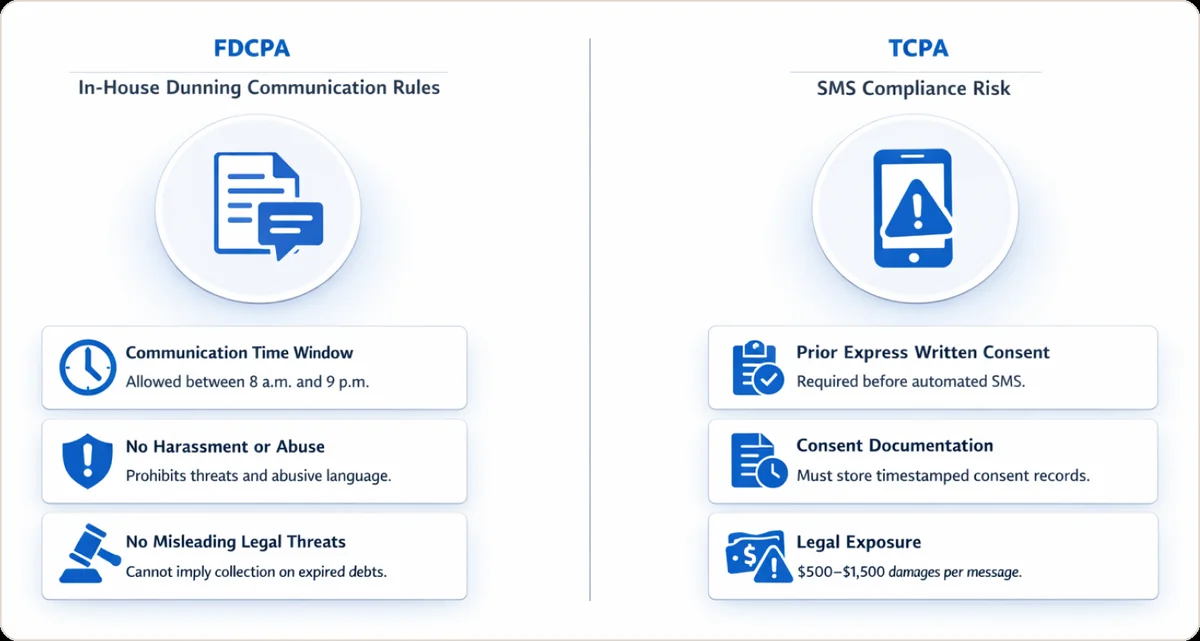
FDCPA: What Rules Apply to In-House Dunning Communications?
The Fair Debt Collection Practices Act (FDCPA) primarily targets third-party debt collection agencies, but its conduct standards establish the behavioral baseline for all dunning communications. The law prohibits harassment, abusive language, and misleading threats of legal action.
Communications must occur between 8 a.m. and 9 p.m. in the customer's local time zone. In Buchanan v. Northland Group, the court found that sending settlement offers for debts past the statute of limitations violated the FDCPA by creating a misleading impression of collectability.
TCPA: The Highest-Risk Compliance Area for SaaS SMS Dunning
The Telephone Consumer Protection Act (TCPA) is the most immediate legal risk for any SaaS business sending SMS dunning messages. The TCPA requires documented prior express written consent before sending automated text messages to a customer's mobile number. Consent obtained at signup for "service updates" may not be sufficient to cover payment recovery SMS messages.
TCPA class action lawsuits carry statutory damages of $500 to $1,500 per message. A campaign of 10,000 SMS messages sent without adequate consent could expose millions of people. Before enabling SMS in any dunning sequence, confirm that your signup flow captures explicit consent for payment-related text communications and that consent records are stored and timestamped.
Compliance Checklist for SaaS Dunning in 2026:
- Restrict all dunning communications to 8 a.m. to 9 p.m. customer local time
- Capture and store explicit TCPA consent for SMS at signup, separate from general marketing consent
- Never make threats of legal action in dunning emails unless your legal team has approved the specific language
- Use payment tokenization (not raw card storage) to satisfy PCI DSS requirements
- Include a one-click data access and deletion option in all payment update flows for CCPA compliance
- Review California, New York, and Texas state-level collections rules annually, as they carry distinct local provisions
For companies that also manage chargebacks, the compliance surface expands further. Our card scheme compliance guide covers Visa and Mastercard program thresholds that interact directly with your dunning and dispute workflows.
Conclusion: Dunning Management Is a Revenue Decision, Not a Billing Setting
The companies recovering 80-85% of failed payments are not doing anything magical. They classify declines correctly so they do not retry hard failures. They use Automatic Account Updaters to prevent failures before they happen. They run smart retry schedules informed by payment timing data. They communicate with empathy, not accusation. And they route high-value accounts to a human before the relationship is lost.
Each of those steps is achievable with the right configuration and, where needed, the right dedicated tool. For a $10M ARR business, recovering an additional 10% of failed payments returns approximately $79,000 annually. That is not a billing optimization. It is a retention outcome with direct impact on LTV, CAC efficiency, and the Rule of 40.
If you are running SMS dunning sequences in the US without documented TCPA consent, the compliance exposure exceeds any potential recovery. Get the legal foundation right before scaling the automation.
Dunning management, when done correctly, is about preserving customer access. It turns a moment of operational friction into evidence of a brand that handles problems professionally. That is worth building properly.
Frequently Asked Questions
What is the dunning definition in simple terms?
Dunning is the process of contacting customers whose payments have failed. In modern SaaS, dunning management refers to the automated system that retries failed charges and sends structured communications to recover subscription revenue without disrupting the customer relationship.
What is the difference between dunning and chargeback management?
Dunning management addresses failed payments due to technical or administrative reasons, such as expired cards or insufficient funds. Chargeback management addresses disputed transactions where a customer or their bank has reversed a completed charge. The two processes use distinct workflows, tools, and compliance frameworks and should be operated as separate functions. See our chargeback alerts guide and the distinction between chargebacks and refunds for the full picture.
How much does dunning software cost, and when does the ROI justify the investment?
Specialized dunning software ranges from approximately $200 per month (Churnkey, early tier) to $300-plus per month (Churn Buster, Recurly) for mid-market plans. Enterprise AR platforms like Gaviti and HighRadius use custom pricing. At $50,000 MRR, recovering 10% of a 7.9% failure rate returns approximately $400 per month. At $500,000 MRR, that same improvement returns $4,000 per month. The ROI case is typically clear within one billing cycle.
When should a SaaS company invest in dedicated dunning software?
A SaaS company should invest in dedicated dunning software when MRR exceeds $50,000 or when failed payment recovery is not a measured KPI. At that scale, the improvement in recovery rates typically covers the cost of the tool within 30 days. Below that threshold, enabling Stripe Smart Retries and the Automatic Account Updater delivers most of the available recovery benefits at no additional cost.