Gaming Payment Processing: The Operator's Guide to Higher Approvals and Fewer Chargebacks
A practical operator guide covering chargeback prevention by type, authorization rate optimization, Visa and Mastercard network monitoring thresholds, pre-launch payment stack checks, and provider selection across video games and iGaming.
What Is Gaming Payment Processing, and Who Does It Apply To?
Gaming payment processing covers how operators accept player deposits, handle in-game purchases, manage subscriptions, execute payouts, and resolve refunds and disputes. It is the entire money-movement layer between a player's payment method and an operator's bank account, and it includes far more failure points than standard eCommerce.
Two distinct operator types fall under this term. Video game publishers, including studios, mobile developers, and marketplaces like Steam or Roblox, primarily deal with microtransactions, subscription billing, and virtual currency. Regulated iGaming operators, covering sports betting platforms, online casinos, and poker rooms, handle real-money deposits and withdrawals under regional licensing frameworks.
The online gaming payment processing challenges overlap significantly, but the regulatory exposure, acquirer options, and fraud profiles differ in ways that matter operationally.
If you run payments or risk at an iGaming operator, the sections on approval-rate engineering and network thresholds are your highest-leverage starting points. If you lead monetization at a game studio, start with dispute prevention and billing UX.
Why Is Gaming Payment Processing Harder Than Standard eCommerce?
Gaming payments fail at higher rates than most eCommerce verticals for four structural reasons that standard merchants rarely face at the same intensity.
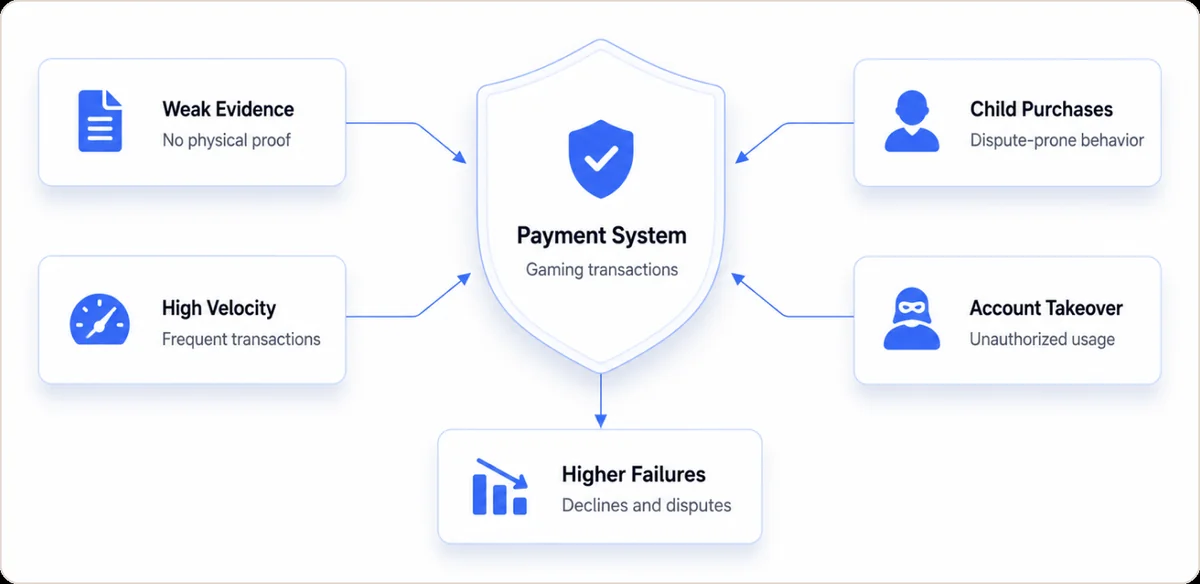
Digital goods leave weak dispute evidence. When a physical order ships, the tracking number anchors your defense. When a player buys 1,000 V-Bucks or places a sports wager, you have login logs, IP data, and session timestamps, but no tangible proof that an issuing bank automatically accepts. That evidentiary gap explains why operators lose a disproportionate share of disputes even on legitimate purchases.
High-frequency, low-ticket transactions trigger issuer fraud models. A single session can involve five or six small purchases in rapid succession. Issuers trained to detect card testing patterns will decline those sequences even when the cardholder is genuinely spending.
Unauthorized child purchases generate disputes at scale. The Consumer Financial Protection Bureau has flagged gaming platforms specifically for enabling large volumes of child-initiated purchases without adequate parental consent. Issuers routinely side with the cardholder in these cases.
Account takeover fraud is endemic. Compromised accounts drain stored value or fund fraudulent purchases using saved payment methods. The legitimate cardholder disputes the charge, and they are entitled to win. Understanding the split between first-party and third-party fraud determines which prevention tools actually apply.
Did you know that false declines are costing merchants billions more than actual fraud? It's not just about one lost sale it's about the customer who never comes back. Industry data shows that up to 40% of falsely declined customers abandon a brand permanently, turning your 'security' into a silent revenue leak (Source).
How Do Chargebacks Actually Happen in Gaming?
Chargebacks in gaming fall into three categories. Treating them as a single problem is why most dispute reduction programs underperform.
Category 1: Friendly fraud. The player made a legitimate purchase, consumed the content, and then disputed the charge. This is the dominant source of chargebacks in gaming. The problem is not the player's intent. It is that your evidence package does not convince the issuer. Prevention requires behavioral evidence captured at transaction time. For operators where friendly fraud is the primary exposure, the 2025 guide to friendly fraud for high-risk merchants covers the representment and evidence strategy in full.
Category 2: True fraud. A stolen card or compromised account was used to make purchases. True fraud in gaming often involves credential stuffing, where automated tools find working accounts with stored payment methods. Prevention is an authentication problem, not a billing one.
Category 3: Service and support failures. The player tried to get a refund, could not, and called their bank. The CFPB documented this explicitly, finding that gamers reported denied refunds, suspended accounts, and unresolvable support loops. No fraud tool fixes a Category 3 problem. It is a product and operations failure.
Roblox disclosed in its 2024 SEC filing that total chargebacks from all fraud sources were approximately 3.41% of bookings. Operators with less mature dispute controls should treat that as a floor, not a target.
The FTC's enforcement action against Epic Games is the clearest case study in what happens when Categories 1 and 3 are ignored together. By June 2025, the FTC had distributed more than $126 million in Fortnite-related refunds (part of a $245 million settlement), tied to absent consent design and poor checkout flows. That is a product decision that became a chargeback and regulatory problem (Source).
What Are the Five Proven Ways to Reduce Chargebacks in Gaming?
Reducing chargebacks in gaming requires fixing five things: your billing descriptor, your receipt flow, your refund path, your evidence logging, and your consent design. Most operators invest in fraud tooling while neglecting the first three, which drive the majority of iGaming payment challenges.

Fix your billing descriptor first. If a charge appears as "GAMESYS-TXN-2948" instead of "GameName Support: 1-800-XXX-XXXX," players and parents dispute it without ever contacting you. Use your platform's recognizable name and add a support URL or number where your acquirer permits. This eliminates a measurable share of "I don't recognize this charge" disputes before they reach your ratio.
Send an instant receipt for every transaction. Every purchase should trigger an immediate email or push notification confirming what was bought, the amount, and how to reach support. Operators who skip this are choosing to let avoidable disputes proceed unchallenged.
Make refunds easier than a bank dispute. If recovering $4.99 requires a 72-hour support queue, players call their bank instead. Self-serve refund options, especially for parental dispute scenarios, close that loop before it escalates. The cost difference between a chargeback vs. refund is material: a dispute costs three to four times more than processing the equivalent refund directly, before the network ratio impact.
Build a structured evidence package at transaction time. Capture login timestamp, device fingerprint, IP address, session behavior, and terms acceptance for every purchase. Pre-dispute tools from Verifi (RDR and CDRN) can intercept disputes before a formal chargeback is filed, but only if your evidence is already structured and ready.
Add affirmative consent flows before every purchase. A confirmation step before any charge, particularly for purchases accessible to minors, is both a legal protection and a dispute prevention mechanism. The Epic case makes the stakes concrete.
As fraud and payments researcher Karisse Hendrick noted: "Gaming operators are often one bad quarter away from a network monitoring program because they treat chargeback management as a back-office function rather than a product design decision." (Chargebacks911)
What Network Thresholds Should Every Gaming Operator Know?
Visa and Mastercard operate monitoring programs that impose fines and ultimately threaten processing termination for operators who exceed chargeback thresholds. Most guides reference these vaguely. The table shows the lines as each program launched; Visa has tightened its thresholds since, and the current numbers are tracked in our VAMP thresholds guide, with the ratio math itself covered in how chargeback ratios are calculated.
| Program | Merchant Category | Chargeback Ratio Threshold | Consequence |
|---|---|---|---|
| Visa VAMP | Standard merchant | 0.9% of transactions | Monitoring entry, fees begin |
| Visa VAMP | High-risk / iGaming (MCC 7995) | 0.65% of transactions | Monitoring entry at tighter threshold |
| Mastercard ECM | Standard merchant | 1.5% of transactions | Enhanced Chargeback Monitoring, fines |
| Mastercard HECM | High-risk merchant | 1.0% of transactions | Heightened Enhanced Chargeback Monitoring |
| Both networks | Excessive Chargeback Merchant tier | Above 2.0% | Account termination risk |
Thresholds are subject to network rule updates. Verify current parameters directly with your acquirer.
iGaming operators under MCC 7995 sit at the tighter threshold by default. If you have not confirmed your classification with your acquirer, that conversation needs to happen before you review your dispute ratio. The Visa Acquirer Monitoring Program guide covers exactly how Visa calculates these ratios month to month, which differs from how most operators assume it works.
How Do You Maximize Payment Approval Rates in Gaming?
Authorization rate optimization is the highest-leverage work most gaming operators are not doing systematically. A 2024 Forrester Consulting study on recurring‑payment friction in the US found that payment‑experience issues such as failed transactions and checkout friction are a major cause of digital revenue leakage, customer churn, and reduced profitability for subscription and recurring‑revenue businesses.
Use local acquiring where volume justifies it. Routing transactions through an acquirer in the same jurisdiction as the issuing bank removes the cross-border risk signal and typically improves authorization rates by three to seven percentage points on domestic volume.
Build intelligent retry logic. A soft decline on the first attempt does not mean the card will not authorize. Structured retry sequences, with varied intervals and authentication signals, recover a measurable share of initially declined transactions, particularly on subscription renewals.
Deploy 3DS strategically. 3D Secure shifts fraud liability to the issuer for completed challenges. For high-value purchases, that is worth the friction. For microtransactions under $5, mandatory 3DS drops conversion without reducing fraud meaningfully. Risk-based step-up authentication is the correct approach.
Analyze decline reason codes, not just aggregate approval rate. "Insufficient funds," "do not honor," and "card not supported" require different responses. Operators who track only a top-line approval rate cannot separate issuer risk sensitivity from a payment method gap. Well-optimized gaming payment solutions consistently reach 90 to 94% authorization rates on domestic card volume. If you are below that, a reason code breakdown tells you exactly where the leakage is.
Expand payment method coverage. ACH and pay-by-bank carry no chargeback exposure in the card-network sense, have lower processing fees, and do not fail on expired card numbers. For subscription-heavy gaming models, these methods also reduce involuntary churn from card expiry events.
How Do You Diagnose Gaming Declines and Stay Scheme-Compliant?
A few root causes explain most lost gaming revenue. Read the issuer decline codes. Add 3D Secure authentication where it lifts approvals. Follow card scheme compliance rules. Beast breaks declines down by decline code, issuer, BIN (the bank identification number that starts each card) and MID (merchant ID). This shows teams the actual leak to fix.
- Group declines by issuer and BIN to see which banks reject your gaming MCCs, then route that traffic to a better-matched MID.
- Turn on 3D Secure selectively, not blanket, so you shift liability without adding friction to every checkout.
- Map each scheme's rules to your billing descriptors and retry windows before a single transaction goes live.
What Should a Gaming Operator Confirm Before Going Live on Payments?
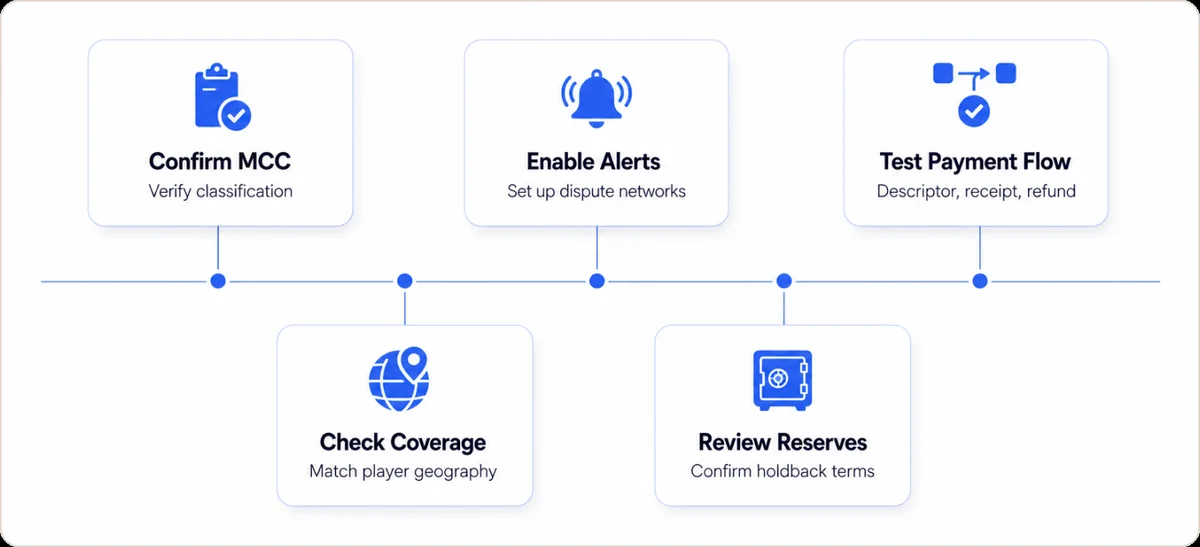
Confirm your MCC classification in writing. MCC 7995 carries lower chargeback thresholds than standard categories. Some processors assign different codes to video game studios. Confirm this before processing a single transaction.
Verify acquirer coverage matches your player geography. A processor approved in one regulated market may not cover another under the same agreement.
Set up dispute alert services before launch. Ethoca and Verifi networks provide pre-dispute interception from day one. Operators who add these reactively are always two billing cycles behind the problem.
Confirm reserve terms before signing. New gaming merchants typically face rolling reserves of 5 to 10% of volume. Get the holdback percentage, calculation basis, and release timeline in writing before execution.
Test your descriptor, receipt, and refund path live. Check the charge on a real bank statement. Confirm the receipt arrives within 60 seconds. Run the refund flow as a player who does not know the system.
Ongoing gateway compliance monitoring is as important as the launch setup itself. Processor rules, card scheme requirements, and network program thresholds change on a rolling basis. Operators who only audit at onboarding accumulate compliance gaps they do not discover until a fine or termination notice arrives. A structured approach to payment gateway compliance monitoring keeps your stack within network rules continuously, not just at launch.
How Do You Choose the Right Payment Gateway for Games?
The useful question is not "which processor accepts gaming merchants?" It is "which processor has the infrastructure to improve performance after onboarding?"
| Evaluation Criterion | What Good Looks Like | Red Flag |
|---|---|---|
| Gaming merchant experience | Named iGaming or video game publisher references | Generic eCommerce-only portfolio |
| Local acquiring access | In-market acquirer relationships for domestic routing | All volume through a single offshore acquirer |
| Dispute management tools | Pre-dispute tools (RDR, CDRN), structured evidence workflows | Chargeback notification only |
| Decline reason reporting | Breakdown by reason code, card type, and issuer | Single aggregate approval rate only |
| Reserve terms | Explicit holdback with defined release schedule | Rolling reserve with no release date |
| Alternative payment methods | ACH, digital wallets, pay-by-bank | Card rails only |
| Payout speed | Same-day or next-day settlement | Standard 3-to-5 business day settlement |
Prioritize the first three. A processor with strong dispute tooling and local acquiring access will outperform a cheaper processor with no pre-dispute infrastructure over any 12 months.
What Should You Do Next?
Authorization rates drift. Dispute ratios creep. Network program thresholds update quarterly. Operators who treat payment infrastructure as a launch task rather than an ongoing discipline consistently underperform those who track it monthly.
Three immediate actions produce the fastest returns: run a decline reason code breakdown across your last 30 days to find your authorization leak; check your current dispute ratio against the network thresholds in the table above; and test your billing descriptor on a real bank statement before your next release cycle.
Frequently Asked Questions
What is gaming payment processing?
Gaming payment processing covers the infrastructure and workflows that handle player deposits, in-game purchases, subscriptions, payouts, refunds, and dispute resolution for video game publishers and regulated iGaming operators.
What is the average chargeback rate in gaming?
Roblox's 2024 SEC disclosure reported chargebacks at approximately 3.41% of bookings. Visa's standard monitoring threshold starts at 0.9%, with the iGaming threshold at 0.65%, making active dispute management essential from the first month of processing.
How do gaming operators reduce chargebacks?
The five highest-impact methods are a clear billing descriptor, instant purchase receipts, self-serve refunds, behavioral evidence logging, and affirmative consent flows. Most operators underinvest in the first three, which prevent Category 3 service-failure disputes that fraud tooling cannot touch.
What is the difference between a chargeback and a refund in gaming?
A refund is issued directly by the operator and costs only the transaction value. A chargeback is a forced bank reversal that costs the transaction value plus a $15 to $100 processing fee, and it counts against your network dispute ratio.
What is MCC 7995 in gaming payments?
MCC 7995 is the Merchant Category Code for betting-related businesses, including online casinos, sports betting, and lottery. Operators under MCC 7995 face lower Visa and Mastercard monitoring thresholds than standard merchants, so the margin for error is smaller.
How does local acquiring improve gaming payment approvals?
Local acquiring routes transactions through an acquirer in the same country as the issuing bank, removing the cross-border risk signal that triggers stricter issuer decline criteria. This typically improves authorization rates by three to seven percentage points on domestic volume.
What payment methods reduce chargebacks in iGaming?
ACH and pay-by-bank carry no chargeback exposure under card network rules. ACH disputes run through a separate NACHA process with different timelines and protections, making these methods useful for operators managing high dispute ratios on recurring revenue.
What is the best payment gateway for games?
Prioritize payment gateways with explicit gaming merchant experience, pre-dispute interception tools, and local acquiring relationships in your core markets. Low headline rates with no gaming infrastructure are a false economy over 12 months.
Why do gaming payments get declined more often?
Issuers flag many gaming MCCs (merchant category codes, which classify what a business sells) as elevated risk. Approvals dip when the BIN, descriptor or amount looks off to the bank. Beast breaks declines down by decline code, issuer, BIN and MID (merchant ID). You then see which banks reject your traffic. You route around them instead of guessing.
Does 3D Secure help or hurt gaming approval rates?
3D Secure can do both. Applied to every transaction, it adds friction and drops conversion. Applied only to risky BINs or high amounts, it shifts liability to the issuer and lifts approvals. Test it by segment. Watch the approval rate and chargeback percentage per MID (merchant ID). Then roll it out wide.