Involuntary Churn: The $5.1M Revenue Leak Hiding in Your Stripe Dashboard
Most subscription payment failure is fixable. Learn how to reduce involuntary churn using card updaters, smart retries, and pre-dunning workflows. Prevent involuntary churn and recover six figures annually.
What Is Involuntary Churn?
Involuntary churn is the loss of subscription customers due to payment processing failures rather than deliberate cancellation decisions. Customers affected by involuntary churn want to continue using a service but lose access because their payment method fails to process successfully.
Last month, a $12M ARR SaaS founder showed me his churn dashboard. "We're bleeding customers," he said, pointing to the red bar trending upward. "Our product team is working overtime, but people keep leaving."
I pulled up his Stripe data and filtered for decline reasons.
34% of his "churn" wasn't people leaving. Their credit cards had expired, and nobody had told them.
He'd spent six months building features nobody asked for while $400,000 in annual recurring revenue walked out the door because of expired Visa cards. Cards that Stripe could have automatically updated with a single settings toggle he didn't know existed.
This is what involuntary churn looks like, and it's the silent killer that most subscription businesses don't even measure separately from voluntary cancellations.
Stripe research shows subscription businesses lose approximately 9% of annual revenue to subscription payment failure. For a $10M company, that's $900,000 in recoverable revenue disappearing every year.
Quick Answer
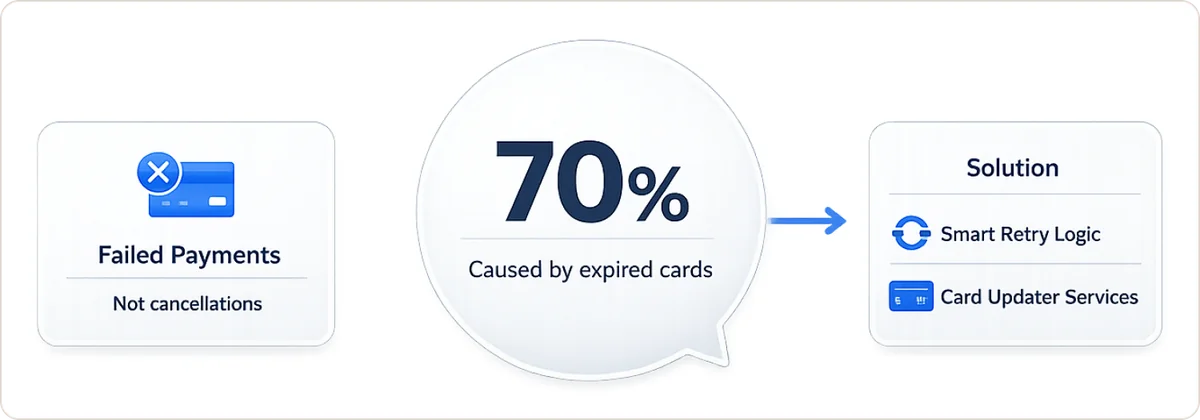
Involuntary churn occurs when subscription customers lose access to their service due to failed payment processing, rather than through intentional cancellation. Expired credit cards cause 70% of these failures, yet most are preventable with automated payment infrastructure like smart retry logic and card updater services.
Here's the Mistake Costing You Millions
You see churn. You assume people don't like your product. You pour resources into new features, UI redesigns, and customer success programs.
Meanwhile, 40% of that churn is people whose credit cards expired.
You're solving the wrong problem.
Quick question: Do you know your involuntary churn rate right now? Not total churn. Involuntary churn.
If you hesitated, you're not alone. 73% of SaaS companies I audit can't answer this question. They're flying blind, hemorrhaging revenue, and attributing losses to the wrong causes.
I worked with a B2B marketing platform generating $3M ARR. Their executive team was convinced they had a competitive positioning problem. Total churn sat at 4.2% monthly, and they were preparing to slash prices.
We spent one afternoon analyzing their payment data.
1.2% of their 4.2% monthly churn was involuntary. People whose cards failed, whose companies changed corporate card providers, and whose banks flagged legitimate charges as fraud. Customers who never intended to leave.
After implementing basic payment recovery infrastructure, involuntary churn dropped to 0.6% within eight weeks. That 0.6% improvement saved $216,000 annually. Implementation cost? Under $15,000.
ROI: 14× in the first year.
Compare that to the $500,000+ they were about to spend on product development to solve a problem that didn't exist. Understanding how to reduce involuntary churn transformed their entire retention strategy.
Why Does Involuntary Churn Happen?
Involuntary churn stems from five primary payment failure categories. Expired credit cards cause approximately 70% of all involuntary churn occurrences, followed by insufficient funds, fraud detection false positives, generic bank declines, and payment gateway errors.
Let me show you what this looks like:
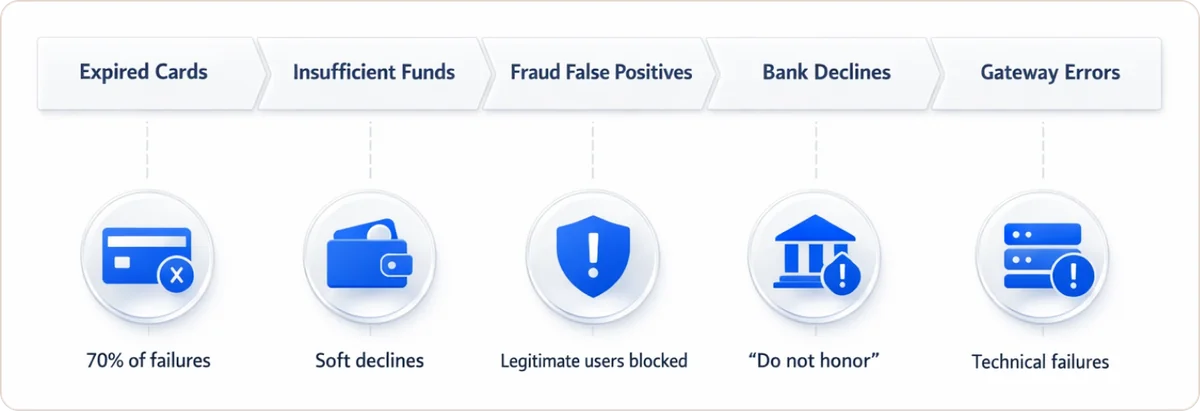
1. Expired Credit Cards (70% of failures)
Sarah runs a 50-person design agency using your $299/month platform for two years. Her company, Amex, renewed in September. Your billing system charged the old card on October 1st. Declined. The new card sat on her desk while your system locked her team out.
According to Visa data via Checkout.com, 30% of card details change yearly, and 35% of customers forget to update their details.
2. Insufficient Funds (15-20% of failures)
These are soft declines. The customer's account had $2,847 when you tried to charge $299. Would have succeeded if you'd tried again three days later on payday. Most billing systems try once, maybe twice, then give up.
3. Fraud Detection False Positives
A customer travels internationally. Their bank flags your $79 charge as suspicious and blocks it. These are legitimate customers being blocked by overzealous fraud detection systems.
4. Generic Bank Declines
Banks issue "do not honor" decline codes that provide zero explanation. These represent approximately 40% of all payment failures. No reason given. Just "declined."
5. Payment Gateway Technical Errors
Server timeouts. Network hiccups. Processing system outages. Sometimes, valid payments fail because of technical glitches. Understanding payment routing optimization can help minimize these technical failures.
The common thread? None of these customers wanted to leave.
Let Me Show You How Bad This Actually Is
You see a $79 failed payment and think, "whatever, we lost $79."
Wrong. You lost $1,422.
That customer was going to stay 18 months. Their lifetime value was $1,422. Now multiply that by 300 failed payments per month.
You didn't lose $23,700 this month. You lost $426,600 in lifetime value. Annually? $5.1 million just vanished.
And here's what keeps me up at night: nobody noticed.
The Real Impact on Your Business:
| Metric | Impact of Involuntary Churn | Example (10,000 Subscribers) |
|---|---|---|
| Monthly Recurring Revenue | 0.5-2% immediate reduction | $50,000-$200,000 monthly loss |
| Customer Lifetime Value | 15-30% decrease per lost customer | $270-$540 per customer gone |
| CAC Payback Period | 20-40% longer to recover costs | Additional 3-6 months to break even |
| Net Revenue Retention | 5-10 percentage points lower | 95% NRR instead of 105% NRR |
A Forrester survey found that 66% of B2B customers consider switching providers after experiencing involuntary service interruptions. Learning how to increase customer lifetime value through payment data becomes critical when involuntary churn threatens your best customers.
High involuntary churn also lowers your merchant ID reputation score with payment processors. When too many transactions fail, banks classify your business as higher risk, leading to lower authorization rates. This creates a vicious cycle where involuntary churn bleeds existing revenue and chokes new growth.
How to Actually Measure Involuntary Churn
Involuntary churn rate measures the percentage of customers lost due to payment failures rather than voluntary cancellations. Calculate it by dividing customers lost to payment failures by total customers at the period start, then multiplying by 100.
The Formula:
Involuntary Churn Rate = (Customers Lost to Payment Failures / Total Customers at Start) × 100
Real Example:
- Starting customers: 5,000
- Customers lost to payment failures: 43
- Involuntary churn rate: (43 / 5,000) × 100 = 0.86%
According to Recurly's benchmark data, analyzing thousands of subscription businesses, 0.86% is the median involuntary churn rate monthly across all industries. All the published benchmarks are collected on our involuntary churn statistics page. For SaaS specifically, it's 0.67% monthly.
A 0.86% monthly involuntary churn rate compounds to approximately 10% annual involuntary churn. For a $5 million ARR business, that's $500,000 in preventable annual losses.
What You Should Actually Track:
| Metric | How to Calculate | Healthy Benchmark |
|---|---|---|
| Payment Failure Rate | Failed Payments / Total Payment Attempts | <3% monthly |
| Recovery Rate | Recovered Payments / Total Failed Payments | >50% (default is 30-40%) |
| Time to Recovery | Days Between Failure and Successful Retry | <7 days |
| Involuntary Churn Cost | Failed Payments × Avg Customer LTV | Decreasing trends |
I recommend reviewing these metrics weekly, not monthly. Payment patterns change based on seasonality, economic conditions, and even day of month. Our approval rate drop analysis service helps identify sudden pattern changes before they become major revenue drains.
The 3-Tier System to Prevent Involuntary Churn
Preventing involuntary churn requires a multi-layered approach. The most effective strategies to reduce involuntary churn address failures before they occur rather than trying to recover after the fact.
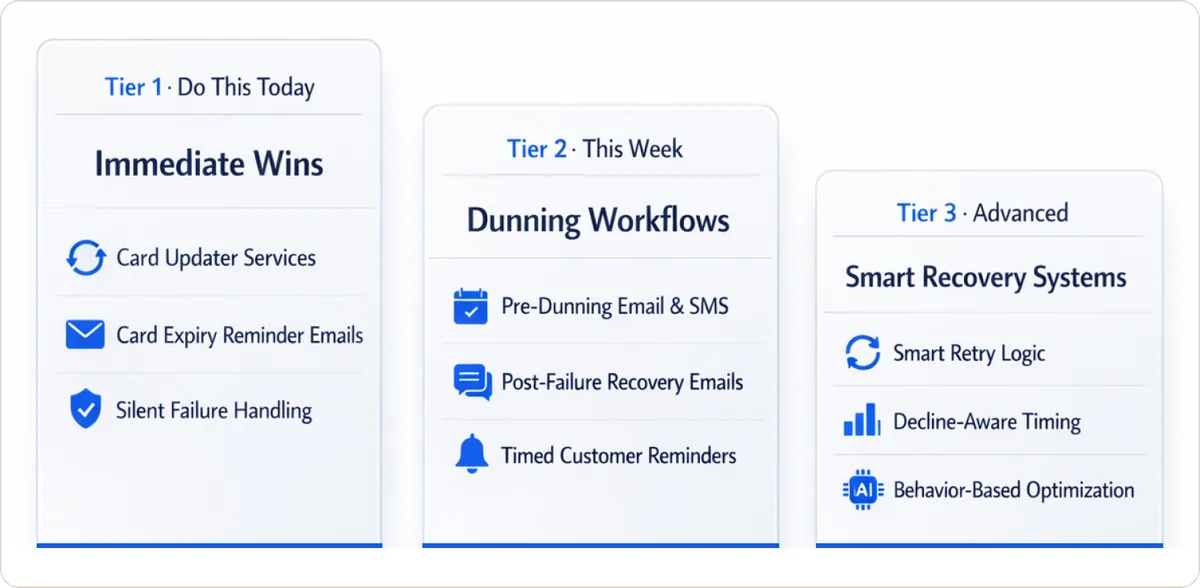
Tier 1: Do This Today (No Developer Required)
1. Enable Card Account Updater Services (5 minutes)
Card account updater services automatically receive new card details when customers' cards are renewed or replaced. Stripe, Recurly, and Chargebee all offer this functionality.
One $1 million MRR SaaS company I worked with recovered $10,000 in monthly recurring revenue simply by enabling card updater in their Stripe settings. The feature had been available for months. Nobody knew it existed.
How to do it:
- Log into your Stripe dashboard
- Go to Settings → Billing → Subscriptions
- Toggle "Automatic card updates" to ON
2. Set Up Proactive Card Expiry Emails (30 minutes)
Set up automated emails to fire 45 days before cards expire.
Email template:
Subject: Update your payment info to keep [Product] running smoothly
"Hi [Name], quick heads up: the credit card ending in [last 4 digits] expires on [date]. To ensure uninterrupted access, please update your payment information: [One-click update link]. This takes 30 seconds."
This simple tactic addresses 70% of involuntary churn causes with one automated sequence.
3. Turn Off "Payment Failed" Receipt Emails (2 minutes)
Netflix and Amazon don't send payment failure receipts. Why? Because it reminds customers that they could cancel.
When a payment fails, your retry system should handle it silently. Send a friendly "please update your payment info" email, not a threatening "YOUR PAYMENT FAILED" receipt.
Tier 2: Implement This Week
4. Build a Pre-Dunning Email Sequence
Pre-dunning means contacting customers before payment failures occur. According to SlickerHQ data, multi-channel pre-dunning workflows reduce involuntary churn by 15% compared to post-failure dunning alone.
The timeline:
- Day -7: Email reminder with payment date and amount
- Day -3: SMS text for high-value customers ($200+/month)
- Day -1: Push notification for mobile app users
- Day +1: If payment fails, friendly email with update link
- Day +7: Second email if still not resolved
5. Create a Post-Failure Dunning Sequence
When payments fail, you need systematic recovery. The most effective sequences send 3-5 emails over 10-14 days.
Email 1 (Day 1): "Action needed: Update payment for [Product]" (Helpful tone, one-click link) Email 2 (Day 3): "Reminder: Payment update needed" (Slightly urgent, still friendly) Email 3 (Day 7): "Final notice: Account at risk" (Urgent but empathetic)
Our failed payment recovery service automates this entire sequence and optimizes timing based on customer behavior patterns.
Tier 3: Advanced Plays
6. Implement Smart Retry Logic
Smart retry logic uses data to reattempt failed payments when they're most likely to succeed. Netflix uses AI to schedule retries around customer paydays.
Default payment processor retry schedules achieve 30-40% recovery rates. Optimized smart retry systems achieve 50-65% recovery by considering:
- Time of month relative to payday cycles
- Day of week (weekdays vs. weekends)
- Specific decline reason code
- Customer's historical payment patterns
Retry Strategy Performance:
| Retry Approach | Recovery Rate | Implementation Complexity |
|---|---|---|
| No retries | 0% | None |
| Single retry (default) | 30-40% | Low |
| Time-optimized retries | 45-55% | Medium |
| AI-powered smart retries | 50-65% | High |
What's the Difference Between Voluntary and Involuntary Churn?
Voluntary churn occurs when customers intentionally cancel subscriptions due to dissatisfaction, cost concerns, or no longer needing the service. Involuntary churn happens when customers lose access due to payment failures despite wanting to continue.
The distinction matters because each requires completely different retention strategies.
Critical Comparison:
| Aspect | Voluntary Churn | Involuntary Churn |
|---|---|---|
| Customer Intent | Deliberate cancellation | Wants to continue service |
| Primary Causes | Product dissatisfaction, price | Expired cards, payment failures |
| Prevention Strategy | Product improvements | Payment infrastructure |
| Recovery Rate | 10-20% | 50-65% with proper systems |
| Resolution Cost | High (product dev) | Low (automated processes) |
Companies dramatically underinvest in preventing involuntary churn because they don't measure it separately. When executives see a 5% monthly churn rate, they assume it's all voluntary and pour resources into product enhancements.
Meanwhile, 2% of that churn (40% of total) is involuntary and could be cut in half with basic payment infrastructure improvements.
If your total churn is 4% monthly and you haven't measured the involuntary component, you likely have 0.8-1.6% involuntary churn representing hundreds of thousands in recoverable annual revenue.
Real Results: What Happens When You Fix This
Companies that systematically address involuntary churn typically recover 10-30% of previously lost revenue within 90 days. MasterClass achieved a 27% boost in recovered revenue after implementing advanced payment recovery systems.
Real Client Example:
Company: B2B SaaS platform, $3M ARR Problem: 1.2% monthly involuntary churn (unmeasured until audit)
What We Implemented:
- Enabled card updater in Stripe (Day 1)
- Set up 45-day card expiry email sequence (Week 1)
- Created 5-email post-failure dunning sequence (Week 2)
- Optimized retry timing based on customer patterns (Week 3-4)
- Added SMS for accounts >$500/month (Week 6)
Results after 60 days:
- Involuntary churn: 1.2% → 0.6%
- Recovery rate: 32% → 58%
- Monthly recovered revenue: $18,000
- Annual impact: $216,000 saved
- Total cost: $14,700
- ROI: 14.7× in year one
Here's the ROI math for your business:
If you have:
- $5 million ARR
- 1% monthly involuntary churn = $50,000 monthly loss
- Reducing to 0.5% saves $25,000 monthly
- Annual savings: $300,000
- Implementation cost: $10,000-$30,000
- ROI: 10-30× in first year
These aren't aspirational numbers. They're typical results for companies that treat involuntary churn as a solvable technical problem. Our profitability analysis service helps calculate your exact recovery potential.
Here's What You Need to Do This Week
If you're still reading, you know involuntary churn is costing you money. The question is whether you're going to do something about it.
Your 3-step action plan for this week:
Monday (5 minutes): Calculate your actual involuntary churn rate. Pull your payment processor data. Count failed payments. Divide by total customers. Write down the number.
Tuesday (5 minutes): Enable card updater in your payment processor settings. This alone will recover 25-30% of card-related failures.
Wednesday-Friday (2-3 hours): Set up a basic 3-email pre-dunning sequence and a 3-email post-failure dunning sequence using the templates above.
Do those three things this week, and you'll recover 15-25% of your failed payments. For a $5M ARR business, that's $75,000-$125,000 in annual revenue you're leaving on the table right now.
Frequently Asked Questions
What percentage of my churn is typically involuntary?
Involuntary churn accounts for 20-40% of total customer churn in subscription businesses, according to ProfitWell research. Some industries experience rates as high as 53%. The exact percentage depends on your subscription type and billing frequency.
How do I calculate the true cost of involuntary churn?
Multiply failed payments by average customer lifetime value, not monthly subscription price. A $100 monthly subscription with 18-month average retention represents $1,800 in lost value per failed payment.
What's a good involuntary churn recovery rate?
Payment processors' default retry systems recover 30-40% of failed payments. Best-in-class businesses using smart retry logic and dunning workflows achieve 50-65% recovery rates.
When should I send dunning emails after a payment failure?
Send the first email within 24 hours of failure, followed by emails on days 3, 7, and 14. Never send more than 5 dunning emails per failure.
Can I completely eliminate involuntary churn?
No. Involuntary churn cannot be completely eliminated, but can be reduced to 0.3-0.5% monthly with comprehensive prevention strategies. Some failures (closed accounts, permanently canceled cards) cannot be recovered.
What's the difference between hard and soft payment declines?
Soft declines are temporary failures (insufficient funds, network issues) that may succeed if retried later. Hard declines are permanent failures (closed accounts, stolen cards) requiring customer intervention. Understanding pre-authorization charges helps reduce false declines.
Which decline codes cause the most involuntary churn?
Start with a decline-code breakdown instead of one failure total. Beast Insights splits recovery and declines by decline code, issuer, BIN (bank identification number, the first digits of a card) and gateway/MID (merchant ID). It also splits them by acquirer, card brand and billing cycle. That breakdown separates recoverable soft failures from the codes that typically need a customer card update.
Can retrying failed payments cause chargebacks?
It can. A customer treats a closed card as finished. Repeated attempts on that card often surface later as disputes. Beast Insights reports recovery, declines and chargebacks on the same dimensions. Those dimensions cover decline code, issuer, BIN (bank identification number, the first digits of a card) and gateway/MID (merchant ID). They also cover acquirer, card brand and billing cycle. Use that view to cap retries where dispute rates climb.