How to Reduce Payment Failed Rates on Recurring Billing
A practical guide to diagnosing, preventing, and recovering failed recurring payments, with retry logic, dunning workflows, and metrics for subscription billing teams.
Why Do Recurring Payments Fail in the First Place?
Recurring billing payment failures happen for four broad reasons: the customer's card expired or was reissued, the issuer declined the transaction for risk or policy reasons, the billing system sent incorrect stored credential data, or the processor encountered a technical error. Each root cause requires a different fix.
This distinction matters more than most RevOps and finance teams realize. The single most common mistake when auditing a billing stack is treating all failures as the same event. They are not, and conflating them produces the wrong response.
Here is how the causes break down:
Customer-related causes
- An expired or reissued card is the most common source of preventable failure
- Card cancelled after fraud or loss
- Insufficient funds on the billing date
- The customer changed financial institutions
Issuer-related causes
- Generic do-not-honor with no specific reason code
- Velocity or fraud scoring triggers
- International transaction restrictions
- Card not provisioned for recurring or subscription billing
Merchant or integration causes
- Incorrect stored credential flags on the transaction
- Merchant category code mismatches
- Billing descriptor mismatches that trigger cardholder disputes
Processor or technical causes
- Gateway timeouts during peak billing windows
- Currency conversion or settlement errors
- Temporary processing outages on batch billing runs
Most billing teams respond by adjusting retry schedules or dunning copy. Both matter. But a significant share of payment failures originates before the authorization request even reaches the issuer. Fixing upstream problems produces compounding improvements that no dunning sequence can replicate.
What Is the Difference Between a Soft Decline and a Hard Decline?
A soft decline is a temporary rejection where retrying on a different date or with updated card data can result in approval. A hard decline is a permanent rejection where retrying is both ineffective and a potential card network compliance violation.
This is the most consequential diagnostic split in subscription billing. Getting it wrong means either leaving recoverable revenue on the table or accumulating retry violations that trigger Mastercard and Visa compliance reviews.
Understanding the full spectrum of responses before building retry logic is non-negotiable. Our guide to credit card decline codes breaks down which codes are actionable and which require a different path entirely.
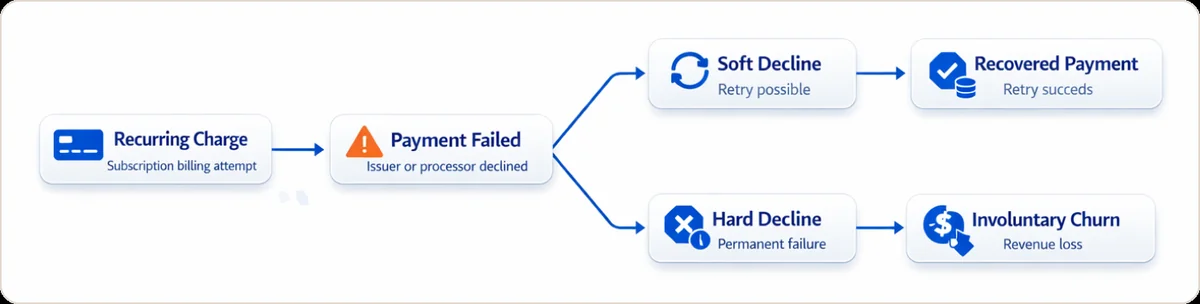
Soft declines (retry eligible)
- Insufficient funds
- Issuer temporarily unavailable
- Generic do-not-honor on an account in good standing
- Exceeds single-transaction withdrawal limit
One soft decline carries its own instruction. Where the issuer asks for authentication before it will approve the card, see our guide to retrying with 3DS.
Hard declines (do not retry)
- Card reported stolen or involved in confirmed fraud
- Account closed at the bank
- Invalid card number
- Do-not-honor paired with a fraud response code
According to Mastercard's rules require merchants to stop retrying recurring payments after permanent decline MACs (e.g., 03: Do not retry). Violations like excessive attempts trigger fees, higher rates, and monitoring. The Visa Acquirer Monitoring Program is one mechanism card networks use to flag merchants whose transaction patterns fall outside acceptable thresholds.
How Do You Troubleshoot a Sudden Spike in Failed Recurring Charges?
Start with the failure type, not the failure count. Stripe sorts every failure into three buckets. The issuing bank declined it, Stripe blocked it before authorization, or your own billing code sent an invalid request. Ask which bucket grew. Then count unique declines. A raw count counts the same dunning retry, the automatic repeat charge attempt, over and over.
- Bucket the declines by the advice code Stripe attaches to each one, which says what to do next: do_not_try_again, try_again_later, or confirm_card_data.
- Group the attempts by the card fingerprint rather than the charge ID, so one card's eight dunning tries count once.
- Check your own retry settings. Stripe caps its recommendation at eight retries inside two weeks, and extra attempts can read as fraud to a bank.
- Separate the payments Stripe blocked itself, which carry type blocked and network status not_sent_to_network, because those never reached a bank at all.
- Read the network decline code and the network advice code together, against the card brand. Mastercard calls its advice codes Merchant Advice Codes (MAC), where 01 means fetch updated card data, 02 means try later, and 03 means do not try again.
- Treat a cluster of issuer_not_available or processing_error as an infrastructure problem, not a customer problem.
- Visa R0, R1 and R3 are revocation codes: the cardholder or the bank cancelled the mandate, so the fix is to stop billing rather than to retry.
Compare the spike against published payment decline statistics and your own baseline. That comparison shows whether the mix changed or only the volume. Map each code to an action with our guide to gateway decline codes. Then check your timing against smart retry scheduling before you add attempts. Visa now allows 20 reattempts per card in 30 days on retryable declines, raised from 15. The retry budget is finite.
How Does the Prevention Stack Reduce Payment Failures Before They Happen?
The prevention stack, which includes account updater services, network tokens, pre-dunning outreach, and stored credential hygiene, reduces billing failures before a cycle begins. This produces better outcomes than any recovery workflow applied after the fact.
Most recurring billing guides lead with dunning. That is the wrong starting point. Build this prevention layer first.
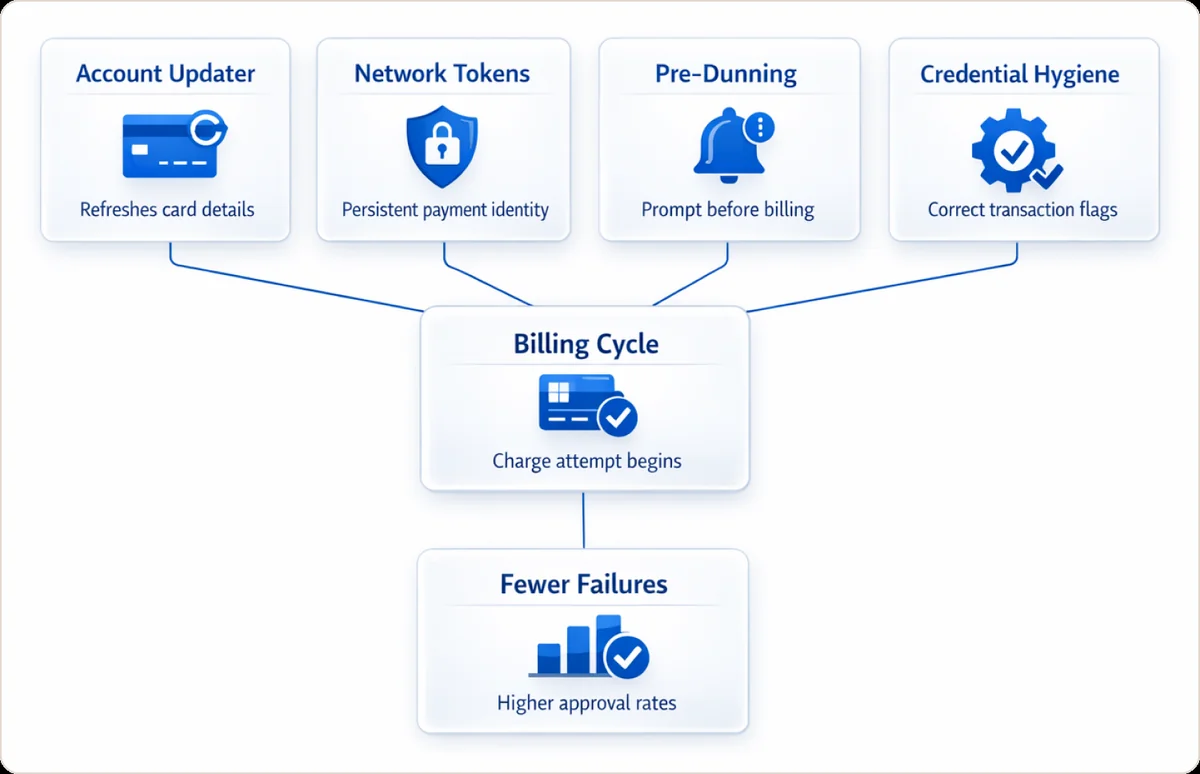
Account updater services
When a customer's card expires or is replaced after fraud, card networks including Visa, Mastercard, and American Express push updated credentials to enrolled merchants automatically. The customer does not need to act. According to Visa's Account Updater documentation, enrollment allows issuers to share new card data before the old card causes a billing failure.
North American benchmarks from GoCardless' Payment Success Index 2020 show one retry drops failure rates from 2.9% (no retries) to 1.6%, a 44% reduction. Our breakdown of the card account updater explains how to implement this at the processor level.
Network tokens
Network tokens replace stored card numbers with a persistent identifier tied to the customer's underlying account rather than a specific physical card. When a card is reissued, the token stays valid. Tokenized transactions also carry higher authorization rates because issuers treat them as lower fraud risk.
Pre-dunning outreach
Send a proactive payment reminder 5-7 days before the billing date for customers whose cards expire within 60 days. This is not a failed payment recovery email. It is a prevention step. Customer update rates on pre-dunning communications are consistently higher than post-failure outreach because the customer has not yet experienced a disruption.
Stored credential hygiene
If stored credential flags are incorrect on recurring submissions, issuers may decline legitimate charges as suspicious. Every recurring charge after the initial customer-initiated transaction should be submitted as a merchant-initiated transaction with a reference to the original authorization ID. Custom-built integrations should be validated against the current Visa and Mastercard stored credential guidelines before launch.
Can Smarter Payment Routing Reduce Failed Payment Rates?
Often, yes. Every charge takes a route through a specific MID, gateway, and acquirer. A MID is a merchant ID, the payment account a bank gives you. An acquirer is the bank that processes your card payments. Issuers, the banks that issue your customers' cards, score each route differently. Route choice therefore changes approval odds. Review failure rates route by route. Then shift volume with payment routing optimization. Dunning is the follow-up you send after a failed payment. This work typically recovers approvals that retry timing and dunning copy alone would miss.
- Compare approval rate for the same customer segment across every active MID and gateway
- Check whether one acquirer carries most of your soft declines on identical traffic
- Look at card brand and issuer mix per route, not just a blended pass rate
- Watch billing-cycle days: batch runs concentrated on the 1st can hit issuer velocity limits
- Confirm stored credential and merchant-initiated flags are set correctly on each route
Routing decisions are only as good as the reporting behind them. Beast Insights breaks recovery, declines, and disputes down by decline code, issuer, BIN, gateway or MID, acquirer, card brand, and billing cycle. A BIN is the bank identification number, the first digits of a card. MID Performance shows approval rate and chargeback percentage side by side for each MID. Teams then fix the actual leak.
How Do You Reduce Failed Rebills When You Bill Across Multiple MIDs?
The credential breaks before the routing does. A gateway token belongs to the account that created it. Even a second account at the same provider cannot charge that token. The card networks issue network tokens instead. One network token stays chargeable on more than one merchant ID.
- An acquirer or gateway swap invalidates the stored network transaction ID, the reference that ties a renewal to the charge the cardholder approved. Banks then stop recognizing the chain and decline more of it.
- Pinning a charge to one merchant ID and relying on automatic failover are mutually exclusive: a pinned transaction does not fail over.
- A gateway override set at checkout does not stick to the subscription, so later renewals drift back to the default gateway.
- A trial split across merchant IDs fails at renewal, because the $0 verification and the renewal are routed by two separate settings.
- Account Updater is bought per merchant account, and card-brand enrollment takes 12 to 14 business days before the new account sees refreshed cards.
- Account Updater terms bar you from submitting update inquiries for another entity unless you enroll as a billing aggregator, so one merchant ID cannot refresh another's card file.
- Visa bars changing data elements, the acquiring identifier included, when you reattempt a declined authorization.
Visa uses the term load balancing for spreading payments across several accounts to stay under risk monitoring. Visa investigates several accounts that serve one sales channel with identical descriptors. Visa permits distinct channels with unique descriptors. A MID is a merchant identification number, the account identifier your acquirer assigns. Our guide to recovering failed rebills across multiple MIDs walks the token and identifier checks account by account. Beast Insights reports declines by gateway, merchant ID, acquirer, issuer and BIN, the card number prefix that identifies the issuer. That breakdown names the account that leaks.
What Does an Effective Failed Payment Recovery Stack Include?
An effective failed payment recovery stack combines intelligent retry scheduling, sequenced customer outreach, direct self-serve update flows, backup payment methods, and a grace period that preserves access while recovery completes. Recovery probability declines sharply after 72 hours, making speed the most important operational variable.
Step 1: Retry scheduling (Day 1, Day 3, Day 7, Day 14). Use intelligent retry timing based on the decline reason. Soft declines should follow a schedule informed by issuer behavior patterns, not arbitrary intervals.
Step 2: First recovery email (within 24 hours). Send a clear, direct email with a link that takes the customer straight to the payment update form. No intermediate login screens. No billing menu navigation. Every additional step reduces completion rates.
Step 3: In-app notification (Day 2). Surface a persistent prompt inside the product at login. Many customers see the in-app alert before they open any email. The message should be direct: update payment details to keep the subscription active, with one clear action button.
Step 4: Second email (Day 5-7). Increase urgency without damaging the relationship. Include the direct update link, a plain-language note about when access may change, and an option to switch to an alternative payment method.
Step 5: Self-serve portal. Customers must be able to update payment credentials without contacting support. Many SaaS businesses still route payment updates through a support ticket queue, which extends recovery time and reduces success rates. Our failed payment recovery guide covers portal design and update flow best practices in depth.
Step 6: Backup payment method. Offer ACH or bank debit as an alternative on the payment update screen. Bank account numbers do not expire and are not reissued after fraud at the rate of physical cards, making ACH a structurally lower-failure alternative for U.S. subscription businesses.
Step 7: Grace period with preserved access. Cutting off product access immediately on billing failure increases permanent cancellation rates. A 7-14 day grace period keeps the customer inside the product, which improves recovery probability and prevents the billing problem from becoming a voluntary cancellation driven by a poor experience.
"Address first-payment failures promptly, but route recurring ones through automated dunning cycles." Recurly Support, Best Practices for Initial and Recurring Payment Failure Recovery.
Which Metrics Actually Show Whether Your Recovery System Is Working?
The five metrics that matter are: payment failure rate, recovery rate, time to recovery, top decline reason breakdown, and involuntary churn rate as a percentage of total MRR lost. Tracking these five consistently separates teams managing billing failure systematically from teams reacting to it event by event.
| Metric | Definition | Healthy Benchmark | Warning Signal |
|---|---|---|---|
| Payment failure rate | Failed charges as a % of total billing attempts | Under 5% for card-based models | Over 8% indicates infrastructure or data problems |
| Recovery rate | Recovered charges as a % of all failures | 40-60% within 30 days | Under 30% indicates timing or UX problems |
| Time to recovery | Average days from failure to successful charge | Under 7 days | Over 14 days means customers churn before recovery |
| Hard decline rate | Hard declines as a % of total failures | Under 20% | Over 30% may signal fraud surge or bad stored data |
| Involuntary churn rate | MRR lost to unrecovered failures as a % of total MRR | Under 1.5% monthly | Over 2% requires an immediate billing stack audit |
If your authorization rate is declining over time rather than holding steady, that is a separate diagnostic problem from dunning.
What Do Industry and Research Sources Say About the Scale of This Problem?
Industry data consistently shows that payment failure on recurring billing is one of the largest controllable revenue leaks in subscription businesses, not a minor operational friction point.
Industry research on subscription commerce indicates that unexpected payment failure is one of the leading reasons consumers do not return to a subscription service after an access interruption. A single failed billing attempt has measurable downstream effects on customer lifetime value beyond the immediate recovery question. (Source)
A 2024 Forrester Consulting study commissioned by GoCardless on recurring‑payment strategies found that businesses using automated payment recovery and recurring‑payment infrastructure report significantly lower churn and reduced days‑sales‑outstanding, compared with organizations relying on manual collections and static retry rules. Our guide on what is churn analysis explains how to build a churn model that captures both in one view.
What Are the Most Common Operational Mistakes with Payment Failures?
The most damaging mistakes are retrying hard declines, delaying customer contact beyond 48 hours, burying update links behind login screens, applying one recovery workflow to all failure types, and giving high-value accounts the same low-effort treatment as low-value accounts.
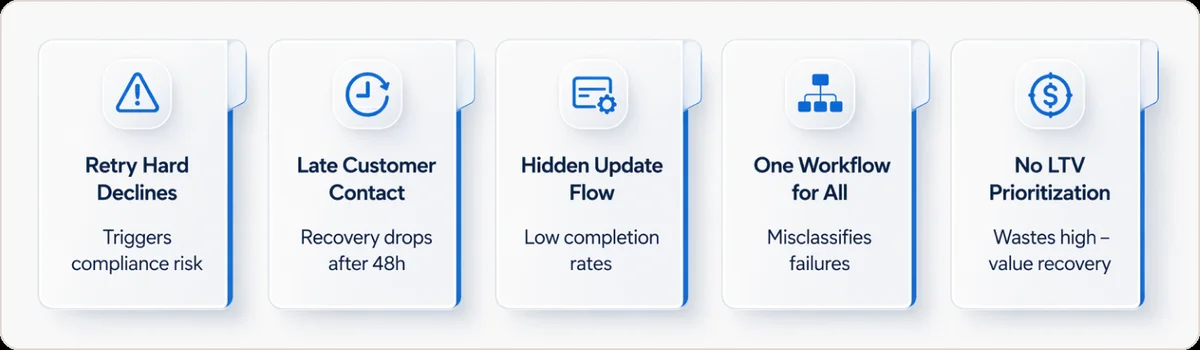
Retrying hard declines burns retry attempts, increases processing costs, and can trigger compliance monitoring. Build decline-code classification into retry logic before queuing any second attempt.
Sending recovery emails too late is one of the highest-cost mistakes in failed payment recovery. Recovery probability drops sharply after 48 hours. Teams that batch dunning weekly are systematically underrecovering revenue.
Burying the payment update link behind a login screen produces low completion rates. The email must deep-link directly to a card update form with no intermediate steps. Every additional click reduces the probability that the customer completes the update before churning.
Treating first-payment failures identically to recurring failures is a structural mistake. A first-payment failure often signals a card data entry error or a fraud review requiring manual clearing. These should escalate to a support flow immediately, not enter a standard dunning sequence built for established subscribers.
Applying uniform recovery effort regardless of LTV is a prioritization failure. A subscriber generating $50 per month and one generating $2,000 per month do not warrant identical treatment. Segment the failure queue by customer value and route high-value accounts to direct outreach, not just automated sequences.
Where to Start if Payments Are Failing
Payment failure on recurring billing is a revenue problem disguised as a billing problem. The fix is not a better dunning email template. It is upstream prevention, decline-aware retry logic, fast customer outreach, and clean analytics showing how much revenue is leaking and why.
Start with these three questions before changing anything else in the billing stack:
- Are account updater services and network tokens enabled through your payment processor?
- Is the first recovery communication reaching customers within 24 hours, with a direct link to update payment credentials?
- Is retry logic separating soft and hard declines, and is the recovery rate being tracked by decline reason?
If any answer is no, those are the first three priorities.
The subscription businesses that recover the most revenue treat payment failure as an operational system with measurable inputs and outputs, not a billing exception handled case by case. The infrastructure to do this well exists today. The gap is rarely access to tooling. It is knowing what to fix first and in what order.
FAQ: Failed Payments on Recurring Billing
What does payment failed mean on a subscription?
Payment failed on a subscription means a scheduled billing attempt was declined by the card issuer, bank, or payment processor. The failure is classified as a soft decline if retrying is permitted or a hard decline if the card network prohibits further attempts.
How many times should a failed subscription payment be retried?
Most recurring billing frameworks recommend three to four retry attempts spread across 14-21 days for soft declines. Mastercard and Visa impose explicit retry frequency limits, and exceeding those limits can result in fines or monitoring program placement. Hard declines should never be retried.
What is involuntary churn?
Involuntary churn is the loss of a subscriber caused by a billing failure rather than a deliberate cancellation decision. It accounts for 20-40% of total subscription churn across SaaS and media businesses, making it one of the largest controllable retention levers available.
What is an account updater service?
An account updater service is a card network program that automatically delivers updated card credentials to enrolled merchants when a customer receives a replacement card. Enrollment reduces failures caused by expired or reissued cards without requiring any action from the customer.
Can false declines cause recurring payment failures?
Yes. Issuers sometimes decline legitimate recurring charges due to overly aggressive fraud scoring, particularly for merchants in high-risk categories or with inconsistent billing descriptors. Our guide on false declines covers how to identify and reduce issuer-side friction on legitimate transactions.
When should access be paused rather than cancelled after a billing failure?
Most billing best practices recommend a 7-14 day grace period before restricting or cancelling access after a payment failure. Immediate cancellation converts a recoverable billing problem into a permanent customer loss, since customers who lose access abruptly are far less likely to return even after the payment issue is resolved.
Why is my payment failure rate higher on one MID than another?
Approval odds vary by acquirer, issuer mix, and MID configuration. Near-identical traffic can therefore fail at different rates. Beast Insights breaks recovery, declines, and disputes down by decline code, issuer, BIN, gateway or MID, acquirer, card brand, and billing cycle. That breakdown typically shows where the leak sits.
How do I tell whether retries or routing are the bigger problem?
Split failures by decline code first. A soft decline is a temporary refusal that the issuer may approve on a later attempt. If soft declines dominate and retries recover most of them, timing is your main lever. If approval rates differ sharply between gateways or acquirers on comparable traffic, routing is your main lever. Beast Insights segments both views by decline code, issuer, BIN, and MID.
Why did my failed payments spike overnight with no code change?
The failure mix tells you. Pull the failure type behind each decline. Then count unique cards rather than attempts, because dunning retries, the automatic repeat charge attempts, inflate the count. A cluster of issuer_not_available or processing_error codes points at an outage. A generic_decline means the bank withheld its reason. The bank discusses specifics only with the cardholder.
Can you retry a declined rebill on a different merchant ID (MID)?
You cannot do this safely. Visa bars changing data elements when you reattempt a declined authorization. The acquiring identifier is one of those elements. You may not resubmit Category 1 codes at all, such as 04, 14, 41, 43 and 57. For retryable declines the budget is 20 attempts per card in 30 days. Visa counts that budget per declined transaction, not per merchant ID.