Chargeback Insurance: What Coverage Pays and What It Misses
Chargeback insurance reimburses the disputed dollars on covered fraud. It leaves your VAMP and Mastercard counts exactly where they were, and most rebill disputes fall outside the schedule.
Chargeback insurance reimburses the money you lose on a covered fraudulent order. It does not remove the dispute from the ratios Visa and Mastercard use to police your account. That gap decides the outcome for a subscription business. A vendor can pay you back on a covered rebill, and Visa can still place you in a monitoring programme.
A second gap sits underneath the first. Vendors underwrite coverage on orders a fraud engine approved. They do not re-screen rebills as new approved orders. So the product prices against your renewal volume and pays out against a narrow slice of your dispute mix. This guide prices both gaps in one unit: cost per disputed rebill, not cost per approved order.
What is chargeback insurance, and how does it differ from a chargeback protection service?
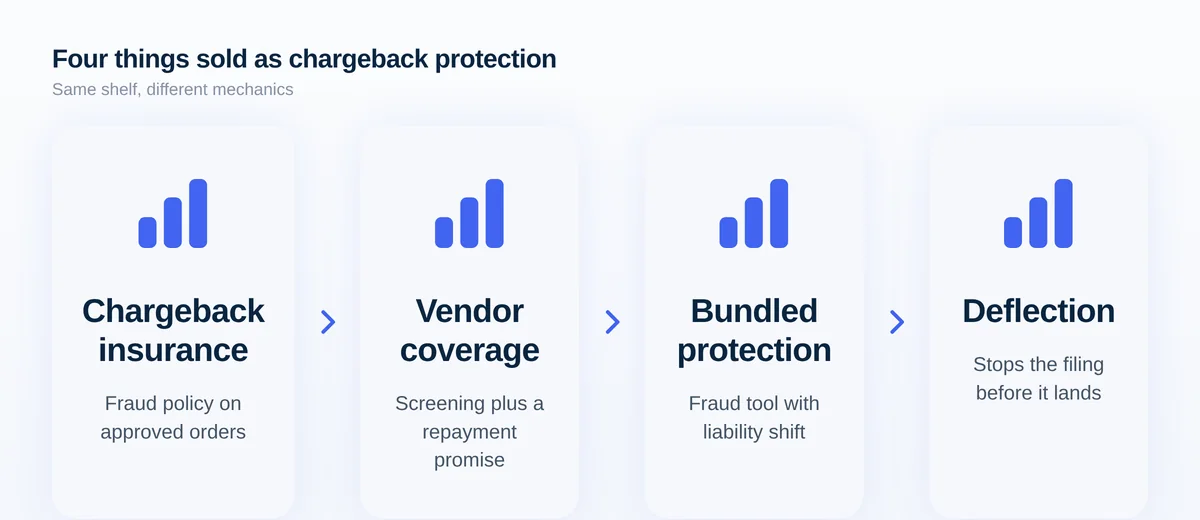
Chargeback insurance is a fraud policy. A vendor screens your orders, approves some, and promises to repay you if an approved order later produces a fraud chargeback. The product usually has no risk pool and no underwriter behind it. That is why it sits closer to vendor indemnity than to insurance in the regulated sense.
The naming in this category is loose. Vendors sell the same mechanic as chargeback insurance, as protection bundled with a fraud tool, or as a liability shift on approved orders. The label rarely changes what you get. Three contract terms change what you get: the covered reason-code schedule, the definition of an eligible charge, and the claim window. Chargebacks911 defines the insurance form narrowly as protection against a card being used by someone other than the cardholder. A rebill dispute usually falls outside that population.
How a policy mechanically works
- The vendor screens each order in real time and returns an approve or decline decision. You are typically charged a percentage of order value on approvals and nothing on declines.
- Approved orders enter the covered pool. Coverage attaches to the transaction the vendor approved, not to every charge on the account.
- A chargeback arrives weeks or months later. You file a claim, usually inside a hard window measured in business days before the processor response deadline.
- The vendor checks the reason code against the schedule, checks fulfilment evidence, and either pays or declines the claim.
- On an approved claim you are reimbursed the disputed amount and, with some vendors, shipping and processor fees, up to an annual cap.
That approval step breaks coverage for recurring billing. Vendors write coverage against the moment of approval. A subscription renewal is an off-session merchant-initiated charge, and no fraud engine sees it as a fresh approved order. Stripe's Chargeback Protection terms make this explicit: a Protected Charge is one submitted through Stripe Checkout. Stripe's own documentation notes that charges after a trial period and future recurring fees do not qualify. Shopify Protect states the same limit more bluntly. Only the first order in a subscription is eligible, and the programme covers no digital products at all.
| Product and price | Covered scope | What that means for a renewal |
|---|---|---|
| Stripe Chargeback Protection, 0.4% per eligible transaction | Fraud disputes only: Visa 10.4, Mastercard 4837 and 4840, plus Amex and Discover fraud codes | Attaches to Checkout charges, so off-session renewals sit outside it, and reimbursements are capped at $25,000 a year. |
| Shopify Protect, free on eligible Shop Pay orders | Fraudulent and unrecognised chargebacks on orders containing only physical shippable items | Shopify states recurring orders after the first are not covered, and merchants already in a monitoring programme are excluded. |
| Wyllo (formerly NoFraud), 1% to 1.5% of revenue with a monthly minimum | Card-not-present fraud codes: Visa 10.4 and 10.5, Mastercard 4837 and 4863, Amex F24 and F29, Discover UA02 | Requires proof of delivery, caps digital goods at 10% of sales without prior approval, and pays in account credit that expires. |
| Signifyd Complete Chargeback Protection, rate not published | Fraud plus non-fraud reasons including Subscription Canceled, Unrecognised, Item Not Received and Credit Not Processed | The counter-example: an expanded tier can reach rebill codes, still billed as a percentage of approved order value. |
Coverage scope is set by the reason-code schedule in the contract, not by the product category. Read the schedule before the marketing page.
What is excluded, and why do most exclusions bite hardest on recurring billing?
Exclusions cluster around three things a fraud engine cannot see: intent that changes after approval, fulfilment the vendor cannot verify, and paperwork you file late. Recurring billing trips all three at once. Your system auto-approves renewals, digital delivery leaves no carrier record, and disputes surface months after the charge that caused them.
- First-party and friendly fraud, where the cardholder authorised the purchase, which fraud policies exclude by definition.
- Non-fraud consumer disputes: cancelled subscription, item not received, credit not processed and product not as described.
- Merchant and processor error, including duplicate charges, incorrect descriptions, billing errors and unprocessed refunds.
- Transactions without proof of delivery, plus digital goods above a stated share of sales, which is unsatisfiable for a software subscription.
- Orders screened after the chargeback was initiated, or more than a set number of days after the order was placed.
- Claims filed after the policy window, which on one published policy is at least seven business days before the response is due.
- Anything above the annual reimbursement cap, commonly $25,000, while the percentage fee keeps accruing on volume above it.
Chargebacks911 estimates that only 20% to 30% of a typical merchant's chargebacks qualify for reimbursement once those conditions apply. The same source lists subscription disputes as an explicit carve-out, alongside friendly fraud, merchant error and digital goods. Vendors classify billing confusion as a business-model problem rather than fraud. A recurring charge generates exactly that category.
Does chargeback insurance cover friendly fraud and "I don't recognise this subscription" claims?
Standard fraud policies exclude it. First-party misuse is uninsurable under a fraud schedule by definition, because the order was legitimate at the moment the engine approved it. Visa routes the "I never agreed to this subscription" claim to condition 13.5, and post-cancellation billing to 13.2. Both are non-fraud conditions, and a fraud-only schedule does not list them.
This exclusion costs you more than any other, because of the dispute mix. Visa's own subscription-merchant guidance identifies recognition failure as the root cause of rebill disputes. The same guidance notes that issuers file the same complaint inconsistently as Fraud, Cancelled Recurring or Goods Not Received. Visa puts first-party misuse at about 20% of fraudulent disputes globally, and at up to 30% for high-volume online merchants. Visa names recurring billing and subscription services as two of the categories where it is most common. In aggregated alert data, Visa 13.2 carries about 8.5% of coded alerts and 13.7 another 8.2%. That pair is worth 16.7% against card-absent fraud's 11.1%.
The eligibility of any given rebill dispute therefore turns on the code the issuer picked, not on what actually happened. Stripe notes that the unrecognised-charge category is effectively indistinguishable from the fraudulent one. Mastercard's unrecognised bucket includes 4863, Cardholder Does Not Recognize, Potential Fraud. The same customer behaviour can land inside coverage on one network and outside it on another. Our breakdown of first-party versus third-party fraud is the companion piece for that mental model.
Do reimbursed chargebacks still count toward your VAMP and Mastercard monitoring ratios?
Yes, a reimbursed chargeback still counts. The ratio under VAMP, Visa's acquirer monitoring programme, counts disputes rather than dollars. Reimbursement is not one of the two exclusions Visa names. Mastercard's chargeback-to-transaction ratio counts chargebacks received in a calendar month, with no netting for who paid or who won. Your acquirer sees the count, not your recovery ledger.
The formula in Visa's VAMP fact sheet is the count of fraud reports (TC40) plus disputes (TC15) over the count of settled card-not-present transactions (TC05). The fact sheet lists exactly two carve-outs: disputes resolved through pre-dispute solutions, and TC40 fraud that qualifies for Compelling Evidence 3.0. Third-party reimbursement is not on that list. A $10 rebill dispute damages the ratio identically to a $10,000 one. Our deeper walkthrough of the chargeback ratio and the VAMP programme covers the mechanics end to end.
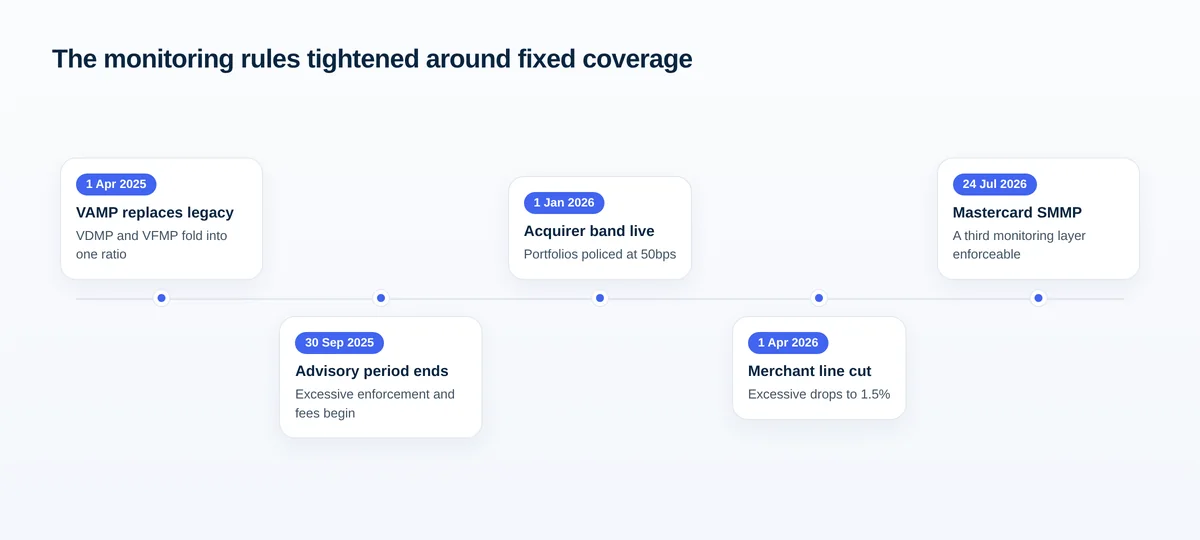
The thresholds moved against you while the coverage stayed the same. The Excessive Merchant threshold in AP, Canada, the EU and the US fell to 150 basis points (150bps, or 1.5%) on 1 April 2026. It stood at 220bps from 1 June 2025. CEMEA remains at 220bps. Visa assesses merchants identified under the programme about $8 per fraudulent or disputed transaction, and no reimbursement offsets that charge. A first identification in a rolling twelve months carries a three-month grace period. On the Mastercard side, ECM (Excessive Chargeback Merchant) triggers at 100 chargebacks in a month with a ratio of 1.50% or more. HECM (High Excessive Chargeback Merchant) triggers at 300 chargebacks and 3.00%. Fines escalate from $1,000 in month two to $100,000 a month at 19 months and beyond. Exit requires three consecutive months below threshold.
Two second-order effects hurt subscription books specifically. First, Visa grades an acquirer's own portfolio far tighter than yours: Above Standard at 50bps and Excessive at 70bps. Acquirers must flag merchants exceeding thresholds and report monthly on disputes by merchant. Through that mechanism, an acquirer reprices or offboards a fully reimbursed but noisy account long before it approaches its own 150bps line. Second, a TC40 fraud report can land with no chargeback attached at all. That happens on small-ticket rebills, where the issuer credits the customer directly. You have nothing to reimburse and nothing to represent, and the ratio still moves. A single incident can also count twice, once as the TC40 and once as the TC15.
What does chargeback insurance cost per disputed rebill, not per approved order?
Coverage bills on approved order value. So a renewal book pays the fee on the whole stream, and the vendor covers only the trickle that turns out to be third-party fraud. Convert the fee into cost per reimbursed dispute. The figure often lands well above the average subscription dispute value, which Mastercard segment data puts at $69.
Published rates are scarce. Stripe Chargeback Protection is the clean benchmark at 0.4% per eligible transaction. Wyllo's Shopify listing is the only public rate card in the wider category. It charges 1% of revenue with a $250 monthly minimum, rising to 1.25% and 1.50%. Signifyd, Riskified, Forter and Kount publish a pricing unit and stop there. You have to run the arithmetic below yourself against a quote.
- Start from rebill volume, not GMV: $2M of annual renewals at a $40 average ticket is 50,000 charges.
- Apply the fee to all of them. At 0.4% that is $8,000 a year, billed whether or not a rebill is disputed.
- Count the disputes: at a 0.5% dispute rate that is 250 cases, and at a $69 average subscription dispute value that is roughly $17,250 at risk.
- Cut to what the schedule covers. If a quarter of those read as fraud codes on eligible, in-window charges, roughly 60 cases are reimbursable, worth about $4,140.
- Divide: $8,000 of fee against $4,140 of recovery is about $133 of fee per reimbursed dispute, on a $69 average dispute.
- Sanity-check the same asymmetry at a higher rate: at $2M of volume and a 0.4% chargeback rate, disputed volume is $8,000 a year while a 0.5% premium on protected volume costs $10,000 a year.
Two lines rarely appear in that calculation, and both belong there. The processor's dispute fee of about $15 to $25 lands regardless of which protection product you buy. Stripe adds a second $15 counter fee in the US, and refunds it only on a win. Once Visa identifies you under VAMP, it charges the $8 per disputed or fraudulent transaction on covered disputes too.

How do alerts, RDR, and representment compare with buying coverage on recurring rebills?
Vendors price alerts and RDR per disputed transaction, and both can keep the case out of the count. Vendors price coverage per approved order, and it moves money after Visa has taken the count. Representment sits in between, priced on contingency. On a Visa 10.4 dispute, a qualifying Compelling Evidence 3.0 submission can remove the associated TC40.
| Lever | How it is priced | Effect on the VAMP or ECM count | Reaches rebill disputes? |
|---|---|---|---|
| Coverage or indemnity | Percentage of approved order value, billed on every approved renewal | No effect. The dispute counts from the day it is filed | Only if the reason-code schedule includes non-fraud codes |
| Prevention alerts (Ethoca, CDRN) | Roughly $29 per Ethoca alert and $15 per CDRN alert, per disputed transaction | TC15 disputes resolved pre-dispute are excluded from the VAMP ratio | Yes. Alerts are not scoped to fraud reason codes |
| Visa RDR | Roughly $15 per alert, auto-refunding on merchant-set rules | Resolved TC15s are excluded; TC40 fraud records have counted since April 2025 | Yes, subject to how wide your rule set is |
| Representment | Contingency, roughly 20% to 25% of recovered value | No change, except a qualifying CE 3.0 win, which removes the TC40 | Yes, though CE 3.0 itself is limited to Visa 10.4 |
Processor dispute fees of roughly $15 to $25 apply regardless of which lever you choose. Confirm ratio treatment with your acquirer before you budget on it.
Deflection carries its own costs. You resolve an alert by refunding the order in full. So the true cost per deflection is the fee plus the refunded principal. On a low-ticket rebill, that total can exceed the chargeback fee you avoided. Industry readings also disagree on ratio treatment. Forter reads the pre-dispute exclusion as holding only when dispute and resolution fall in the same calendar month. TC40 fraud records resolved through RDR and CDRN have counted since April 2025. Our comparison of Verifi and Ethoca alerts and the wider guide to chargeback alerts cover the operational trade-offs. They set RDR's instant auto-refund against the manual window of about 72 hours on CDRN and Ethoca.
Representment is the lever that subscription merchants systematically under-use. Compelling Evidence 3.0 requires two prior undisputed transactions from 120 to 365 days before the dispute. Those transactions must share at least two matching core data elements, and one must be IP address or device ID. A monthly plan clears that bar naturally by month five to seven. Visa confirms that CE 3.0 works for recurring merchant-initiated transactions. Visa also states that a qualifying submission removes the associated TC40. The recurring-specific failure mode is descriptor drift across signup, trial conversion, upgrades and retries. That drift can break Visa's merchant matching logic even when the rest of the data is strong. On the Mastercard side, First-Party Trust resolves the "I did not recognise this charge" dispute pre-chargeback, using device, delivery and identity evidence. A case resolved through it does not enter the count.
When is a policy worth it for a subscription merchant, and what should you ask a vendor before you sign?
Coverage earns its fee under three conditions. Your disputes are genuinely third-party fraud on charges the vendor approved. Your ticket is high enough that dollar losses dominate. Your ratio has headroom. On a low-ticket rebill book dominated by recognition failures, the same budget usually buys more ratio relief as alerts, descriptor hygiene and CE 3.0 evidence.
Start with the cheapest lever, because it attacks the cause rather than the symptom. Visa requires subscription merchants to send an electronic reminder with an online cancellation link at least seven days before a recurring charge. That rule applies when a trial has expired or when terms have changed. Visa also mandates a trial-period statement descriptor plus a populated Recurring Payment Indicator on the first post-trial charge. That work is descriptor and notification hygiene. It costs engineering time rather than basis points. It also removes the disputes no policy would have paid on anyway.
- Ask for the covered reason-code schedule as an appendix, and check whether Visa 13.2, 13.5 and 13.7 and the Mastercard 4841 and 4853 variants appear on it.
- Ask whether off-session merchant-initiated renewals are covered, or only the first checkout charge in a subscription.
- Ask what proof of delivery is required for a digital subscription, and get the accepted evidence named in the contract.
- Ask for the claim window in business days and check it against your processor's response deadline, not against the chargeback date.
- Ask whether reimbursement is cash or service credit, when the credit expires, and what triggers expiry.
- Ask what the annual reimbursement cap is, and whether the percentage fee keeps accruing on volume above the cap.
- Ask the vendor to confirm in writing that covered disputes still count in your VAMP and Mastercard monitoring ratios.
- Ask what decline-rate commitment comes with the coverage, who controls representment, and what the exit terms are if approvals tighten.
Finally, check whether the ratio argument applies to you yet. Visa's entry floor outside CEMEA is 1,500 combined fraud and dispute events per month. So a smaller rebill book can run a poor ratio without entering the programme, while its acquirer still feels the pressure at 50bps across the portfolio. Buying coverage on ratio grounds when the real exposure is acquirer-level scrutiny is the most common mispricing in this category.
Frequently Asked Questions
What is chargeback insurance and how does it work?
Chargeback insurance is a contractual promise from a fraud vendor to reimburse you for disputes on orders its engine approved. You pay a percentage of approved order value, file a claim inside a set window when a covered chargeback lands, and receive the disputed amount plus, with some vendors, shipping and processor fees back.
Does chargeback insurance cover friendly fraud?
Usually not. Standard policies underwrite third-party fraud, meaning a card used by someone other than the cardholder, and first-party misuse is excluded by definition because the order was legitimate at the moment of approval. Some expanded tiers do add non-fraud codes, so read the schedule rather than the category.
How much does chargeback insurance cost?
Published rates run from 0.4% of eligible transactions at the low end to 1% to 1.5% of revenue on the one public rate card in the category, which carries a monthly minimum. Most vendors publish no rate at all and quote a percentage of approved order value that varies by vertical, volume and average ticket.
What is not covered by chargeback insurance?
Typically excluded: first-party and friendly fraud, non-fraud consumer disputes such as cancelled subscription and credit not processed, merchant and fulfilment error, orders without proof of delivery, digital goods above a stated share of sales, late claims, and anything above the annual reimbursement cap.
Do reimbursed chargebacks still count against my chargeback ratio?
Yes. Visa's VAMP ratio counts fraud reports and disputes at filing, and its fact sheet names only two carve-outs: pre-dispute resolutions and TC40 fraud qualified for Compelling Evidence 3.0. Mastercard's ratio counts chargebacks received in the month, with no adjustment for who ultimately paid.
Is chargeback insurance worth it for a subscription business?
It can be, when your dispute mix is genuinely third-party fraud on covered charges and your ratio has headroom. If most rebill disputes read as cancelled recurring or unrecognised, per-dispute deflection and representment typically price better, because coverage bills on approved renewals rather than disputed ones.