Payment Orchestration Layer: What It Is and Whether You Actually Need One
Payment orchestration is middleware that routes transactions across multiple processors in real time. This guide explains how it works, what it costs, and when your business actually needs one.
What Is a Payment Orchestration Layer?
A payment orchestration layer is provider-agnostic middleware. It does not process transactions itself. It sits above your processors and decides which one handles each transaction, based on rules you configure around cost, geography, approval history, and card type.
Here is how I explain it to clients evaluating infrastructure changes: a payment gateway is a lane on the highway. A payment orchestration platform is the traffic control system that decides which lane each vehicle uses, reroutes around accidents in milliseconds, and delivers a unified log at the end of the day.
The gateway moves the transaction. The orchestration layer decides where it goes and what happens if that route fails.
These four terms are not interchangeable. Here is what each one actually means:
- A payment gateway (such as Stripe or Braintree) processes transactions through its own acquiring network. It is a single path.
- A payment service provider (PSP) bundles gateway access, acquiring relationships, and often fraud tooling into one commercial product. Still a single ecosystem.
- A payment orchestration layer is agnostic middleware connecting to multiple PSPs and gateways without preferring any of them. It routes across all of them.
- A merchant-of-record model (used by Paddle, for example) handles tax liability and compliance on behalf of the merchant. It is a fundamentally different commercial arrangement, not a routing tool.
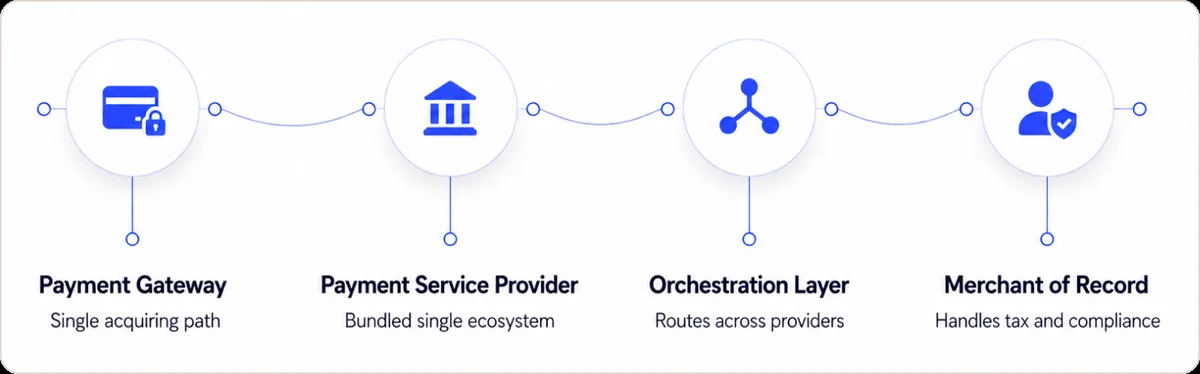
Most content conflates the first three. They are distinct products solving different problems at different stages of business complexity.
How Does Orchestration Actually Work?
Payment orchestration works by intercepting each transaction at checkout, running it through a rule engine, selecting the optimal processor, executing the payment, handling failures automatically, and consolidating all outcomes into unified reporting.
The sequence inside an orchestrated stack looks like this:
- Tokenization at capture. The orchestrator tokenizes the customer's card data immediately upon capture. The merchant's server never stores raw card details, which significantly reduces the PCI DSS scope and removes liability from the merchant's infrastructure.
- Rule engine evaluation. The orchestrator evaluates each transaction against parameters you configure: card BIN, geography, transaction value, real-time processor health, and cost rules.
- Smart routing. The platform selects the processor most likely to approve the transaction at the lowest cost for that specific combination of variables. A UK debit card routed through a local acquirer may carry a 7% higher approval rate than the same card sent through a US acquirer.
- Automatic failover. If the selected processor returns a soft decline or a network error, the orchestrator cascades the transaction to the next best option within milliseconds. The customer sees nothing.
- Unified reconciliation. Settlement data from every connected processor is consolidated into a single reporting interface. Finance teams stop stitching together reports from multiple portals every month.
The difference between this and simply running multiple gateways is the intelligence layer. Multiple gateways without orchestration logic still require manual failover decisions and manual reconciliation. The orchestration layer removes both.
How Do Routing and Multi-Acquirer Setups Fit In?
Orchestration sits on top of payment routing. Payment routing is the logic that decides which acquirer or gateway handles each transaction. Start with the basics in our guide to what payment routing is. Then layer a multi-acquirer strategy and a multiple payment gateway setup. Beast breaks results down by gateway, MID (merchant account ID), acquirer and card brand. This shows you what actually approves, so you route to it.
- Acquirer and MID: send volume to the processor with the highest approval rate and lowest chargeback percentage.
- Card brand and BIN: match traffic to the acquirer that performs best for each brand or issuing range.
- Decline code and issuer: retry through a different path when a specific issuer soft-declines.
What Problems Does It Actually Solve?
Payment orchestration solves four specific revenue and operational problems: false declines, processor downtime, cross-border friction, and fragmented reconciliation. Each has a measurable cost.
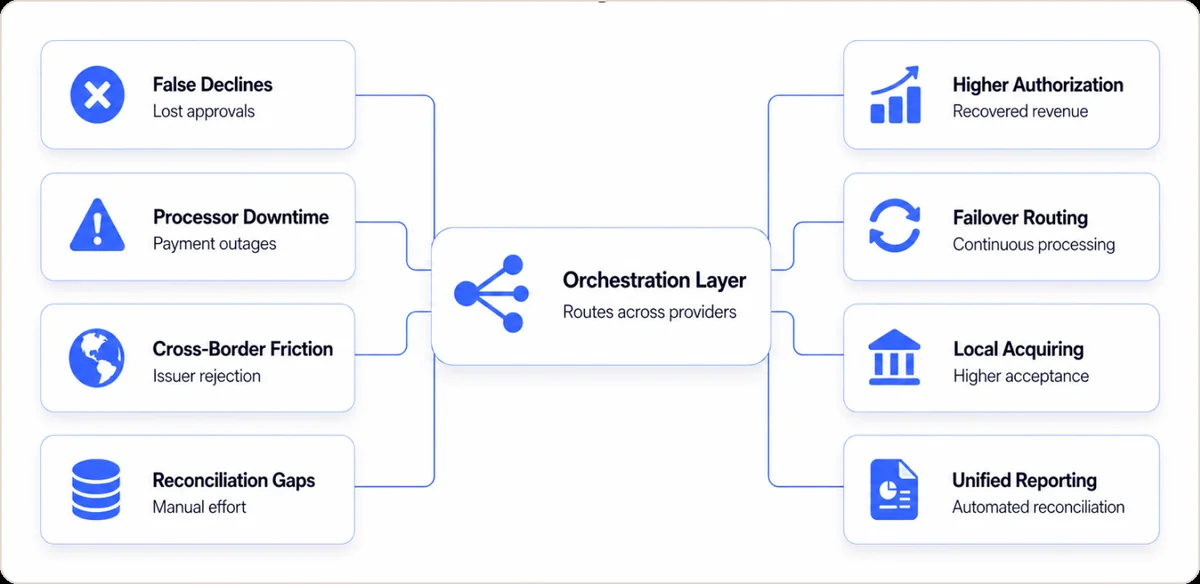
False declines and authorization leakage. A 2022 Checkout.com–Oxford Economics study of the US, UK, France, and Germany found that issuer‑side false declines cost merchants billions of dollars in lost sales annually. The gap between a well‑configured orchestration layer and a static single‑processor setup has been estimated at 3%–11% in recovered authorizations in some merchants. For a business processing $5 million per month, a 5% improvement would imply recovering $250,000 in monthly revenue that would otherwise be lost without a visible error message.
Processor downtime. FreedomPay's research found that U.S. businesses experience more than five major payment outages per year, with 63% occurring during peak trading periods. The average outage runs close to two hours. Consumer tolerance for payment failure is measured in seconds, not hours. Automatic failover converts those outages from revenue events into invisible backend reroutes.
Cross-border friction. A merchant routing European card transactions through a US acquirer typically loses 5% to 10% of those transactions to issuer rejection, because the issuing bank does not recognize the acquiring country. Orchestration enables local acquiring in each target market without a separate engineering project per region. According to Worldpay's 2026 Global Payments Report, digital wallets now represent 56% of global ecommerce transaction value (17% US POS, growing fast). Any stack that cannot route flexibly across wallets, local rails, and cards is already behind.
Reconciliation cost. Industry research suggests that finance teams using multiple payment service providers spend dozens of hours monthly on manual reconciliation due to fragmented settlement reporting and inconsistent data formats. Orchestration normalizes that data automatically. For most mid-market finance teams, that is nearly two full working days recovered per month.
How Does Orchestration Compare to a Gateway, PSP, and Merchant of Record?
| Feature | Payment Gateway | Payment Service Provider | Payment Orchestration Layer | Merchant of Record |
|---|---|---|---|---|
| Processes transactions | Yes | Yes | No, routes only | Yes |
| Multi-provider routing | No | No | Yes | No |
| Provider-agnostic token vault | No | No | Yes | No |
| Automatic failover across providers | No | Sometimes | Yes | No |
| Unified reconciliation across providers | No | No | Yes | No |
| Handles tax and compliance liability | No | No | No | Yes |
| Requires existing PSP relationships | No | No | Yes | No |
| Single-market, single-currency businesses | Yes | Yes | No | Depends |
| Multi-PSP, multi-market enterprise | No | Partial | Yes | No |
Most businesses at an early stage are best served by a strong PSP. Orchestration earns its place when multi-provider complexity is already real or approaching.
Do You Actually Need a Payment Orchestration Platform?
You likely need a payment orchestration platform if you are managing two or more PSPs, processing above $400,000 per month, expanding into multiple international markets, or seeing authorization rates below 90%, you cannot diagnose with your current tooling.
The honest version of this answer includes a "not yet" category that most vendor content skips entirely.
Orchestration is premature if:
- You operate in a single market with a single currency.
- Your current PSP handles your volume reliably, and your approval rates are stable.
- You have no international expansion planned in the next 12 months.
- You do not have an internal team able to configure and maintain routing logic after implementation.
That last point matters more than any other. Buying an orchestration platform without the operational capacity to tune it is like buying a Formula One car and driving it at 40 miles per hour. The capability is there. The outcome is not.
What Are the Real Risks Most Content Ignores?
The two risks that actually cost companies money are token portability and governance failure. Most vendor content does not cover either with enough depth.
Token portability is the most important contract question you will ask. If the orchestration vendor stores your tokenized card data in a vault they control, switching providers later may require customers to re-enter their payment details. For a subscription business or any merchant with stored credentials, that is a serious churn event. Before signing anything, ask directly: "Do I own my tokens? Can I export them in a portable format if I move to a different platform?" If the answer is unclear or conditional, that is a red flag.
Governance failure causes more orchestration underperformance than technical failure. A routing rule engine only improves outcomes if someone is reviewing performance data and adjusting configurations on a regular cadence. Without a named internal owner and a scheduled review process, the routing logic configured at implementation becomes stale within months. Approval rates plateau or decline. No one knows why because no one is watching. This is the most common reason orchestration implementations disappoint.
Connector depth varies significantly. Many platforms advertise 100-plus PSP connections, but the quality of those connections differs. A thin connector may only support basic authorization, missing advanced routing signals, network tokenization, or specific fraud data that drives the actual value of the integration. Ask vendors to demonstrate the connector depth for your two or three most important processors, specifically, not their aggregate connection count.
The orchestrator itself can fail. Ask every vendor for their uptime SLA, their status page, and their incident history for the past 12 months. An orchestration layer with poor availability creates a single point of failure more consequential than the fragmented stack it replaced.
How Should You Evaluate Payment Orchestration Providers?
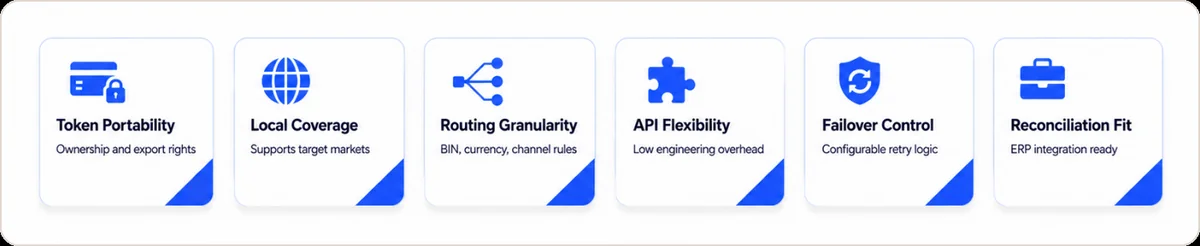
Start with token portability. If a vendor cannot give a clear, contractual answer on token ownership and export rights, eliminate them before evaluating anything else. Everything else is secondary to data ownership.
After that, evaluate in this order of importance:
Geographic and local acquiring coverage. Does the platform support local acquiring in every market you operate in today, plus the markets you plan to enter within 24 months? Local acquiring is not optional for cross-border authorization performance.
Routing logic granularity. Can you configure rules at the BIN level, currency, transaction amount, and channel independently? Platforms that only support broad routing rules deliver a fraction of the authorization improvement that granular routing produces.
API flexibility and engineering overhead. Can your team integrate and maintain the API without dedicated specialist knowledge? Complexity here creates long-term dependency on the vendor's support team.
Failover and retry configuration. Is failover logic configurable, or does the platform handle it as a black box? Understanding exactly what happens on a decline matters for compliance and for diagnosing performance issues.
Reconciliation output compatibility. Does the normalized settlement data integrate directly with your existing ERP or finance tooling, or does it create a new manual step?
Documented uptime history. A vendor's SLA number means less than their actual incident history. Request it.
Pure-play orchestrators such as Spreedly, Primer, and IXOPAY are built specifically for multi-PSP environments and tend to offer stronger provider neutrality. Platforms like Adyen and Stripe offer orchestration-adjacent features within their own ecosystems, but those features are optimized for their own acquiring network rather than genuinely agnostic routing. Neither is wrong. They serve different architectural goals.
When Is the Investment Actually Worth It?
Use this framework. Pick the tier that matches your current state.
Not now. Single market, single PSP, stable approval rates, no international expansion in the next 12 months. The better investment is optimizing your existing PSP relationship, not adding a new layer.
Evaluate it. Processing $300,000 to $400,000 per month, beginning to manage a second PSP, or entering a second international market. Complexity is approaching the threshold where orchestration recovers its cost. Run the math on authorization lift before committing.
Implement it. Processing above $400,000 per month across multiple markets, managing two or more PSPs, seeing authorization rates below industry benchmarks, or carrying reconciliation as a meaningful finance team burden. The ROI case is documentable. A payment routing assessment is the practical next step.
The Zebrands case, documented by Spreedly, produced an approximately 35% reduction in false declines (from ~40% to 5-8%) after implementing orchestration-led routing. That outcome is achievable with ongoing optimization. It is not automatic, and it does not happen at go-live.
Is a Payment Orchestration Platform Right for Your Business?
Payment orchestration is not a default upgrade. It is the right infrastructure investment when multi-provider complexity is already creating revenue leakage, operational drag, or geographic expansion friction that a single PSP relationship cannot resolve.
The decisions you make about payment infrastructure now cost significantly less to get right than they will to rebuild under pressure at scale.
Frequently Asked Questions
How much does payment orchestration cost?
Payment orchestration platforms typically charge a per-transaction fee ranging from 0.05% to 0.15%, a monthly platform fee, or a combination of both. The total cost is usually recovered within the first few months for businesses processing above $400,000 per month, primarily through authorization rate improvements and reduced reconciliation overhead.
What is the difference between payment orchestration and a payment gateway?
A payment gateway processes transactions through a single provider path. A payment orchestration platform manages multiple gateways simultaneously, applying routing logic to select the best path for each transaction and handling automatic failover if the primary path fails.
How does payment orchestration improve authorization rates?
Payment orchestration improves authorization rates by routing each transaction to the processor most likely to approve it, based on card BIN, geography, and transaction size. Failed transactions are automatically retried through alternative processors before the customer sees a decline message.
Is payment orchestration only for large enterprises?
Payment orchestration is most cost-effective for businesses processing above $400,000 per month or managing two or more payment service providers. Single-market businesses with stable approval rates typically gain more from optimizing one PSP relationship than from adding an orchestration layer.
How long does implementation take?
Enterprise payment orchestration implementations typically take three to six months, depending on the number of PSP integrations required, routing rule complexity, and internal engineering capacity available.
What is the token portability risk?
If an orchestration provider controls the token vault and does not allow standard token export, switching providers later may require customers to re-enter payment details. Always confirm token ownership terms and export rights in writing before signing a contract.
Can payment orchestration replace a payment gateway?
Payment orchestration does not replace payment gateways. An orchestration layer routes transactions to gateways and processors. It requires existing gateway or PSP relationships to function and adds intelligence above them, not instead of them.
When should a business not use payment orchestration?
A business should avoid payment orchestration when it operates in a single market with one currency, processes below $300,000 per month, has stable authorization rates, and has no internal team available to manage and optimize routing logic after implementation.
Is payment orchestration the same as payment routing?
No. Payment routing is one function inside orchestration. It is the set of rules that pick an acquirer or gateway for each transaction. Orchestration also handles retries, tokenization, reconciliation and reporting. Beast complements both. It breaks approvals and declines down by decline code, issuer, BIN (bank identification number, the first digits of a card), MID (merchant account ID), acquirer and card brand.
Do I need multiple acquirers to benefit from orchestration?
Multiple acquirers unlock the biggest gains. They give you failover, higher approval rates and lower concentration risk. Start with one acquirer. Add a second once your volume justifies it. Beast shows approval rate and chargeback percentage per MID (merchant account ID). This tells you which acquirer to scale.