Failed Payment Statistics 2026: Decline Rates, Costs and Recovery Benchmarks
How often card payments fail, why they fail, what that costs subscription businesses, and how much of it is recoverable. Every number on this page is attributed to a verified source.
This page collects the most reliable published statistics on failed card payments: how often they happen, why, what they cost, and how much of the loss is recoverable. Every figure links to its source. Last updated September 2026.
| Statistic | Figure | Source |
|---|---|---|
| Recurring transactions declined | ~15% | Visa/Mastercard data, via Chargebacks911 |
| Issuer declines caused by insufficient funds | 44.4% | Ethoca |
| Median involuntary churn per month | 0.86% (0.67% SaaS) | Recurly |
| Cards reissued each year | 33 to 40% | Stripe |
| Involuntary churn caused by failed payments | 50% | PYMNTS |
| False decline losses vs actual fraud losses | 13x higher | Javelin |
| Falsely declined customers who never return | up to 40% | Radial |
| Recovery rate on the 3 most common declines | over 45% | Recurly |
| Lost revenue recovered within 90 days | 10 to 30% | Butter Payments |
| Approval lift from smarter routing | 10 to 15% | Worldpay |
Every figure is linked to its source in the sections below.
How common are failed payments?
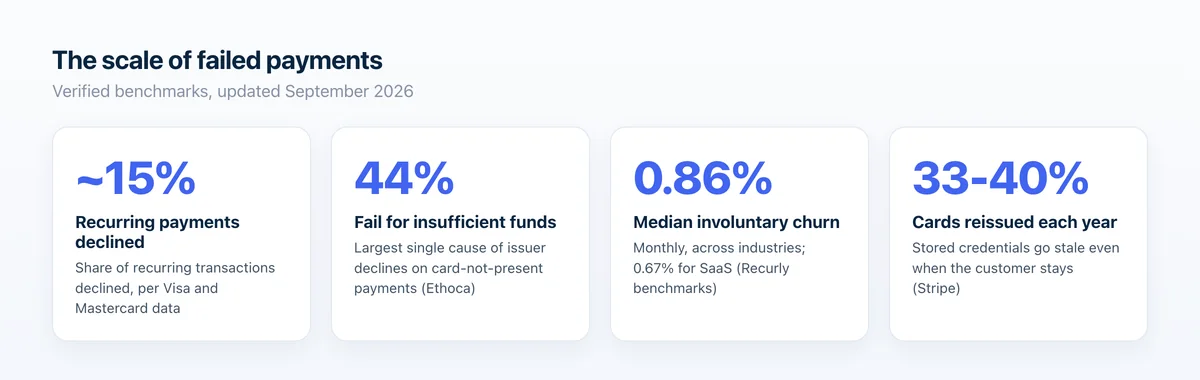
For subscription businesses, payment failure is not an edge case. It is a steady tax on every billing cycle. Approximately 15% of recurring transactions are declined, per Visa and Mastercard data cited by Chargebacks911, and in some industries the rate runs higher.
The downstream effect shows up as involuntary churn: customers who never chose to leave. The median involuntary churn rate is 0.86% per month across industries, and 0.67% for SaaS, per Recurly benchmarks built from thousands of subscription businesses. The full churn-side numbers live on our involuntary churn statistics page.
Why do payments fail?
Most failures come down to three families, and each needs a different response.
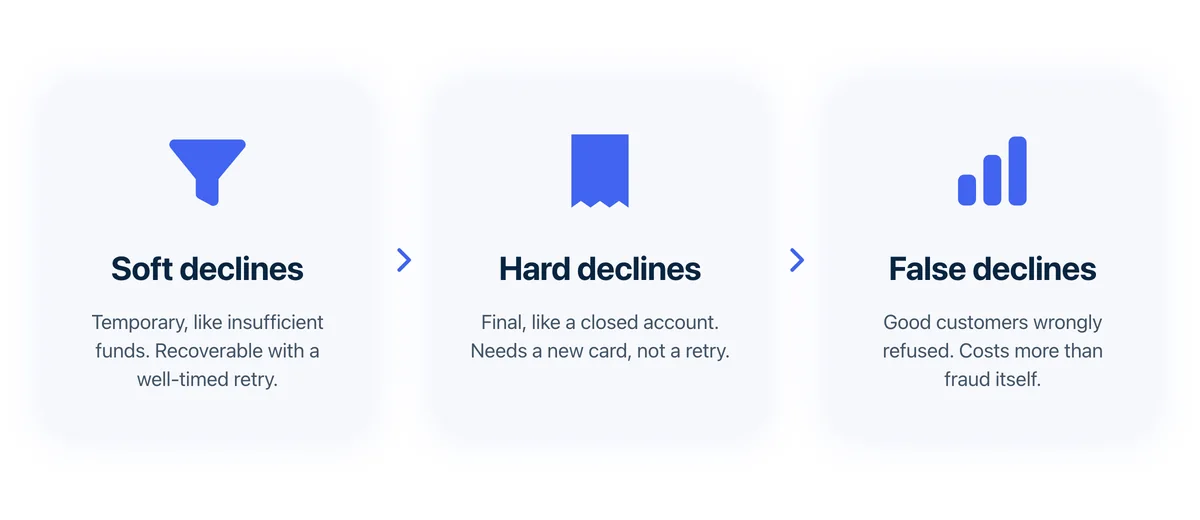
- Insufficient funds is the biggest single cause. It accounts for 44.4% of issuer declines on card-not-present transactions, per Ethoca research. These are soft declines, and many succeed when retried at the right time.
- Stale card credentials are the quiet second cause. Roughly 33 to 40% of cards are reissued in any given year, per Stripe. The customer stays; their stored card number dies.
- Credential failures drive a large share of churn. They account for about 40% of involuntary subscription churn, per a Mastercard report on recurring billing.
- Some declines are simply wrong. False declines are legitimate customers refused by an over-cautious fraud model. Their cost is out of proportion to their share, covered next.
For a code-by-code breakdown of what each decline means and which ones are worth retrying, see our credit card decline code guide. For the wider market numbers, from card fees to processor outages, see our payment processing statistics.
What do failed payments cost?
The direct lost sale is the smallest part of the bill. The larger costs are churn and the customers you refuse by mistake.
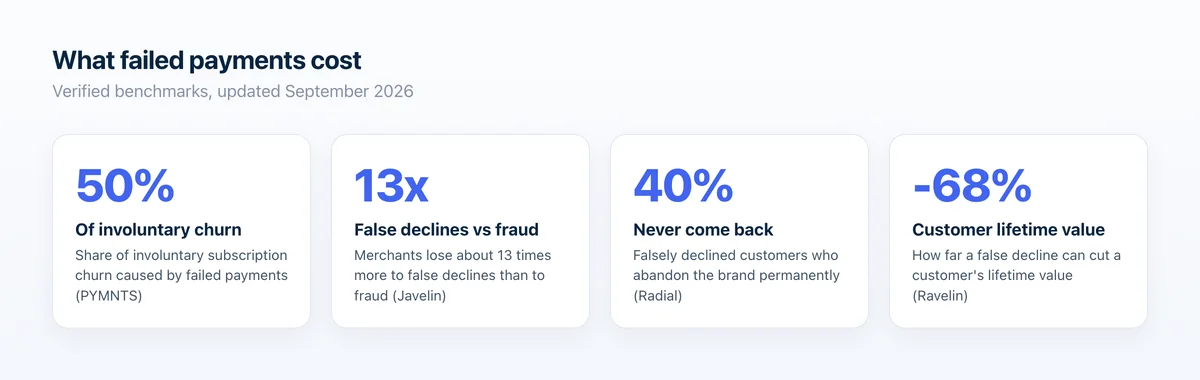
- Failed payments cause 50% of involuntary subscription churn, and 27% of subscribers say they would likely cancel over avoidable payment issues, per PYMNTS.
- Merchants lose about 13 times more to false declines than to actual fraud, per Javelin Strategy.
- Up to 40% of falsely declined customers abandon the brand permanently, per Radial.
- A false decline can cut customer lifetime value by 68%, per Ravelin.
- Even the error message matters: 4% of users abandoned checkout when their card was declined without a useful explanation, per Baymard Institute.
Retention economics make the stakes compound. Increasing customer retention by 5% increases profits by 25% to 95%, per Forrester. A failed payment that quietly cancels a subscriber works directly against that lever. Our involuntary churn guide covers the mechanics.
How much is recoverable
The encouraging half of the story: a large share of failed payments are winnable.
| Recovery benchmark | Figure | Source |
|---|---|---|
| Recovery rate on the 3 most common decline messages | over 45% | Recurly |
| Recovery on invalid-card declines after credential refresh | over 20% | Recurly |
| Previously lost revenue recovered within 90 days | 10 to 30% | Butter Payments |
| Approval rate lift from routing to the best provider | 10 to 15% | Worldpay |
| First-charge approval before and after routing, one measured account | 57.1% to 68.1% | Beast Insights |
Sources: Recurly, Butter Payments, Worldpay, and the Beast Insights case study for the measured account. Recovery is time-boxed and code-dependent, which is why timing matters more than retry count. The playbook is in our payment retry strategies guide, and the product side, recovery with every recovered payment attributed to the action that won it, is what Beast’s failed payment recovery does.
The rules that limit retries
| Rule | What it says | If you ignore it |
|---|---|---|
| Visa Excessive Reattempts Rule | Max 20 retries per declined transaction in 30 days, raised from 15 on 25 May 2025 | Non-compliance fees per excess attempt |
| Mastercard decline advice codes | Some codes mean do not retry at all | Advice decline fee rose from $0.05 to $0.78 in 2026 on the Canadian schedule |
Sources: the Visa Core Rules on the reattempt cap, TD’s 2026 pricing notice on the Mastercard fee. The practical consequence: blind retry loops are now a cost center. Reading the decline code before retrying is what separates recovery from fee accumulation.
How to use these numbers
Benchmark yourself with three questions. What share of your recurring payments fail each month, against the roughly 15% baseline? What is your monthly involuntary churn, against the 0.86% median? And what share of your failed payments do you recover, against the 45%-plus that the most common declines allow? If you cannot answer the third one, that measurement gap is usually the cheapest thing to fix first.
Frequently asked questions
What percentage of card payments fail?
For recurring billing, Visa and Mastercard data suggest approximately 15% of transactions are declined. One-time checkout payments fail less often; recurring payments fail more because stored credentials age and balances fluctuate between billing cycles.
What is the most common reason for a failed payment?
Insufficient funds. Ethoca research attributes 44.4% of issuer declines on card-not-present transactions to it. It is a soft decline, which means a well-timed retry often succeeds.
How much failed payment revenue can be recovered?
Recurly benchmarks show the three most common decline messages recover at over 45%, and Butter Payments reports companies that address involuntary churn systematically recover 10 to 30% of previously lost revenue within 90 days. Actual results depend on your decline mix and retry timing.
What is a good involuntary churn rate?
Recurly’s benchmark across thousands of subscription businesses puts the median at 0.86% per month across industries, and 0.67% for SaaS. Below those medians you are doing better than typical; well above them usually means failed payments are going unrecovered.
How Beast can help
Beast is a payment performance platform for subscription businesses. It reads the decline code behind every failed payment, times retries inside the network rules covered above, refreshes stale card credentials, and attributes every recovered payment to the action that won it, so recovery is measured rather than assumed. Beast is not a payment processor; it works across the processors you already use. If your recovery rate sits below the benchmarks on this page, a look at how Beast recovers failed payments or a free audit is a practical next step.