Soft Decline vs Hard Decline: What to Retry and When
A code-by-code map of which card declines are soft (retry them) versus hard (stop and repair), plus how many times and how soon to retry each one.
Every declined subscription charge forces one decision: retry, or stop. The answer hinges on a single classification. A soft decline means the card is valid but the payment failed for a temporary reason, so you retry. A hard decline means the card is no longer valid, so you stop and repair the credential instead.
What is the difference between a soft decline and a hard decline?
A soft decline is a temporary failure on a valid card: insufficient funds, a spending-limit hit, issuer system maintenance, a velocity check or a billing-address change. A hard decline is a permanent failure on an invalid card: expired, closed, lost, stolen or reported fraudulent. That validity distinction, not the raw code, decides whether a retry can ever succeed.
If you have already mapped every reason code in our guide to credit card decline codes and the mechanics of an issuer decline, you know the raw codes. Soft-vs-hard is the layer that sits on top. It turns those codes into an action. The card networks encode it directly. Visa sorts declines into four retry categories. Mastercard returns a Merchant Advice Code that tells you to retry or stop.
Which decline codes are soft, and which are hard?
Soft (retry) codes include insufficient_funds, processing_error, issuer_not_available, card_velocity_exceeded and Visa Category 2 codes like 51 and 91. Hard (do-not-retry) codes include expired_card, lost_card, stolen_card, invalid_account and Visa Category 1 codes like 41, 43 and 46. Fix-the-data codes such as 54 (expired) and 14 (invalid number) need new credentials before any retry.
| Code / example | Class | Retry? | Note |
|---|---|---|---|
| insufficient_funds / Visa 51 | Soft | Retry | Time it to payday, 24 to 72h later |
| processing_error / issuer_not_available | Soft | Retry | Transient, retry within hours |
| Visa Cat 2 (91, 96) / MAC 02 | Soft | Retry later | Issuer cannot approve right now |
| expired_card / Visa 54 | Hard (data) | Do not blind-retry | Run account updater for new details |
| lost_card / stolen_card / Visa 41, 43 | Hard | Do not retry | Permanent, start dunning or new card |
| invalid_account / Visa 14 | Hard (data) | Do not retry same PAN | Get an updated instrument |
| do_not_honor / Visa 05 | Ambiguous | Retry once, then stop | Depends on the MAC, not the code |
Treatment follows the accompanying Mastercard MAC or Visa response category, not the raw code alone.
Why does the soft-vs-hard distinction decide whether you retry?
Retrying a hard decline cannot succeed, and it now costs money. The card networks penalize it directly. Visa treats any reattempt of a Category 1 code as excessive. Mastercard charges a fee for retrying after a do-not-retry advice code. Soft declines resolve with time, so a retry has real recovery odds.
Visa's Excessive Reattempts Rule has been in force since April 2022. It now caps you at 20 reattempts in any 30-day period, raised from 15 on 25 May 2025, and charges about $0.10 per excessive domestic attempt. Any Category 1 retry counts as excessive from the first try. On the Mastercard side, a Merchant Advice Code (MAC) 03 or MAC 21 is a stop signal. Retrying after it now carries an excess-authorization fee that reached up to $0.50 per transaction as of January 2025. That fee is up from $0.10 in 2022. This is why any serious payment retry strategy branches on the code before it schedules an attempt.
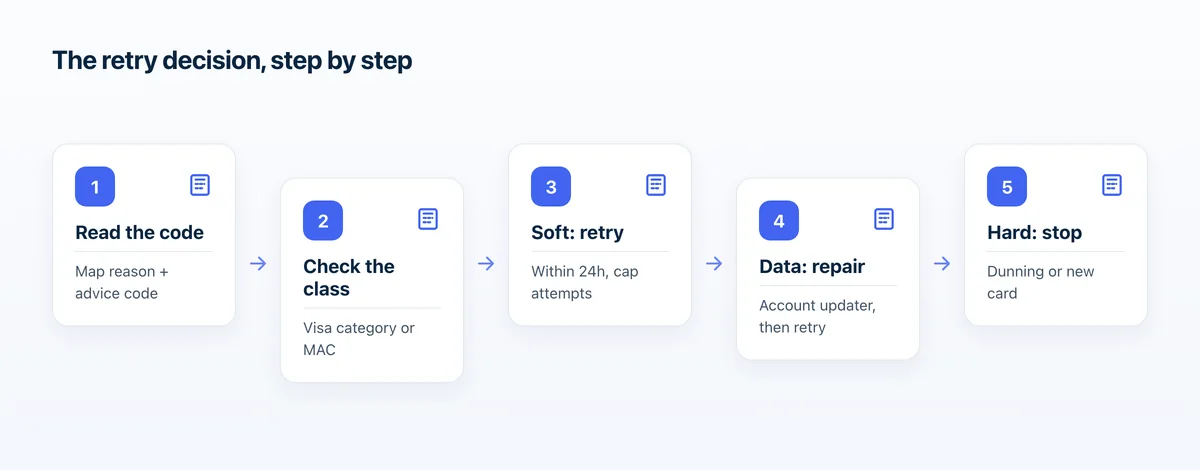
How many times and how soon should you retry a soft decline?
Retry a soft decline within 24 hours. Then space attempts 3 to 5 days apart. Cap the sequence at 5 to 8 attempts. Visa permits up to 20 reattempts in 30 days since 25 May 2025, and Stripe recommends a maximum of 8. Recovery concentrates in the first three tries, so extra attempts mostly add penalty risk.
Recovery front-loads hard. The first retry recovers 40 to 60% of soft declines. The second recovers another 15 to 25%. The third adds another 10 to 15%. After that, rates drop sharply. Timing should branch by reason. Retry insufficient_funds against payday cycles, 2 to 7 days out. Retry processing or issuer-timeout errors within hours, because the block clears quickly.
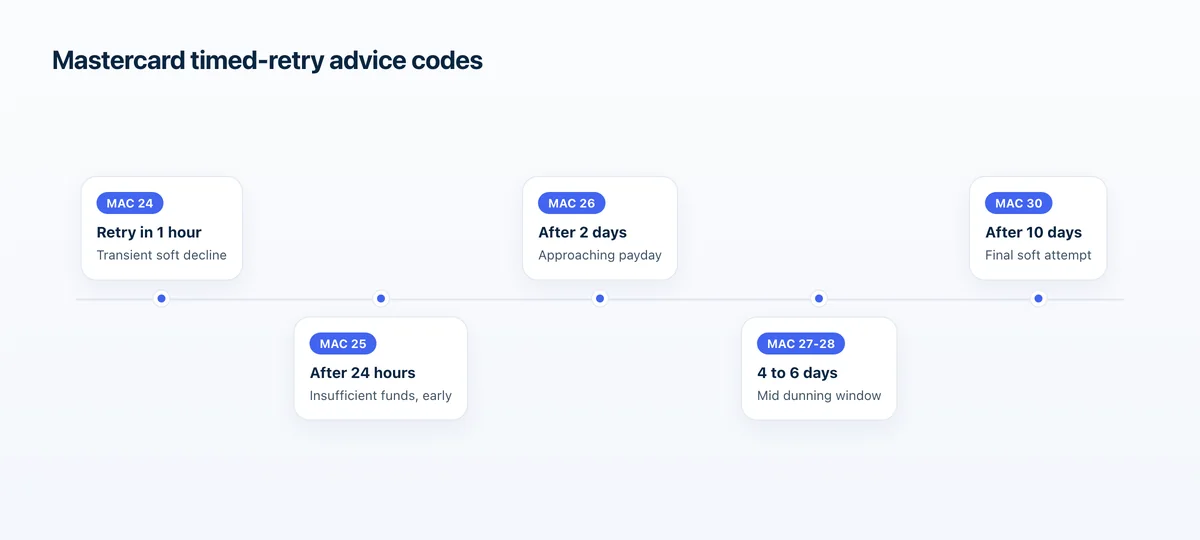
Mastercard even tells you the exact cadence with its timed-retry advice codes. MAC 24 means retry in the next hour. MAC 25 means retry after 24 hours. MAC 26 through 30 space attempts across 2 to 10 days. The network hands you a retry schedule for each decline.
What should you do with a hard decline instead of retrying?
Repair the credential. Do not re-charge it. For an expired or reissued card, run the account updater. That is the Visa Account Updater (VAU) or the Mastercard Automatic Billing Updater (ABU). You can also refresh the network token. Then retry against the new details. For lost, stolen or closed cards, stop retrying and start dunning. Email the customer for a new payment method.
Mastercard signals this for you. MAC 01 means new account information is available. Pull it from the account updater rather than retrying blindly. MAC 03 and MAC 21 mean stop all attempts. A tight dunning management sequence catches the cases an updater cannot fix. It routes the customer to self-serve a new card before the subscription lapses.
- Classify every decline as soft, hard, or fix-the-data before you schedule anything.
- Retry soft declines only; stop on Visa Category 1 and Mastercard MAC 03 or 21.
- Retry the first attempt within 24 hours, then space attempts 3 to 5 days apart.
- Cap the sequence at 5 to 8 attempts to stay under network reattempt limits.
- Time insufficient_funds retries to payday; retry technical errors within hours.
- Route expired or reissued cards to the account updater and network tokens.
- Start dunning for lost, stolen or closed cards instead of re-charging them.
- Monitor recovery rate by code, issuer and BIN and cut codes that recover near 0%.
How does soft-vs-hard classification cut involuntary churn on subscriptions?
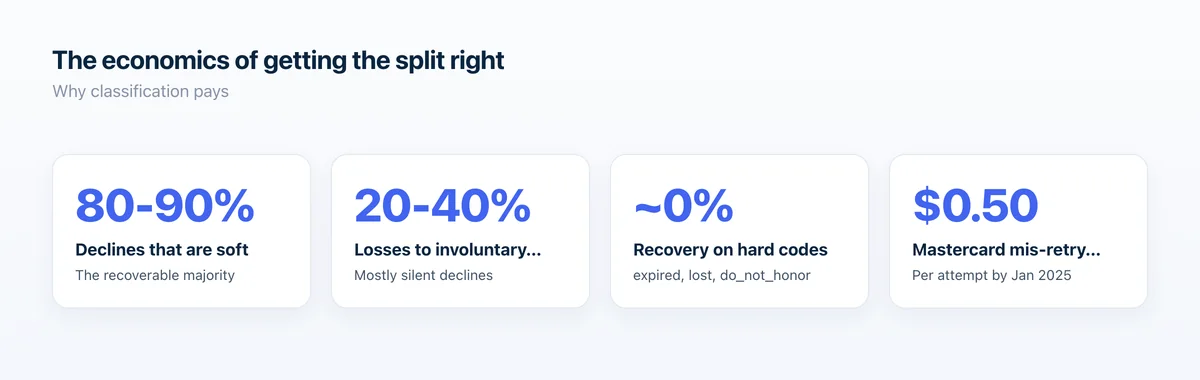
Involuntary churn accounts for an estimated 20 to 40% of all subscription losses. That churn is a paying customer lost to a silent decline, not a cancellation. Soft declines are the recoverable majority. Classifying them correctly and retrying them is the biggest lever on that number. Every soft decline you misfile as hard is revenue you abandon.
Up to 70% of that churn traces back to failed transactions from customers who never meant to leave. And 62% of users who hit a payment error never return. A layered failed payment recovery program separates soft from hard. It lifts recovery from the industry median near 47.6% toward the 70 to 85% that top performers reach.
How can network tokenization and account updater turn hard declines into recoveries?
They fix the credential before a charge even fails. Account updaters (Visa VAU, Mastercard ABU) refresh expired or reissued card details on file. Network tokens auto-update at the scheme level when a card is reissued. The next billing cycle then runs against valid credentials, with no failed charge and no customer action.
The uplift is measurable. Visa reports network tokens lift card-not-present authorization rates by 4.6% and Mastercard by 2.1%. Account updaters recover a few percent more transactions that would otherwise decline on stale credentials. Layer both. Token updates arrive in real time, while account-updater batches lag by days. Charges on a stale primary account number (PAN), the card number on file, fail in that gap.
Frequently Asked Questions
Should you retry a soft decline or a hard decline?
Retry soft declines, never hard declines. A soft decline (insufficient funds, processing error, issuer timeout) is a temporary failure on a valid card, so a later retry can succeed. A hard decline (expired, lost, stolen or closed card) is permanent, so retrying wastes attempts and risks network penalties.
Is insufficient funds a soft or hard decline?
Insufficient funds is a soft decline. The card is valid and the money simply was not there at that moment, so it is retryable. Time the retry to the cardholder's payday cycle, roughly 24 to 72 hours later, which is when recovery odds are highest.
Is do not honor a soft or hard decline?
Do not honor (Visa code 05) is ambiguous and sources disagree. Visa buckets it as a retryable generic decline, but a persistent do not honor behaves like a permanent block. Treat it as retry once after about 24 hours, then classify it as hard and contact the customer.
How many times can you retry a declined card payment?
Visa allows up to 20 reattempts within any 30-day period on retryable declines, raised from 15 on 25 May 2025, and attempts beyond the cap are excessive and fee-bearing. Stripe recommends a maximum of 8 retries. In practice, 5 to 8 attempts capture nearly all recoverable revenue; more mostly adds cost.
What is a Merchant Advice Code and how does it decide retries?
A Merchant Advice Code (MAC) is a Mastercard signal returned alongside the decline that tells you what to do next. MAC 02 means try again later (soft), MAC 01 means pull updated card details from the account updater, and MAC 03 or 21 mean stop all retries (hard).